• Fri frakt över 249 kr
  • •
  • Snabba leveranser
  • •
  • Billiga böcker
Kundservice

Du är på sajten för privatpersoner.

Företag, bibliotek eller offentlig verksamhet?

Du handlar på classic.bokus.com, där alla dina funktioner finns intakta.
Till classic.bokus.com
Bokus logotyp. Gå till startsidan.
  • Erbjudanden
  • Nyheter
  • Student
  • Topplistor
  • Barn & ungdom
  • Bokus Play
  • E-böcker
  • Pocketböcker
  • Spel & pussel

10% rabatt på allt med kod: NYSTART10 →

Sidfot

Mina sidor

    Hjälp

    • Kundservice
    • Vanliga frågor och svar
    • Frakt och leverans
    • Retur vid ångerrätt
    • Reklamera vara
    • Betalning
    • Köpvillkor
    • Allmänna villkor
    • Information om webbplatsens tillgänglighet

    Om Bokus

    • Om oss
    • Pressrum
    • För studenter
    • För företag
    • För bibliotek och offentlig verksamhet
    • För leverantörer
    • Hållbarhet

    Populärt

    • Aktuella erbjudanden
    • Presentkort
    • Studentlitteratur
    • Nya böcker
    • Topplistor
    • Signerade böcker
    • Engelska böcker

    Inspiration

    • Boktips
    • BookTok
    • Populära bokserier
    • Barnbokskaraktärer
    • Populära författare
    Logotyp för Bokus
    Följ oss på Facebook (extern länk)Följ oss på Instagram (extern länk)Följ oss på YouTube (extern länk)Följ oss på TikTok (extern länk)
    bokus @ CookiesAnpassa cookiesIntegritetspolicyKöpvillkor
    Till Citymail hemsida (extern länk)Till Budbee hemsida (extern länk)Till Postnord hemsida (extern länk)Till Schenker hemsida (extern länk)Till Early Bird hemsida (extern länk)Till Walleys hemsida (extern länk)
    1. Historia och arkeologi
    2. Historia
    3. Asiens historia

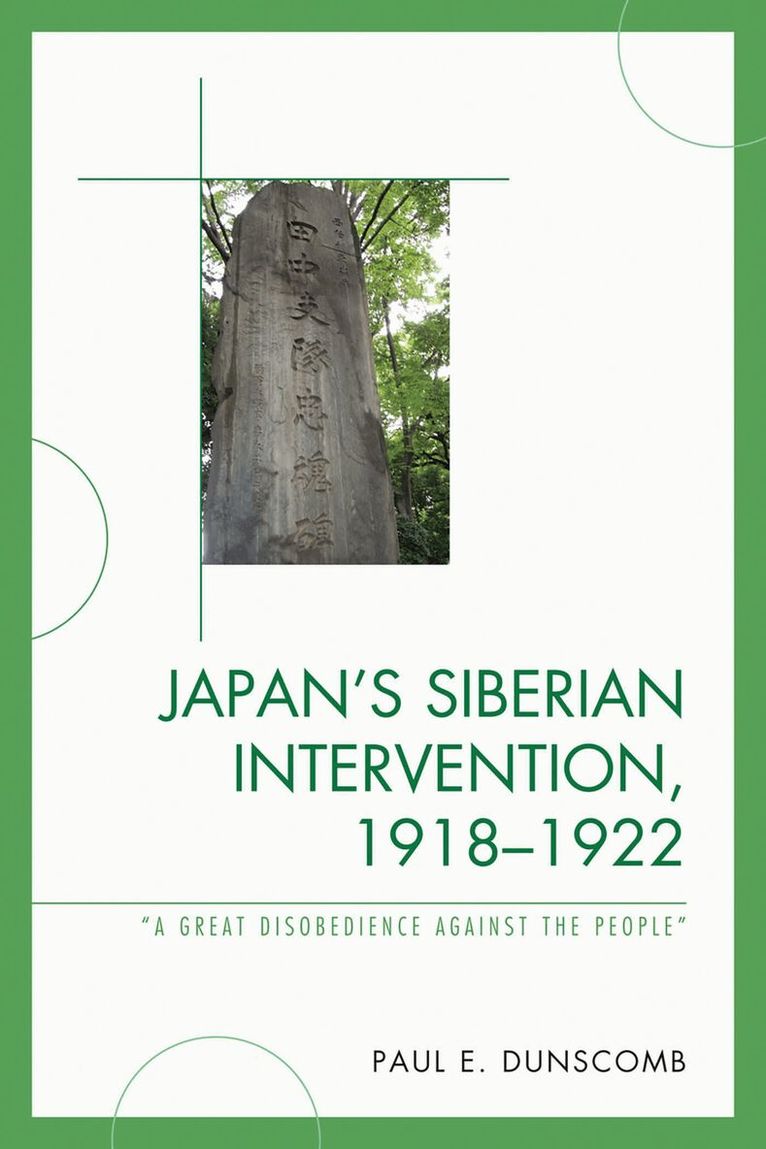
    Japan's Siberian Intervention, 1918–1922

    'A Great Disobedience Against the People'

    AvPaul E. Dunscomb,Douglas Slaymaker

    Inbunden, Engelska, 2011

    Del i serien New Studies in Modern Japan

    1 579 kr

    Beställningsvara. Skickas inom 10-15 vardagar. Fri frakt över 249 kr.

    Fler format och utgåvor

    Häftad

    722 kr

    Beskrivning

    The fifty months of the Siberian Intervention encompass the existential crisis which affected Japanese at virtually all levels when confronted with the new "world situation" left in the wake of the First World War. From elite politicians and military professionals, to public intellectuals and the families of servicemen in small garrison towns, the intervention was perceived as a test of how Japan might fit itself into the emerging postwar world order. Both domestically and internationally Japan's actions in Siberia were seen as critical proof of the nation's ability, depending on one's viewpoint, to embrace or to ride out the "trends of the times," the seeming triumph of constitutional democracy and Wilsonian internationalism. The course of the Siberian Intervention illuminates the struggle to cement "responsible" party cabinets at the heart of Japanese decision making, the high water mark of efforts to bring the Japanese military under civilian control, the attempt to fundamentally reshape Japanese continental policy, and the hopes of millions of Japanese that their voices be heard and their desires respected by the nation's leaders. The book attempts a broad examination of domestic politics, foreign policy, and military action by incorporating a wide array of voices through a detailed examination of public comment and discussion in journals and magazines, the major circulation daily newspapers of Tokyo and Osaka as well as those of smaller cities such as Nara, Mito, Oita, and Tsuruga.

    Produktinformation

    • Utgivningsdatum:2011-01-27
    • Mått:163 x 240 x 26 mm
    • Vikt:565 g
    • Format:Inbunden
    • Språk:Engelska
    • Serie:New Studies in Modern Japan
    • Antal sidor:264
    • Förlag:Bloomsbury Publishing Plc
    • ISBN:9780739146002

    Utforska kategorier

    • Asiens historia inom Historia och arkeologi

    Mer om författaren

    Paul E. Dunscomb is associate professor of history at the University of Alaska, Anchorage.

    Recensioner i media

    Paul Dunscomb fills a major historical lacuna, explaining in clear, persuasive prose the nature of Japan's incursion into Siberia late in World War I and the complex issues that have so long baffled historians. Drawing on a rich array of primary sources, both governmental and journalistic, he sheds light not only on the often disastrous experiences of Japan's army but on the domestic debates that the expedition triggered. Dunscomb is incisive in exploring the internal struggles of Taish? Japan's political world, sometimes between interventionists and "realists," more often between the cabinet and the army, which used tones that presaged the militarists' rhetoric of the 1930s in insisting on its "right of supreme command." The issues raised here also speak (sometimes uncannily) to more recent military incursions elsewhere in the world, particularly in Vietnam and Afghanistan.

    Innehållsförteckning

    • Chapter 1 Introduction: "To Demonstrate Our Power To Aid Civilization": The Meaning of Japan's Intervention in SiberiaChapter 2 1. "A Delicious Stew": Entropy and Plurality in Japanese Politics, 1890-1917Chapter 3 2. "There is No Reason Not to Oppose It": Debating Intervention, December 1917- June 1918Chapter 4 3. "The Seiyukai Will Greatly Contribute to the Fate of the Empire": Intervention and the Rise of the Hara Cabinet, July-November 1918Chapter 5 4. "International Democracy Cannot Exist in Opposition to Democracy at Home": The Rise and Fall of "Allied" Intervention November 1918-December 1919Chapter 6 5. "The Army Minister's Head Must be Placed on the Chopping Block First": The Transition to Unilateral Intervention, January-August 1920Chapter 7 6. "Indefinitely Stationing Troops is Harmful and Unproductive": Towards Withdrawal "In Principle," September 1920-May 1921Chapter 8 7. "Oh, Meaningless Intervention!": A Year of Drift, June 1921-June 1922Chapter 9 8. "Who Must Take Responsibility For This Crime?": Withdrawal and Reckoning the Costs of Intervention, June-November 1922Chapter 10 Afterword: "A Situation In Which We Can Only Come Out Losers": The Siberian Intervention and the Evolution of Imperial Japan