• Fri frakt över 249 kr
  • •
  • Snabba leveranser
  • •
  • Billiga böcker
Kundservice

Du är på sajten för privatpersoner.

Företag, bibliotek eller offentlig verksamhet?

Du handlar på classic.bokus.com, där alla dina funktioner finns intakta.
Till classic.bokus.com
Bokus logotyp. Gå till startsidan.
  • Erbjudanden
  • Nyheter
  • Student
  • Topplistor
  • Barn & ungdom
  • Bokus Play
  • E-böcker
  • Pocketböcker
  • Spel & pussel

10% rabatt på allt med kod: NYSTART10 →

Sidfot

Mina sidor

    Hjälp

    • Kundservice
    • Vanliga frågor och svar
    • Frakt och leverans
    • Retur vid ångerrätt
    • Reklamera vara
    • Betalning
    • Köpvillkor
    • Allmänna villkor
    • Information om webbplatsens tillgänglighet

    Om Bokus

    • Om oss
    • Pressrum
    • För studenter
    • För företag
    • För bibliotek och offentlig verksamhet
    • För leverantörer
    • Hållbarhet

    Populärt

    • Aktuella erbjudanden
    • Presentkort
    • Studentlitteratur
    • Nya böcker
    • Topplistor
    • Signerade böcker
    • Engelska böcker

    Inspiration

    • Boktips
    • BookTok
    • Populära bokserier
    • Barnbokskaraktärer
    • Populära författare
    Logotyp för Bokus
    Följ oss på Facebook (extern länk)Följ oss på Instagram (extern länk)Följ oss på YouTube (extern länk)Följ oss på TikTok (extern länk)
    bokus @ CookiesAnpassa cookiesIntegritetspolicyKöpvillkor
    Till Citymail hemsida (extern länk)Till Budbee hemsida (extern länk)Till Postnord hemsida (extern länk)Till Schenker hemsida (extern länk)Till Early Bird hemsida (extern länk)Till Walleys hemsida (extern länk)
    1. Ekonomi och Ledarskap
    2. Nationalekonomi

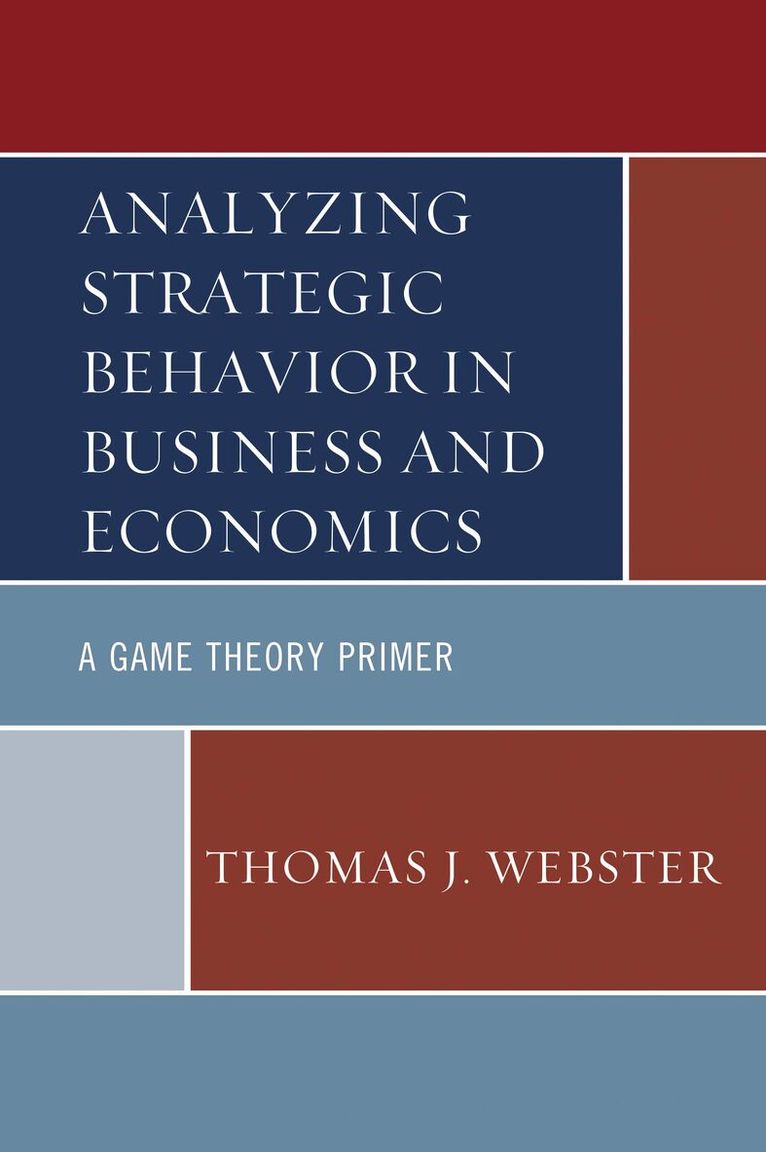
    Analyzing Strategic Behavior in Business and Economics

    A Game Theory Primer

    AvThomas J. Webster

    Inbunden, Engelska, 2014

    1 722 kr

    Beställningsvara. Skickas inom 10-15 vardagar. Fri frakt över 249 kr.

    Fler format och utgåvor

    Häftad

    622 kr

    Beskrivning

    This textbook is an introduction to game theory, which is the systematic analysis of decision-making in interactive settings. Game theory can be of great value to business managers. The ability to correctly anticipate countermove by rival firms in competitive and cooperative settings enables managers to make more effective marketing, advertising, pricing, and other business decisions to optimally achieve the firm’s objectives. Game theory does not always accurately predict how rivals will act in strategic situations, but does identify a decision maker’s best response to situations involving move and countermove. As Nobel Prize winner Thomas Shelling noted: “We may wish to understand how participants actually do conduct themselves in conflict situations; an understanding of the ‘correct’ play may give us a bench mark for the study of actual behavior.” The concise and axiomatic approach to the material presented in this textbook is easily accessible to students with a background in the principles of microeconomics and college mathematics. The selection and organizations of topics makes the textbook appropriate for use in a wide range of curricula by students with different backgrounds.

    Produktinformation

    • Utgivningsdatum:2014-02-07
    • Mått:189 x 265 x 23 mm
    • Vikt:721 g
    • Format:Inbunden
    • Språk:Engelska
    • Antal sidor:286
    • Förlag:Bloomsbury Publishing Plc
    • ISBN:9780739186046

    Utforska kategorier

    • Nationalekonomi inom Ekonomi och Ledarskap
    • Ledarskap och motivation inom Ekonomi och Ledarskap
    • Försäljning och marknadsföring inom Ekonomi och Ledarskap

    Mer om författaren

    Thomas J. Webster is a professor of economics in the Department of Finance and Economics of Pace University’s Lubin School of Business in New York City. Before joining the faculty at Pace University, Dr. Webster held positions as an international economist with the Central Intelligence Agency, the U.S. Department of Defense, Manufacturers Hanover Trust Company, and Continental Illinois National Bank and Trust Company. Dr. Webster has served as graduate and undergraduate finance program chair, and as faculty advisor to Beta Gamma Sigma, the international honor society for collegiate schools of business. He is the recipient of the Lubin School of Business Scholarly Research Award for Basic Scholarship, the Lubin School of Business Outstanding Faculty Service Award, the Pace University Award for Distinguished Service, and the Beta Gamma Sigma Commitment to Excellence Award. Dr. Webster received his BA from the School of International Service of American University, and his MA, MPhil, and PhD from the City University of New York.

    Recensioner i media

    Business decisions are rarely made in a competitive vacuum. A manager’s ability to maximize a firm’s value on behalf of shareholders may be hamstrung by an inability to raise finance capital, disruption in the flow of critical raw materials, shortages of skilled labor, capacity constraints, labor unrest, insufficient warehouse space, more. Managers who are able to put themselves in to the shoes of rivals are more likely to successfully achieve the firm’s objectives than those who do not. This volume is an introduction to game theory, the systematic analysis of decision making in interactive settings. Game theory identifies a decision maker’s best response to situations involving move and counter move. Thomas J. Webster is professor of economics in the Department of Finance and Economics of Pace University’s Lubin School of Business in NYC.

    Innehållsförteckning

    • PREFACE1INTRODUCTION TO GAME THEORYIntroductionStrategic behaviorShort history of game theoryLexicon of game theoryRational versus actual behaviorPractice ExercisesPART I: STATIC GAMES WITH COMPLETE INFORMATION2COALITION GAMESIntroductionPrisoner’s dilemmaThe extensive formThe normal formNash equilibriumShortcut for finding-pure strategy Nash equilibriaDeterminants of business collusionNumber of firms with similar interestsFirm size relative to the industryVisibilityPractice Exercises3STRATEGIC MOVES AND DETERRING DEFECTIONIntroductionStrategic movesDeterring defectionContractsReputationCutting off communicationsPreventing retreatBrinksmanshipIncrementalismTeamworkAgentsPractice exercises4COMPETITION GAMESIntroductionStrictly-dominant strategiesWeakly-dominant strategiesIterated elimination of dominated strategiesThree-player gamesNon-dominant strategiesMaximin (secure) strategyPractice exercises5COORD