Du är på sajten för privatpersoner.
263 kr
Beställningsvara. Skickas inom 5-8 vardagar. Fri frakt över 249 kr.
Stanley Cohen is at the London School of Economics and Political Science. He is the author of numerous books, including Visions of Social Control (Polity, 1985), Folk Devils and Moral Panics:The Creation of the Mods and Rockers (1980), Against Criminology (1988) and Psychological Survival: The Experience of Long Term Imprisonment (1973).
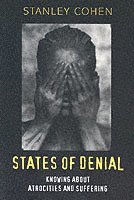
Congratulations to Stanley Cohen on winning the American Society of Criminology's International Division Award for outstanding publication of 2000-2001 for States of Denial!'With images of disaster and atrocity raining down on us from every quarter, it's hard not to resort to a balming fatalism. Sociologist Stanley Cohen's timely book about how people and societies deny information which is too disturbing or threatening serves as a brilliant corrective ... This is how scholarship should be - zesty, engaged, witty, and always accessible.' Anne Karpf, The Observer 'Cohen is original, wise and essentially optimistic ... [He] looks towards a practical utopia where "a deep shame of passivity" would become a mobilizing norm of social life.' Victoria Brittain, The Guardian 'The sociologist Stanley Cohen, who spent many years in Israel before continuing his academic work in Britain, offers one key to why wars happen, why peace settlements do not take, and why terrible conflicts are ignored or dealt with ineffectively. His new book stresses how central denial is in conflict, indeed in all human life. The concept is well known, but Cohen's careful building up of the detail of denial in its many forms is truly illuminating. He leads the reader to the conclusion that it is denial that is "normal" and an ability to see the truth and act accordingly which is rare, whether in individuals or in governments.' Martin Woolacott, The Guardian '[a] brilliant and important book.' Anne Karpf, Jewish Chronicle 'Stan Cohen masterfully exposes the intricate matrix of forms of denial ... Artfully crafted and beautifully written, States of Denial is certainly not an easy read: it forces us to confront our blind spots and rationalizations. After the twentieth century no serious intellectual can afford not to tread this book and absorb Stan Cohen's profound insights.' TIKKUN 'Over a period of several decades Cohen has made a series of original and provocative contributions to the field of criminology . This book offers a rich contribution to criminology of a much broader scope, one more in tune with an era of increasing globalization. It explores in a profound way the pervasive resistance to confronting some of the worst crimes of our time.' Choice 'In an exceptionally wide-ranging treatment of the topic, Cohen's timely book traces multiple forms of the denial of distant suffering. He analyses denial through through the rich literature of its expression, including cognitive psychology and psychoanalysis, social and political sources, the reports of witnesses and bystanders, legal theory and literary texts.' Anthony Elliott, The Australian 'Ignorance is bliss. But Cohen knows it is not. The details of denial are shocking to read ... [but] Cohen looks beyond despair towards a more honest way of living. He calls it the possibility of "living outside the lie", the phrase used by former Czech president Vaclav Havel. This isn't easy to achieve, he concedes, but that shouldn't stop you from trying.' Sydney Morning Herald 'This is a pathbreaking and comprehensive study of how political actors, civic groups, and private citizens manage to know and not know about the atrocity and suffering around them, a rare book whose practical value for activists and officials is as great as its contribution to scholarship.' Eric Klinenberg, Le Monde Diplomatique 'It would be hard to deny that denial is ubiquitous these days, but few have tried to survey the topic as comprehensively as Cohen does here.' Lynne Segal, Radical Philosophy 'How do we deal with the unthinkable? How do the perpetrators of horrors justify their actions to themselves and to society? And to what extent is a bystander a perpetrator? These are basic, painful questions that need to be confronted directly - which is what Stanley Cohen resolutely does in this book. Rating: very good.' New Internationalist 'Few topics can be so painful to contemplate as the modes of avoidance we construct to protect ourselves from what we do not want to know. Stanley Cohen guides us through this labyrinth in a compelling study that is cool, thorough and analytic, yet also passionate and riveting, and, remarkably, infused with sympathetic understanding for the forms of denial that are a foundation for "every personal life and every society", but must be faced honestly and overcome. It is an impressive achievement. To read and ponder it is an unsettling experience, but a very valuable one.' Noam Chomsky 'This is an exceptionally important book, because it asks difficult and painful questions and answers them with that rare combination of tenacity and modesty which Stan Cohen has made his trade mark. The question of denial is at the very centre of the question of why human beings find being virtuous so difficult. States of Denial is the most rigorous attempt to analyse our various strategies of denial and I am sure that this book will become the starting point for all future debate on the subject' Michael Ignatieff 'States of Denial is thoughtful, profound, engaging, disturbing, knowledgeable and comprehensive. Cohen reveals, modestly but thoroughly, a mastery of a vast amount of scholarly and journalistic work. It's a remarkable book ' Howard Becker '...as fine a product as any scholar might reasonably wish for. The book is sociological while at the same time an exercise in social psychology...a very good book about many things.' British Journal of Sociology 'This book presents the case history of human denial. It is disturbing but gripping reading, a tonic of truth for us all.' Journal of Medicine,Conflict & Survival 'States of Denial deserves a wide readership. It is testament of Cohen's brilliance both as a sociologist and as a writer that he manages to deal with a broad and difficult topic in a manner that is both comprehensive and deeply engaging.' The Howard Journal of Criminal Justice "In an exceptionally wide-ranging treatment of the topic, Cohen's timely book traces multiple forms of the denial of distant suffering. He analyses denial through the rich literature of its expression. including cognitive psychoanalysis. Social and political sources, the reports of witnesses and bystanders, legal theory and literary texts." The Australian "A remarkable new book that hits the nail on the head page after page after page. It should be compulsory reading for the political class in Northern Ireland, players of historical games and experts in 'whataboutery'." Leader " This book compels readers to look at their own responses and judge their own behaviour when faced with the atrocities and suffering of others." Criminal Justice Matters "States of Denial presents a highly differentiated understanding that includes an appreciation of the value of denial alongside recognition of its perils, the goals of the book are excruciatingly important, and the results are a rich source of insights and concepts. This is compelling moral sociology, among other things, and will be an important starting point for the future research." American Journal of Sociology "This is a passionate work, with a fierce commitment to humanity and to the need for societal and personal transformation to resist the denuals which permit atrocities to flourish. Good for the corporate soul." The Round Table "The exhaustiveness of Cohen's review of cases and theories, the constant shifts and linkages between the micro and the macro level, and, above all, the rigour and insightfulness of Cohen's own theoretical framework make the book a 'must' for social scientists. More generally, the nature of the subject matter makes the book a 'must' for any person who is willing to break free the forms of denial inherent in any society." European Journal of Social Theory "This is a noble tract for our times, written by a modest, honest man." British Journal of Criminology "To say that States of Denial is exceptionally important, impressive or remarkable is to understate the enormity of this book's achievement. Stanley Cohen's deeply disturbing study of the ways in which people and states react to knowledge about the suffering of others is an oustanding piece of scholarship."Jacqueline Tombs, Stirling University, UK "This book provides an excellent introduction and exploration of the concept of denial. It examines the concept of denial in such a thorough and all-encompassing manner that the reader is forced to examine their own behaviours to atrocities and suffering. It is easy to read and well researched."Patricia Kingori, University College, London. Medical Sociology News "Denial is a difficult and thought-provoking area. Cohen certainly allows the reader to reflect on the concepts and apply them to current issues. I would therefore recommend this book to professionals working with clients who are in some form of denial" Dr Carol A. Ireland, The Psychologist "States of Denial [is] a quite brilliant examination of the human capacity, or incapacity, to handle disaster and tragedy." Laurie Taylor, The Humanist
There are reason to be very sceptical about attempts to explain events and conditions of world history and world society by means of concepts borrowed from human mind - not least "unconscious" human mind. Today all scientific researchers in the field agree that Sigmund Freud was a totalt swindler, who never cured any patient, and who abused his patients to such extreme degree that they can only be compared with the must cruel colonial powers robbery of the third way. The same is true of his followers. To apply his ideas as the basis for fight against colonialism and its disastrous aftermath may help Freudianism to survive for a while, but it will lead the fight for international justice into a blind alley. Truly, we deny that WE started the war in Rwanda. It would have cost no more than a movement of a hand to prevent it. But why should we care about the murder of 800 000 people, when there is nothing worth stealing in Rwanda? Some variety of denial was involved when we abstained from prevented that war. But listen to Freud's variety of denial. A family friend thrice her age tried to seduce 15-year-old Dora. She told her parents. Doing so proved that she was mentally ill. No 15-year-old girl who was exposed to a seduction attempt, would ever tell her parents about the event unless she was mentally ill. But Dora was "in-denial" and did not know that she was mentally ill. Is this a good point of departure for explaining the colonial aftermath? The whole Western world agreed that God had created the third world so that we could steal all its assets. I was an adult in 1950 when prime minister Mohammad Mussadiq of Iran tried to stop our stealth of the oil. With great enthusiasm over the entire Western world we send Mussadiq in prison and established a fascist dictatorship that burned partisans alive. Without this abominable crime the Khomeiní dictatorship had never emerged. We need only look up YouTube in order to learn that the greatest miracle since the resurrection of Christ is that airplane gasoline can melt steel. But we got a wonderful pretext for conquering the area on earth where oil is most affluent. Why don't it occur to somebody that we had escaped the enormous problem of fugitives if we had not started to conquer Afghanistan. Cohen might have learned something from Lichtenberg. It is not always the best thing to explain the Northern Light as the reflection of herrings.
Max
David R. Webb, Carl W. Pierce, Stanley Cohen
Inbunden, 1987
2 281 kr
Zygmunt Bauman
Häftad, 1994
241 kr
Cornell Woolrich, Joan Richter, L. Fred Ayvazian, Richard A. Moore, Kathleen Hershey, Margaret Millar, Richard Deming, Stanley Cohen, Josh Pachter, Dorothy Salisbury Davis, Stanley Ellin, Susan Dunlap, Morris Hershman, Dorothy A. Collins, Lawrence Treat, James Yaffe, Frank Sisk, Edward D. Hoch, Joyce Harrington, Michele Slung
55 kr