• Fri frakt över 249 kr
  • •
  • Snabba leveranser
  • •
  • Billiga böcker
Kundservice

Du är på sajten för privatpersoner.

Företag, bibliotek eller offentlig verksamhet?

Du handlar på classic.bokus.com, där alla dina funktioner finns intakta.
Till classic.bokus.com
Bokus logotyp. Gå till startsidan.
  • Erbjudanden
  • Nyheter
  • Student
  • Topplistor
  • Barn & ungdom
  • Bokus Play
  • E-böcker
  • Pocketböcker
  • Spel & pussel

10% studentrabatt med kod TERM26

Sidfot

Mina sidor

    Hjälp

    • Kundservice
    • Vanliga frågor och svar
    • Frakt och leverans
    • Retur vid ångerrätt
    • Reklamera vara
    • Betalning
    • Köpvillkor
    • Allmänna villkor
    • Information om webbplatsens tillgänglighet

    Om Bokus

    • Om oss
    • Pressrum
    • För studenter
    • För företag
    • För bibliotek och offentlig verksamhet
    • För leverantörer
    • Hållbarhet

    Populärt

    • Aktuella erbjudanden
    • Presentkort
    • Studentlitteratur
    • Nya böcker
    • Topplistor
    • Signerade böcker
    • Engelska böcker

    Inspiration

    • Boktips
    • BookTok
    • Populära bokserier
    • Barnbokskaraktärer
    • Populära författare
    Logotyp för Bokus
    Följ oss på Facebook (extern länk)Följ oss på Instagram (extern länk)Följ oss på YouTube (extern länk)Följ oss på TikTok (extern länk)
    bokus @ CookiesAnpassa cookiesIntegritetspolicyKöpvillkor
    Till Citymail hemsida (extern länk)Till Budbee hemsida (extern länk)Till Postnord hemsida (extern länk)Till Schenker hemsida (extern länk)Till Early Bird hemsida (extern länk)Till Walleys hemsida (extern länk)
    1. Samhälle och politik
    2. Politik och statsskick

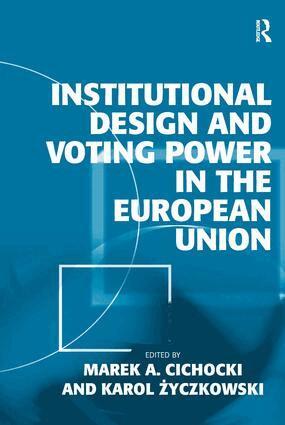
    Institutional Design and Voting Power in the European Union

    AvKarol Zyczkowski,Marek A. Cichocki

    Inbunden, Engelska, 2010

    2 239 kr

    Beställningsvara. Skickas inom 10-15 vardagar. Fri frakt över 249 kr.

    Fler format och utgåvor

    E-bok

    989 kr

    E-bok

    989 kr

    Beskrivning

    Leading global experts in the field of politics and mathematics bring forth key insights on how voting power should be allocated between EU member states, and what the policy consequences are of any given institutional design. Close attention is paid to the practical implications of decision-making rules, the nature and distribution of power, and the most equitable ways to represent the preoccupations of European citizens both in the Council and European Parliament. Highly theoretical and methodologically advanced, this volume is set to enrich the debate on the future of the EU's institutional design. A valuable source of information to scholars of political science, European studies and law, as well as to people working on game theory, theory of voting and, in general, applications of mathematics to social science.

    Produktinformation

    • Utgivningsdatum:2010-10-28
    • Mått:156 x 234 x 27 mm
    • Vikt:760 g
    • Format:Inbunden
    • Språk:Engelska
    • Antal sidor:322
    • Förlag:Taylor & Francis Ltd
    • ISBN:9780754677543

    Utforska kategorier

    • Politik och statsskick inom Samhälle och politik
    • Lag och samhälle inom Juridik

    Mer om författaren

    Marek A. Cichocki, Programme Director, Natolin European Centre, Institute of Applied Social Sciences, University of Warsaw, Poland and Karol Zyczkowski, Professor, Jagiellonian University, Poland

    Recensioner i media

    'Making informed choices in politics is very important. This book offers a common sense approach towards decision making in the EU based on clear scientific reasoning. I hope that it might become of interest for decision-makers.' Jacek Saryusz-Wolski, former Polish Minister for European Affairs, Member of the European Parliament

    Innehållsförteckning

    • Introduction; I: Voting System for the Council of European Union; 1: Is the Double Majority Really Double? The Voting Rules in the Lisbon Treaty 1; 2: Penrose's Square-Root Rule and the EU Council of Ministers; 3: Jagiellonian Compromise – An Alternative Voting System for the Council of the European Union; 4: The Double Majority Voting Rule of the EU Reform Treaty as a Democratic Ideal for an Enlarging Union; 5: The Blocking Power in Voting Systems; 6: The Distribution of Power in the Council of Ministers of the European Union; II: Distribution of Power in the European Union; 7: The Distribution of Power in the European Cluster Game; 8: The Constitutional Power of Voters in the European Parliament; 9: Decision Rules and Intergovernmentalism in the European Union; 10: On the Relative Unimportance of Voting Weights; 11: Patterns of Voting in the Council of Ministers of the European Union; 12: Decision-Making in the EU Council after the First Eastern Enlargement; III: Allocation of Seats in the European Parliament; 13: Degressive Proportionality; 14: Putting Citizens First; 15: Comparative Analysis of Several Methods for Determining the Composition of the European Parliament; 16: On Bounds for Allocation of Seats in the European Parliament; 17: Conclusions