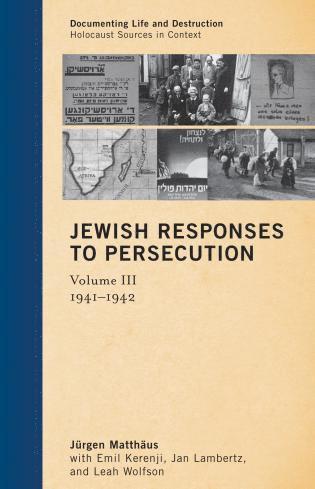
Inbunden, Engelska, 2013
Jewish Responses to Persecution: 1941–1942
Volume 3
Del i serien Documenting Life and Destruction: Holocaust Sources in Context
877 kr
Beställningsvara. Skickas inom 10-15 vardagar. Fri frakt över 249 kr.
Beskrivning
Produktinformation
- Utgivningsdatum: 2013-04-18
- Mått: 161 x 235 x 38 mm
- Vikt: 1 002 g
- Format: Inbunden
- Språk: Engelska
- Serie: Documenting Life and Destruction: Holocaust Sources in Context
- Antal sidor: 584
- Förlag: AltaMira Press
- ISBN: 9780759122581
Mer om författaren
Jürgen Matthäus is the director of the Applied Research Division at the Jack, Joseph and Morton Mandel Center for Advanced Holocaust Studies of the United States Holocaust Memorial Museum. Emil Kerenji is an applied research scholar at the Jack, Joseph and Morton Mandel Center for Advanced Holocaust Studies of the United States Holocaust Memorial Museum.Jan Lambertz is a historian and served on the research team of the Independent Historians Commission on the Role of the German Foreign Office during National Socialism and after 1945. Leah Wolfson is a senior program officer and applied research scholar at the Jack, Joseph and Morton Mandel Center for Advanced Holocaust Studies of the United States Holocaust Memorial Museum.
Recensioner i media
This book’s numerous documents, some previously published but many translated from archival sources for the first time, include heart-stabbing expressions of pain,fear, despair, doomed hope, and innocent delusion. They flow mainly from Jewish sufferers’ pens, with none from the perpetrators’ bureaucracy. The voices are mostly Central or East European, but there are also gripping testimonies from southeastern Europe, the Netherlands, and France. . . .Otherwise, the political documents expose, though without recrimination, the self-delusion and sometimes self-serving attitudes of Jewish leaders in Allied lands, and of members of Judenräte and the Jewish Police in the ghettos. This collection puts myriad significant documents into teachers’ and students’ hands. . . .[T]hese documents illuminate individual fates in a wide range of geographical and socio-cultural settings. Reading such sources, we need not reject the challenge of fashioning a wide-ranging interpretation of Hitlerism and the Holocaust—a historical and philosophical tool much needed if the barbed wire is to be cut. At the start, however, we must recognize that individual fates possess their own existential and epistemological autonomy.
Betyg & recensioner
0 recensioner
Inga recensioner tillgängliga.