• Fri frakt över 249 kr
  • •
  • Snabba leveranser
  • •
  • Billiga böcker
Kundservice

Du är på sajten för privatpersoner.

Företag, bibliotek eller offentlig verksamhet?

Du handlar på classic.bokus.com, där alla dina funktioner finns intakta.
Till classic.bokus.com
Bokus logotyp. Gå till startsidan.
  • Erbjudanden
  • Student
  • Topplistor
  • Barn & ungdom
  • Bokus Play
  • E-böcker
  • Ljudböcker
  • Pocketböcker
  • Spel & pussel

10% rabatt på allt med kod NYSTART10 →

Sidfot

Mina sidor

    Hjälp

    • Kundservice
    • Vanliga frågor och svar
    • Frakt och leverans
    • Retur vid ångerrätt
    • Reklamera vara
    • Betalning
    • Köpvillkor
    • Allmänna villkor
    • Information om webbplatsens tillgänglighet

    Om Bokus

    • Om oss
    • Pressrum
    • För studenter
    • För företag
    • För bibliotek och offentlig verksamhet
    • För leverantörer
    • Hållbarhet

    Populärt

    • Aktuella erbjudanden
    • Presentkort
    • Studentlitteratur
    • Nya böcker
    • Topplistor
    • Signerade böcker
    • Engelska böcker

    Inspiration

    • Boktips
    • BookTok
    • Populära bokserier
    • Barnbokskaraktärer
    • Populära författare
    Logotyp för Bokus
    Följ oss på Facebook (extern länk)Följ oss på Instagram (extern länk)Följ oss på YouTube (extern länk)Följ oss på TikTok (extern länk)
    bokus @ CookiesAnpassa cookiesIntegritetspolicyKöpvillkor
    Till Citymail hemsida (extern länk)Till Budbee hemsida (extern länk)Till Postnord hemsida (extern länk)Till Schenker hemsida (extern länk)Till Early Bird hemsida (extern länk)Till Walleys hemsida (extern länk)
    1. Psykologi och pedagogik
    2. Psykologi
    3. Biologisk psykologi och neuropsykologi

    Will and its Brain

    An Appraisal of Reasoned Free Will

    AvHans Helmut Kornhuber,Lüder Deecke

    Häftad, Engelska, 2012

    Del i serien University Press of America

    492 kr

    Beställningsvara. Skickas inom 10-15 vardagar. Fri frakt över 249 kr.

    Fler format och utgåvor

    Inbunden

    815 kr

    E-bok

    528 kr

    Beskrivning

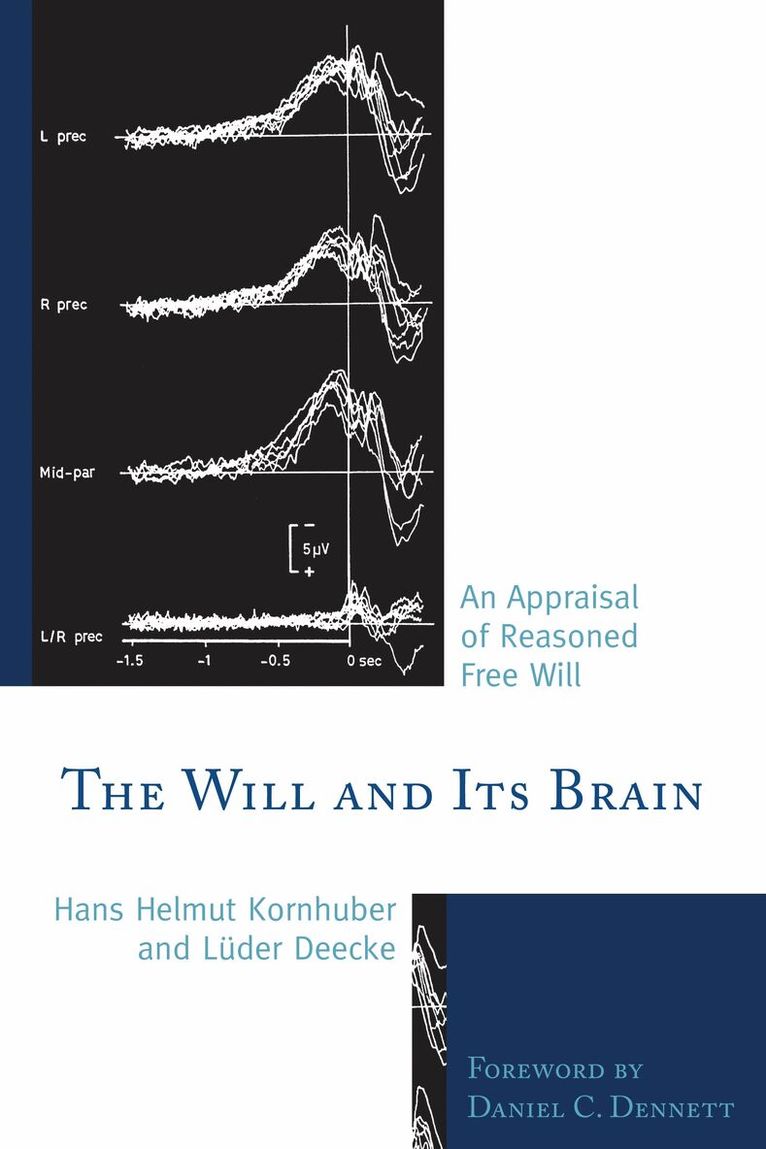
    In 1964–1965, Hans Helmut Kornhuber and Lüder Deecke achieved a scientific breakthrough with the discovery of the Bereitschaftspotential (BP), or readiness potential. In The Will and its Brain, Kornhuber and Deecke present evidence that proves we can record activity from the human brain occurring prior to our volitional movements or actions. Such preparatory activity is generated by specific brain regions, particularly by the supplementary motor area (SMA) of the frontal lobe, which lies on the inner surface of the brain between the hemispheres. The primary (precentral) motor cortex (MI) later becomes activated in preparing for action. Consequently, the authors discriminate between two components of the preparatory activity of the Bereitschaftspotential: an early SMA-generated BP1 and a late MI-derived BP2. Between BP1 and BP2, the intentional activity runs over the so-called motor loop via the basal ganglia. Kornhuber and Deecke discuss these and other brain processing systems while focusing on the concept of free will. They claim that we, indeed, have free will. It may not be absolutely free, but free in terms of degrees. We can take efforts to increase our degrees of freedom through self-improvement, but we can also lose degrees of freedom through self-mismanagement.

    Produktinformation

    • Utgivningsdatum:2012-09-11
    • Mått:149 x 230 x 10 mm
    • Vikt:209 g
    • Format:Häftad
    • Språk:Engelska
    • Serie:University Press of America
    • Antal sidor:110
    • Förlag:University Press of America
    • ISBN:9780761858621

    Utforska kategorier

    • Biologisk psykologi och neuropsykologi inom Psykologi och pedagogik
    • Kognitiv psykologi inom Psykologi och pedagogik

    Mer om författaren

    Hans Helmut Kornhuber was born in 1928 in Königsberg, Germany, and passed away in 2009. He was a brilliant neurologist and neurophysiologist known worldwide. After his release in 1949 from a Russian prisoner of war camp, he studied medicine in Munich, Göttingen, Freiburg, Heidelberg, and Basel. He was trained in clinical neurophysiology at the Neurological University Hospital in Freiburg and became full professor of neurology at the University of Ulm, Germany in 1966. Lüder Deecke was born in 1938 in Lohe, Germany. He studied medicine at the universities of Freiburg, Hamburg, and Vienna. He received his clinical education at the Neurological University Hospital in Freiburg and at the University of Ulm. Deecke became full professor of neurology and head of the Neurological University Hospital in Vienna in 1985. In 1990, he founded and subsequently chaired the Ludwig Boltzmann Institute for Functional Brain Topography.

    Recensioner i media

    . . . required reading for anybody interested in what neuroscience has to say about our capacity to make responsible decisions and be captains of our own destiny.

    Innehållsförteckning

    • List of Figures ForewordPrefacePreface to the German EditionIntroduction — What is the Will?Chapter One: The Will — History and Transcultural AspectsChapter Two: The Will — Its Association with FreedomChapter Three: The Will and Psychiatry/PsychologyChapter Four: The Will and Neurophysiology/Brain ResearchChapter Five: The Will and New Psychology SchoolsChapter Six: The Will and the Real Function of the Frontal Lobe — Commander, Delegator, Supervisor and RaterChapter Seven: The Will and the Evolution of Man — Creativeness and Cooperation — Common WillChapter Eight: The Will and Dream Sleep, Feelings, Drives, Meaning-Happiness, Beauty, Love, Empathy and Theory of MindChapter Nine: The Will and the Limbic System, the Hypothalamus, the Arousal System, Circadian Rhythm, the Endocrine System, Fatigue and ImpetusChapter Ten: The Will is Not Strictly Coupled with Consciousness — There are Conscious and Unconscious Agendas in the Brain and Both are ImportantChapter Eleven: The Will — Is it Grounded upon Freedom or upon Total Determinism?Chapter Twelve: The Will — Its Freedom is Not a Priori Granted: We Have to do Something for It — Actively Increasing our Degrees of FreedomSummaryBibliographyIndexName Index