• Fri frakt över 249 kr
  • •
  • Snabba leveranser
  • •
  • Billiga böcker
Kundservice

Du är på sajten för privatpersoner.

Företag, bibliotek eller offentlig verksamhet?

Du handlar på classic.bokus.com, där alla dina funktioner finns intakta.
Till classic.bokus.com
Bokus logotyp. Gå till startsidan.
  • Erbjudanden
  • Nyheter
  • Student
  • Topplistor
  • Barn & ungdom
  • Bokus Play
  • E-böcker
  • Pocketböcker
  • Spel & pussel

10% rabatt på allt med kod NYSTART10 →

Sidfot

Mina sidor

    Hjälp

    • Kundservice
    • Vanliga frågor och svar
    • Frakt och leverans
    • Retur vid ångerrätt
    • Reklamera vara
    • Betalning
    • Köpvillkor
    • Allmänna villkor
    • Information om webbplatsens tillgänglighet

    Om Bokus

    • Om oss
    • Pressrum
    • För studenter
    • För företag
    • För bibliotek och offentlig verksamhet
    • För leverantörer
    • Hållbarhet

    Populärt

    • Aktuella erbjudanden
    • Presentkort
    • Studentlitteratur
    • Nya böcker
    • Topplistor
    • Signerade böcker
    • Engelska böcker

    Inspiration

    • Boktips
    • BookTok
    • Populära bokserier
    • Barnbokskaraktärer
    • Populära författare
    Logotyp för Bokus
    Följ oss på Facebook (extern länk)Följ oss på Instagram (extern länk)Följ oss på YouTube (extern länk)Följ oss på TikTok (extern länk)
    bokus @ CookiesAnpassa cookiesIntegritetspolicyKöpvillkor
    Till Citymail hemsida (extern länk)Till Budbee hemsida (extern länk)Till Postnord hemsida (extern länk)Till Schenker hemsida (extern länk)Till Early Bird hemsida (extern länk)Till Walleys hemsida (extern länk)
    1. Psykologi och pedagogik
    2. Psykologi
    3. Psykologisk metod

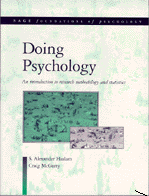
    Doing Psychology

    An Introduction to Research Methodology and Statistics

    AvS. Alexander Haslam,Craig McGarty

    Häftad, Engelska, 1997

    1 992 kr

    Beställningsvara. Skickas inom 3-6 vardagar. Fri frakt över 249 kr.

    Beskrivning

    `Doing Psychology ... challenges the reader to become active in the development and understanding of psychological research and to be critical in its application.

    Academics will find the text would easily complement the structure of an introductory course. Overall this book is written clearly and concisely, adopting a conversational tone, and utilizes a structure that students can easily follow without the techniques and concepts being oversimplified.

    Doing Psychology is certainly a text well worth considering in introductory courses, or as a refresher text for those who need to revise key techniques. The text would provide students with a good foundation for advanced design and statistics courses' - Australian Psychologist

    `Doing Psychology is a sound text with clear and accurate explanations in areas which it covers' - South African Journal of Psychology

    This textbook provides a clear introduction to the principal research methods and statistical procedures that underpin psychological research. The authors build a carefully integrated understanding of the research process from the ground up, and address the many challenges confronting students of psychology - issues surrounding, among other things, research goals, methodological choices and strategy, multiple approaches to statistical inference and ethical controversies.

    Using words and diagrams rather than numbers and equations, Doing Psychology offers a highly readable guide to how to design, analyze and evaluate experiments and surveys in psychological research.

    An Instructor's Manual is available upon request.

    Produktinformation

    • Utgivningsdatum:1997-12-12
    • Mått:189 x 246 x 17 mm
    • Vikt:570 g
    • Format:Häftad
    • Språk:Engelska
    • Antal sidor:312
    • Upplaga:1
    • Förlag:SAGE Publications
    • ISBN:9780761957355

    Utforska kategorier

    • Psykologisk metod inom Psykologi och pedagogik

    Mer om författaren

    S Alexander Haslam (Alex Haslam) is Professor of Psychology and Australian Laureate Fellow at the University of Queensland. Together with colleagues, he has written and edited 15 books and over 300 research articles and chapters. His most recent books are The New Psychology of Leadership: Identity, Influence and Power (with Steve Reicher and Michael Platow, 2nd ed. 2020) and Social Psychology: Revisiting the Classic Studies (edited with Joanne Smith, 2nd ed. 2017). He is former Chief Editor of the European Journal of Social Psychology and former President of the Psychology Section of the British Science Association. He is a recipient of the European Association of Social Psychology’s Kurt Lewin Medal for research excellence, and the International Society of Political Psychology’s Nevitt Sanford Award for contributions to political psychology. He has also received awards for distinguished contributions to psychological science from both the British Psychology Society and the Australian Psychology Society. In 2022 he was appointed a Member of the Order of Australia “for significant service to higher education, particularly psychology, through research and mentoring”.Craig McGarty is Professor of Psychology at Western Sydney University. He received his undergraduate training in psychology at the University of Adelaide and his PhD from Macquarie University in 1991 (where he was a tutor from 1985 until 1989). He spent 1990 as a lecturer in social psychology/social interaction at the University of Western Sydney and moved in 1991 to the Australian National University as a research associate. He was Reader and Head of the School of Psychology before moving to Murdoch University in Western Australia as the Director of the Centre for Social and Community Research and then Director of the Social Research Institute. He has worked on a wide range of topics in experimental social psychology, and his current research includes a social audit of the aspirations and solutions of a remote Indigenous community and studies of the reconciliation process in post-genocide Rwanda. His books include Stereotypes as Explanations (with Vincent Yzerbyt and Russell Spears, 2002) and Categorization and Social Psychology (1999).

    Recensioner i media

    `Doing Psychology is a sound text with clear and accurate explanations in areas which it covers′ - South African Journal of Psychology`Doing Psychology ... challenges the reader to become active in the development and understanding of psychological research and to be critical in its application. Academics will find the text would easily complement the structure of an introductory course. Overall this book is written clearly and concisely, adopting a conversational tone, and utilises a structure that students can easily follow without the techniques and concepts being oversimplified.Doing Psychologyis certainly a text well worth considering in introductory courses, or as a refresher text for those who need to revise key techniques. The text would provide students with a good foundation for advanced design and statistics courses′ - Australian Psychologist

    Innehållsförteckning

    • IntroductionResearch in PsychologyObjectives and IdealsResearch MethodsExperimental DesignSurvey DesignDescriptive StatisticsSome Principles of Statistical InferenceExamining Differences between MeansThe t-testExamining Relationships between VariablesCorrelationResearch EthicsConclusionManaging Uncertainty in Psychological ResearchThe chapters in detailChapter One: Introduction`Why do I have to do this?′; the structure of this book and an overview of the chapters; how to use this bookChapter Two: Research in Psychology: Objectives and IdealsWhat is psychological research and why do it?; how does psychological research progress?; principles of good research; some notes of cautionChapter Three: Research MethodsPsychological measurement; the experimental method; the quasi-experimental method; the survey method; the case study method; overviewChapter Four: Experimental DesignChoosing an independent variable; choosing a dependent variable; choosing an experimental sample; threats to internal validity; threats to external validityChapter Five: Survey DesignThe differences between surveys and experiments; setting the question; finding a sample; types of survey; overview: designing a surveyChapter Six: Descriptive StatisticsDifferent forms of research data; describing a typical score: measures of central tendency; the relationship between measures of central tendency and a response distribution; describing the spread of scores: measures of dispersion; observed distributions Chapter Seven: Some Principles of Statistical InferenceStatistical inference; inferences about individual scores; inferences about means; overviewChapter Eight: Examining Differences between Means: The t-testStudent′s t-distribution; comparing the results for a single sample to a specific value; within-subjects t-tests; between-subjects t-tests; the controversy about what to do with t-values; handling the results of t-teChapter Nine: Examining Relationships between Variables: CorrelationSome basic principles of correlation; the measurement of correlation; interpreting and making inferences about correlations; some notes of caution; conclusionChapter Ten: Research EthicsScience and society; participation in research; research with animals; final commentChapter Eleven: Conclusion: Managing Uncertainty in Psychological Research`Where has all this got us?′; managing uncertainty in psychological research; final commentAppendices: Step-by-step guides to computing t-tests and correlations; statistical tables·