• Fri frakt över 249 kr
  • •
  • Snabba leveranser
  • •
  • Billiga böcker
Kundservice

Du är på sajten för privatpersoner.

Företag, bibliotek eller offentlig verksamhet?

Du handlar på classic.bokus.com, där alla dina funktioner finns intakta.
Till classic.bokus.com
Bokus logotyp. Gå till startsidan.
  • Erbjudanden
  • Nyheter
  • Student
  • Topplistor
  • Barn & ungdom
  • Bokus Play
  • E-böcker
  • Pocketböcker
  • Spel & pussel

Må bättre, för mindre! Upp till 50% rabatt på hälsoböcker

Sidfot

Mina sidor

    Hjälp

    • Kundservice
    • Vanliga frågor och svar
    • Frakt och leverans
    • Retur vid ångerrätt
    • Reklamera vara
    • Betalning
    • Köpvillkor
    • Allmänna villkor
    • Information om webbplatsens tillgänglighet

    Om Bokus

    • Om oss
    • Pressrum
    • För studenter
    • För företag
    • För bibliotek och offentlig verksamhet
    • För leverantörer
    • Hållbarhet

    Populärt

    • Aktuella erbjudanden
    • Presentkort
    • Studentlitteratur
    • Nya böcker
    • Topplistor
    • Signerade böcker
    • Engelska böcker

    Inspiration

    • Boktips
    • BookTok
    • Populära bokserier
    • Barnbokskaraktärer
    • Populära författare
    Logotyp för Bokus
    Följ oss på Facebook (extern länk)Följ oss på Instagram (extern länk)Följ oss på YouTube (extern länk)Följ oss på TikTok (extern länk)
    bokus @ CookiesAnpassa cookiesIntegritetspolicyKöpvillkor
    Till Citymail hemsida (extern länk)Till Budbee hemsida (extern länk)Till Postnord hemsida (extern länk)Till Schenker hemsida (extern länk)Till Early Bird hemsida (extern länk)Till Walleys hemsida (extern länk)
    1. Samhälle och politik
    2. Samhälle och kultur
    3. Kultur och medier
    4. Referensverk och tvärvetenskap

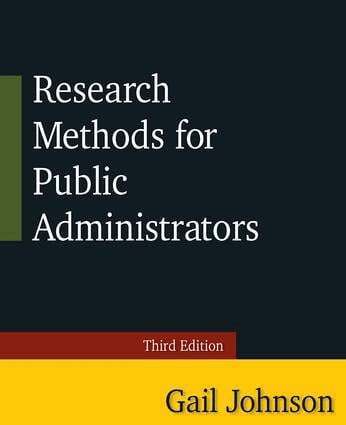
    Research Methods for Public Administrators

    Third Edition

    AvGail Johnson

    Häftad, Engelska, 2014

    938 kr

    Beställningsvara. Skickas inom 10-15 vardagar. Fri frakt över 249 kr.

    Fler format och utgåvor

    E-bok

    1 132 kr

    E-bok

    1 091 kr

    E-bok

    1 094 kr

    Inbunden

    1 048 kr

    Beskrivning

    As in previous editions, this highly practical book is written with beginning MPA students and practitioners in mind. It focuses on the interpretation and use of research findings, not just number crunching. It covers the entire research process, from initial questions to final report, in clear, jargon-free language, and includes numerous easy-to-understand examples and exercises that provide opportunities for concrete applications of the concepts. It is solidly grounded in public administration and recognizes both the promise and limitations of research within a political environment.Key features of the book:--It is highly practical and written to accommodate a mix of readers: those who want to become analysts, managers who will oversee research contracts, and citizens who need to know whether to believe the facts and data they read in today's news;--It minimizes the use of jargon and explains difficult concepts in clear language. Plentiful end-of-chapter exercises provide opportunities for concrete application of the concepts;--Key points are highlighted as "takeaway lessons" so readers are reminded about what really matters. The tough questions to ask are suggested in every chapter;--Examples and applications are used throughout the book to illustrate concepts and add topical interest;--It covers the entire research process, from initial questions to the final report. This book demystifies and makes practical the research every public administrator and policy analyst needs to do the job well. Online instructor's materials, including a Test Bank, PowerPoint slides, and a Survey and Documental Analysis (SDA) guide, are also available to adopters.

    Produktinformation

    • Utgivningsdatum:2014-03-30
    • Mått:191 x 235 x 24 mm
    • Vikt:612 g
    • Format:Häftad
    • Språk:Engelska
    • Antal sidor:350
    • Upplaga:3
    • Förlag:Taylor & Francis Ltd
    • ISBN:9780765637147

    Utforska kategorier

    • Referensverk och tvärvetenskap inom Samhälle och politik
    • Offentlig förvaltning inom Samhälle och politik

    Mer om författaren

    Gail Johnson has worked in several public agencies, including the U.S. Government Accountability Office and the U.S. Department of Health and Human Services. Her work with GAO included reports about management of federal agencies, transforming the civil service, and drug use among youth. She has taught in MPA programs for more than fifteen years, worked as consultant with several local governments, and helped design several research workshops for The World Bank. She recently published Trailblazing Governors: Six Remarkable Women, which tells the stories of six of the first generation of women governors. She maintains a blog, Research Demystified, which explores social science research in the context of politics, policy, public administration, program evaluation, and measuring for results and advocacy.

    Recensioner i media

    "Research Methods for Public Administrators is presented in a clear and comprehensible fashion which enhances the ability of even those with limited knowledge of research methods to understand the topic. The book is well structured, covers the topic with a minimum of jargon, and is designed to develop the critical thinking skills of students. Many examples of research concepts that are relevant to public administrators make the book extremely useful for students and practitioners alike." -- William Leavitt, Old Dominion University"Research Methods for Public Administrators is extremely remarkable as it treats both qualitative and quantitative research methods in a comprehensive manner without compromising clarity and readability. The rare combination of broad coverage and reader-friendliness really makes this book an excellent resource for students learning basic research tools." -- Chih-Wei Hsieh, University of New Mexico"Finally we have an approachable methods book. Gail Johnson's practitioner background helps her to discuss a very complex topic, research methods, in an understandable and practical manner. While covering the basics of research design and statistics, she also gives attention to the important topic of communicating research findings. Additionally, Johnson ties research methods to its uses in the public sector. This book is well suited for a variety of public administration programs, but it is particularly useful for those with many in-service students." -- Jami Taylor, University of Toledo"This is the consummate methods survey text for public administration and policy study, somehow improved in the new edition over already superlative previous ones. In the new edition, conceptual frames continue to be covered with even greater nuance and depth--topics such as policy and program complexity, complex causation, logic modeling, the inter-relation of normative and descriptive/empirical questions in public sector research, research ethics, and the refinement of research questions in these contexts, for instance translating research questions into hypotheses. Most highly recommended!" -- Mario Rivera, University of New Mexico"This textbook offers a comprehensive yet understandable overview of the process of research and its use in the field of public administration. The author's focus on how to use and interpret research findings is a welcome addition to the topic and the real-world exercises provide students with practical application of research skills essential for public managers. A great textbook for MPA students!" -- Pamela T. Dunning, Troy University

    Innehållsförteckning

    • List of IllustrationsPreface and Acknowledgments1. Introduction: Research Methods for Public AdministratorsOverview Goals: Research as a Critical Thinking Tool Research in the Public Sector What Is Research? Types of Research Ethics and Principles of Good ResearchOverview of This BookExercises2. Basic Research ConceptsOverviewThe Secret Language of Social Science Theory Hypothesis in Its Many Forms Variables Values Levels of Measurement Determining Causality Independent and Dependent Variables Control Variables Direction of Relationships Program Evaluation: Research in the Public SectorUsing Models for a Holistic View of RelationshipsThe Logic ModelApplying the Logic ModelConclusionExercises3. What Is the Question?OverviewDetermining the Research QuestionLearning from OthersEngaging the StakeholdersWorking TogetherTypes of Questions Descriptive Questions Normative Questions Relationship Questions ConclusionExercises4. Identifying Measures and Measurement StrategyOverviewDefining Key Terms Conceptual Definitions Operational Definitions Setting BoundariesValid and Reliable Measures Validity Reliability Why Measurement MattersConclusionExercises5. Designs for Research: The Xs and Os FrameworkOverviewDesigning an ExperimentApplying the Design Elements: The Xs and Os Framework Nonexperimental Design Quasi-Experimental Design Classic Experimental Design Design Variations Using Statistical Controls to Create Comparison Groups Longitudinal Studies Internal ValidityWhy Validity MattersExternal ValidityConclusionExercises6. Other Research ApproachesOverviewSecondary Analysis of DataEvaluation Synthesis (Meta-Analysis)Content AnalysisSurvey ResearchCase StudiesCost-Benefit AnalysisConclusionExercises7. Data Collection I: Available Data and ObservationOverviewData Collection: The Degree of StructureAvailable DataData Collection InstrumentsObservationObtrusive and Unobtrusive Data CollectionThe Design MatrixConclusionExercises8. Data Collection II: Interviews and Focus GroupsOverviewGeneral Guidelines About Choosing the Appropriate MethodEncouraging ParticipationIn-Person InterviewsFocus GroupsOther Group Data Collection: Expert Panels, Public HearingsConclusionExercises9. Data Collection III: SurveysOverviewBasic MethodsResponse RatesTelephone SurveysMail SurveysCyber-Research: E-mail and Web-Based SurveysDeveloping Closed-Ended QuestionsUsing One-Way and Two-Way Intensity ScalesRanking QuestionsDemographic QuestionsConclusionExercises10. Sampling DemystifiedOverviewSampling JargonRandom and Nonrandom Samples Random Samples Nonrandom Samples Random Samples: The Options Simple Random Sample Systematic Random Sample Stratified Random Sample Proportional Stratified Sample Disproportionate Stratified Sample Cluster Sample Nonrandom Samples: The OptionsDetermining Sample SizeNonsampling ErrorsConclusionExercises11. Qualitative Data AnalysisOverviewAnalyzing Qualitative DataIdentifying Themes and QuotesWorking with Qualitative DataConclusionExercises12. Data Analysis for DescriptionOverviewSimple Descriptive Statistics in Public AdministrationCommonly Used Descriptive Statistics Counts Percents Rates Ratios Rates of Change Distributions Measures of Central Tendency Which Measure to Use? Comparison of Means Measures of DispersionConclusionExercises13. Analyzing Survey ScalesOverviewHandling Exits and the Middle of a Five-Point ScaleSetting Benchmarks and Extreme AnalysisHandling the Middle Category in One-Way Intensity ScalesShould Means Be Used with Nominal and Ordinal Scales?The Analytical Tool: Cross TabulationsConclusionExercises14. Data Analysis: Exploring RelationshipsOverviewUsing Crosstabs to Examine RelationshipsControlling for a Third VariableExploring Relationships: Comparison of Means and MediansMeasures of AssociationFrequently Used Measures of AssociationWorking with Interval or Ratio DataConclusionExercises15. Data Analysis: RegressionOverviewBivariate Regression: Key ElementsUsing Bivariate Regression Analysis: Sunshine and TourismMultiple Regression Beta Weights: Relative Predictive Strength Regression in the NewsWhy Did the Violent Crime Rate Drop After 1991?ConclusionExercises16. Data Analysis Using Inferential StatisticsOverviewStatistical Significance: Basic ConceptsThe Logic of Statistical Significance TestingErrors in Tests for Statistical SignificanceCommon Tests for Statistical Significance Chi-Square t-Tests: Analyzing Difference in Means Analysis of Variance Tests for Statistical Significance in Regression AnalysisReporting Results of Statistical SignificancePopulation Estimates and Confidence IntervalsConclusionExercises17. Communicating Research ResultsOverviewEffectively Reporting ResultsReporting DataGeneral Guide for Communicating Research ResultsGuide for Writing an Executive SummaryGuide for Writing a Formal ReportGuide for Using Charts and TablesGuide for Oral PresentationsPresenting Unwelcome InformationMaking Sense of Research ResultsConclusionExercises18. Conclusion: Research at the Intersection of Politics and AdministrationOverviewThe Research Process Revisited Planning Doing Reporting Ethics and Social JusticeManaging Research ProjectsAssessing CredibilityThe Limitations of ScienceThe Intersection of Research, Politics, and AdministrationClosing ObservationsExercisesAppendix A. Mathematical Formulas for Selected StatisticsAppendix B. Statistics as a Second LanguageAppendix C. BibliographyAppendix D. Logic Model TemplateAppendix E. The Generic Design MatrixIndexAbout the Author