• Fri frakt över 249 kr
  • •
  • Snabba leveranser
  • •
  • Billiga böcker
Kundservice

Du är på sajten för privatpersoner.

Företag, bibliotek eller offentlig verksamhet?

Du handlar på classic.bokus.com, där alla dina funktioner finns intakta.
Till classic.bokus.com
Bokus logotyp. Gå till startsidan.
  • Erbjudanden
  • Nyheter
  • Student
  • Topplistor
  • Barn & ungdom
  • Bokus Play
  • E-böcker
  • Pocketböcker
  • Spel & pussel

Må bättre, för mindre! Upp till 50% rabatt på hälsoböcker

Sidfot

Mina sidor

    Hjälp

    • Kundservice
    • Vanliga frågor och svar
    • Frakt och leverans
    • Retur vid ångerrätt
    • Reklamera vara
    • Betalning
    • Köpvillkor
    • Allmänna villkor
    • Information om webbplatsens tillgänglighet

    Om Bokus

    • Om oss
    • Pressrum
    • För studenter
    • För företag
    • För bibliotek och offentlig verksamhet
    • För leverantörer
    • Hållbarhet

    Populärt

    • Aktuella erbjudanden
    • Presentkort
    • Studentlitteratur
    • Nya böcker
    • Topplistor
    • Signerade böcker
    • Engelska böcker

    Inspiration

    • Boktips
    • BookTok
    • Populära bokserier
    • Barnbokskaraktärer
    • Populära författare
    Logotyp för Bokus
    Följ oss på Facebook (extern länk)Följ oss på Instagram (extern länk)Följ oss på YouTube (extern länk)Följ oss på TikTok (extern länk)
    bokus @ CookiesAnpassa cookiesIntegritetspolicyKöpvillkor
    Till Citymail hemsida (extern länk)Till Budbee hemsida (extern länk)Till Postnord hemsida (extern länk)Till Schenker hemsida (extern länk)Till Early Bird hemsida (extern länk)Till Walleys hemsida (extern länk)
    1. Historia och arkeologi
    2. Historia
    3. Historia: särskilda händelser och ämnen
    4. Socialhistoria och kulturhistoria

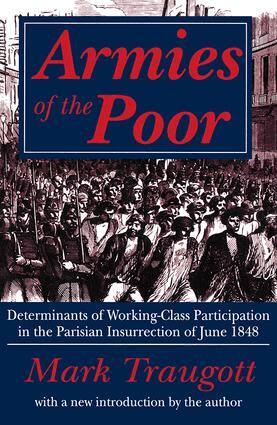
    Armies of the Poor

    Determinants of Working-class Participation in in the Parisian Insurrection of June 1848

    AvMark Traugott

    Häftad, Engelska, 2001

    763 kr

    Beställningsvara. Skickas inom 10-15 vardagar. Fri frakt över 249 kr.

    Fler format och utgåvor

    Inbunden

    2 506 kr

    E-bok

    901 kr

    E-bok

    898 kr

    Beskrivning

    In June 1848, two irregular armies of the urban poor fought a four-day battle in the streets of Paris that decided the fate of the French Second Republic. The Parisian National Workshops and the Parisian Mobile Guard-organizations newly created at the time of the February Revolution-provided the bulk of the June combatants associated with the insurrection and repression, respectively. According to Marx's simple and compelling hypothesis, a nascent French proletariat unsuccessfully attempted to assert its political and social rights against a coalition of the bourgeoisie and lumpenproletariat, represented by the Parisian Mobile Guard. Through a detailed study of archival sources, Mark Traugott challenges this interpretation of these events and proposes an organizational explanation.Research has consistently shown that skilled artisans and not unskilled proletarians stood at the forefront of the revolutionary struggles of the nineteenth century. Traugott compares the social identities of the main participants on opposite sides of the conflict and sorts out the reasons for the political alignments observed. Drawing on work by Charles Tilly and Lynn Lees, Traugott demonstrates that the insurgents were not highly proletarianized workers, but rather members of the highly skilled trades predominant in the Parisian economy. Meanwhile, those who spearheaded the repression were little different in occupational status, though they tended to be significantly younger. Traugott's "organizational hypothesis" makes sense of the observed configuration of forces. He accounts for the age differential as a by-product of the recruitment criteria that Mobile Guard volunteers were required to meet. Finally, he explains why class position creates no more than a diffuse political predisposition that remains subject to the influence of situation-specific factors such as organizational affiliations. Armies of the Poor helps clarify our understanding of the dynamic at work in the insurrectionary turmoil of 1848 in particular and in the great waves of early industrial revolutionism in general. It now is a standard interpretation for subsequent research on the French Revolution of 1848. Armies of the Poor will be of interest to historians seeking a re-interpretation of a major revolutionary episode and social scientists considering a re-examination of Marx and Engels' hypotheses of the roots of political mobilization and protest.

    Produktinformation

    • Utgivningsdatum:2001-02-28
    • Mått:152 x 229 x 21 mm
    • Vikt:453 g
    • Format:Häftad
    • Språk:Engelska
    • Antal sidor:338
    • Förlag:Taylor & Francis Inc
    • ISBN:9780765806901

    Utforska kategorier

    • Socialhistoria och kulturhistoria inom Historia och arkeologi
    • Europas historia inom Historia och arkeologi
    • Politisk aktivism inom Samhälle och politik

    Innehållsförteckning

    • INTRODUCTION; PREFACE; ONE. The June Days of 1848 in Historical Perspective; The Parisian Economy in the Mid-Nineteenth Century Economic Crisis and the February Revolution; Chronology of the Early Second Republic; The June Insurrection in Historical Perspective TWO. The Constitution and Composition of the Parisian Mobile Guard; From the Barricades of February to the Barricades of June; Expectations of Mobile Guard Political Orientation; Contemporary Views of Mobile Guard Composition; The Empirical Investigation of Mobile Guard; The Cohort Hypothesis; THREE. An Organizational Analysis of Mobile Guard Political Orientation; The Constitution of the Mobile Guard Officer Corps; Practical Grievances; Mobile Guard Isolation; FOUR. The Transformation of the National Workshops from Instrument of Co-optation to Insurrectionary Core; The National Workshops as a Comparative Case; The Workshops' Role in the June Insurrection; Social Composition of the National Workshops; Changing Political Orientation, February to June; FIVE. Organizational Determinants of National Workshops' Political Orientation; Practical Grievances; Coherence of the Officer Corps; The Abrupt End to Workshops Isolation; SIX. The Organizational Analysis of the June Days; Explanations from Economic Factors; Explanations from Differences in Age; The Organizational Hypothesis; Concluding Remarks; Methodological Appendix: Procedures Used to Construct the Mobile Guard Sample