• Fri frakt över 249 kr
  • •
  • Snabba leveranser
  • •
  • Billiga böcker
Kundservice

Du är på sajten för privatpersoner.

Företag, bibliotek eller offentlig verksamhet?

Du handlar på classic.bokus.com, där alla dina funktioner finns intakta.
Till classic.bokus.com
Bokus logotyp. Gå till startsidan.
  • Erbjudanden
  • Nyheter
  • Student
  • Topplistor
  • Barn & ungdom
  • Bokus Play
  • E-böcker
  • Pocketböcker
  • Spel & pussel

10% rabatt på allt med kod: NYSTART10 →

Sidfot

Mina sidor

    Hjälp

    • Kundservice
    • Vanliga frågor och svar
    • Frakt och leverans
    • Retur vid ångerrätt
    • Reklamera vara
    • Betalning
    • Köpvillkor
    • Allmänna villkor
    • Information om webbplatsens tillgänglighet

    Om Bokus

    • Om oss
    • Pressrum
    • För studenter
    • För företag
    • För bibliotek och offentlig verksamhet
    • För leverantörer
    • Hållbarhet

    Populärt

    • Aktuella erbjudanden
    • Presentkort
    • Studentlitteratur
    • Nya böcker
    • Topplistor
    • Signerade böcker
    • Engelska böcker

    Inspiration

    • Boktips
    • BookTok
    • Populära bokserier
    • Barnbokskaraktärer
    • Populära författare
    Logotyp för Bokus
    Följ oss på Facebook (extern länk)Följ oss på Instagram (extern länk)Följ oss på YouTube (extern länk)Följ oss på TikTok (extern länk)
    bokus @ CookiesAnpassa cookiesIntegritetspolicyKöpvillkor
    Till Citymail hemsida (extern länk)Till Budbee hemsida (extern länk)Till Postnord hemsida (extern länk)Till Schenker hemsida (extern länk)Till Early Bird hemsida (extern länk)Till Walleys hemsida (extern länk)
    1. Psykologi och pedagogik
    2. Pedagogik
    3. Högskola och universitet

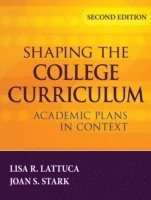
    Shaping the College Curriculum

    Academic Plans in Context

    AvLisa R. Lattuca,Joan S. Stark

    Inbunden, Engelska, 2009

    606 kr

    Beställningsvara. Skickas inom 5-8 vardagar. Fri frakt över 249 kr.

    Beskrivning

    Shaping the College Curriculum focuses on curriculum development as an important decision-making process in colleges and universities. The authors define curriculum as an academic plan developed in a historical, social, and political context. They identify eight curricular elements that are addressed, intentionally or unintentionally, in developing all college courses and programs. By exploring the interaction of these elements in context they use the academic plan model to clarify the processes of course and program planning, enabling instructors and administrators to ask crucial questions about improving teaching and optimizing student learning. This revised edition continues to stress research-based educational practices. The new edition consolidates and focuses discussion of institutional and sociocultural factors that influence curricular decisions. All chapters have been updated with recent research findings relevant to curriculum leadership, accreditation, assessment, and the influence of academic fields, while two new chapters focus directly on learning research and its implications for instructional practice. A new chapter drawn from research on organizational change provides practical guidance to assist faculty members and administrators who are engaged in extensive program improvements. Streamlined yet still comprehensive and detailed, this revised volume will continue to serve as an invaluable resource for individuals and groups whose work includes planning, designing, delivering, evaluating, and studying curricula in higher education."This is an extraordinary book that offers not a particular curriculum or structure, but a comprehensive approach for thinking about the curriculum, ensuring that important considerations are not overlooked in its revision or development, and increasing the likelihood that students will learn and develop in ways institutions hope they will. The book brings coherence and intention to what is typically an unstructured, haphazard, and only partially rational process guided more by beliefs than by empirically grounded, substantive information. Lattuca and Stark present their material in ways that are accessible and applicable across planning levels (course, program, department, and institution), local settings, and academic disciplines. It's an admirable and informative marriage of scholarship and practice, and an insightful guide to both. Anyone who cares seriously about how we can make our colleges and universities more educationally effective should read this book."—Patrick T. Terenzini, distinguished professor and senior scientist, Center for the Study of Higher Education, The Pennsylvania State University

    Produktinformation

    • Utgivningsdatum:2009-09-04
    • Mått:185 x 236 x 28 mm
    • Vikt:839 g
    • Format:Inbunden
    • Språk:Engelska
    • Antal sidor:400
    • Upplaga:2
    • Förlag:John Wiley & Sons Inc
    • ISBN:9780787985554

    Utforska kategorier

    • Högskola och universitet inom Psykologi och pedagogik
    • Läroplaner och kursplaner inom Psykologi och pedagogik

    Mer om författaren

    Lisa R. Lattuca is associate professor and senior research associate at the Center for the Study of Higher Education at The Pennsylvania State University. She is the project director and co-principal investigator for a multi-year, national study of the impact of a new set of outcomes-based accreditation standards on the educational experiences and learning of undergraduate engineers. She is the author of Creating Interdisciplinarity: Interdisciplinary Research among College and University Faculty (2001), and coedited College and University Curriculum: Developing and Cultivating Program of Study that Enhance Student Learning (2001) and Qualitative Research in Higher Education: Expanding Perspectives (2001). Joan S. Stark is professor emerita in the Center for the Study of Higher and Postsecondary Education and dean emerita, The School of Education, University of Michigan. She is the former editor of The Review of Higher Education and the former director of the National Center for Research to Improve Postsecondary Teaching and Learning, a national research center funded by the U.S. Department of Education. She is the author or editor of numerous books and monographs including: Reflections on Course Planning (1988), Student Goals for College and Courses (1989), Planning Introductory College Courses (1990), and Assessment and Program Evaluation (An Association for the Study of Higher Education Reader, 1994).

    Innehållsförteckning

    • Preface xiiiThe Authors xix1 Curriculum: An Academic Plan 1The Need for a Definitional Framework 2Defining Curriculum as an Academic Plan 4Contextual Influences on Academic Plans 11Constructing Plans: Curriculum Development 15Evolution of the Academic Plan Concept 16Advantages of the Academic Plan Model 202 External Influences: Sociocultural Context 23Patterns of Curriculum Debate 25Evolving Educational Purposes 26Debating General Education and Specialization 30Learners: An Emphasis on Access 36Content Debates: Prescription vs. Choice 45Instructional Process: Occasional Innovations 52Evaluation Debates: Emphasis on Quality Control 57Influences and Potential Reforms 643 Internal Influences: College and University Contexts 65Institutional Influences 67Unit-Level Influences 77Emerging Internal Influences 83Converging Influences 874 Internal Influences: Academic Fields 89Characterizing Academic Fields 91Differences in Course Planning 93Seeking Academic Community 101Building on the Strengths of Academic Fields 1115 Creating Academic Plans 115Course Planning 116Program Planning 127College-Wide Planning 132Systematic Design Models 135Sharing Responsibility for Curriculum Design 1436 Learners 145Learner Influences on Course Planning 147Learner Influences on Program Planning 151Learner Influences on College Planning 152Multiple Perspectives on Learning 153Learners and Learning Processes 159Understandings of Learning and Knowledge 168Learning in Academic Fields 174Considering Learners in Curriculum Design 1797 Instructional Processes 183Teaching Styles 184Contextual Influences on Courses and Programs 187Expanding Choices Among Instructional Processes 191Teaching for Intentional Learning 212Reflecting on Planning and Teaching 2258 Evaluating and Adjusting Academic Plans 229Defining Evaluation and Assessment 231Evaluating and Adjusting Course Plans 235Evaluating and Adjusting Program Plans 248College-Wide Evaluation 257Evaluating Evaluation 266Responding to Accountability Demands 2679 Administering Academic Plans 269Curriculum Leadership and Administrative Roles 27510 Models and Strategies for Curricular Change 301Evolution, Adaptation, and Strategic Change 302Scope of Curricular Change 304Models of Change 305Using Multiple Strategies for Curricular Change 318Learning to Change in Academic Organizations 322Maintaining Change 327Academic Plans in Context 329References 331Names Index 359Subject Index 367