• Fri frakt över 249 kr
  • •
  • Snabba leveranser
  • •
  • Billiga böcker
Kundservice

Du är på sajten för privatpersoner.

Företag, bibliotek eller offentlig verksamhet?

Du handlar på classic.bokus.com, där alla dina funktioner finns intakta.
Till classic.bokus.com
Bokus logotyp. Gå till startsidan.
  • Erbjudanden
  • Nyheter
  • Student
  • Topplistor
  • Barn & ungdom
  • Bokus Play
  • E-böcker
  • Pocketböcker
  • Spel & pussel

10% rabatt på allt med kod NYSTART10 →

Sidfot

Mina sidor

    Hjälp

    • Kundservice
    • Vanliga frågor och svar
    • Frakt och leverans
    • Retur vid ångerrätt
    • Reklamera vara
    • Betalning
    • Köpvillkor
    • Allmänna villkor
    • Information om webbplatsens tillgänglighet

    Om Bokus

    • Om oss
    • Pressrum
    • För studenter
    • För företag
    • För bibliotek och offentlig verksamhet
    • För leverantörer
    • Hållbarhet

    Populärt

    • Aktuella erbjudanden
    • Presentkort
    • Studentlitteratur
    • Nya böcker
    • Topplistor
    • Signerade böcker
    • Engelska böcker

    Inspiration

    • Boktips
    • BookTok
    • Populära bokserier
    • Barnbokskaraktärer
    • Populära författare
    Logotyp för Bokus
    Följ oss på Facebook (extern länk)Följ oss på Instagram (extern länk)Följ oss på YouTube (extern länk)Följ oss på TikTok (extern länk)
    bokus @ CookiesAnpassa cookiesIntegritetspolicyKöpvillkor
    Till Citymail hemsida (extern länk)Till Budbee hemsida (extern länk)Till Postnord hemsida (extern länk)Till Schenker hemsida (extern länk)Till Early Bird hemsida (extern länk)Till Walleys hemsida (extern länk)
    1. Samhälle och politik
    2. Samhälle och kultur
    3. Sociala grupper och identitet

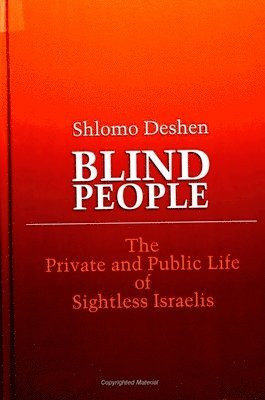
    Blind People

    The Private and Public Life of Sightless Israelis

    AvShlomo Deshen

    Häftad, Engelska, 1992

    Del i serien SUNY series, The Body in Culture, History, and Religion

    382 kr

    Tillfälligt slut

    Beskrivning

    Blind People approaches disability from a fresh perspective: people with an unusual body are conceived of relativistically as a variant of humanity, much the way anthropology approaches people of different culture. While deeply empathic to its subject matter, Blind People raises questions that anthropologists ask routinely, but which are commonly avoided in everyday life because they touch on sensitive matters. Based on fieldwork in Israel, the book constitutes an ethnography of blind Israelis. It starts by focusing on intimate issues of the management of the sightless body, goes on to discuss the role of the blind person in the domestic setting, and moves to issues of how the blind person strives to attain material requirements. Finally, the book relates the way blind people cope with problems of associating with both blind and sighted people in arenas of leisure activity and public affairs. Deshen's book aims to present a truthful, dignified, fully human depiction, in the tradition of socio-cultural anthropology.

    Produktinformation

    • Utgivningsdatum:1992-08-18
    • Mått:153 x 229 x 11 mm
    • Vikt:281 g
    • Format:Häftad
    • Språk:Engelska
    • Serie:SUNY series, The Body in Culture, History, and Religion
    • Antal sidor:197
    • Förlag:State University of New York Press
    • ISBN:9780791410363

    Utforska kategorier

    • Sociala grupper och identitet inom Samhälle och politik

    Mer om författaren

    Shlomo Deshen is Professor of Social Anthropology at Tel-Aviv University. A past president of the Israel Anthropological Association, he is the author of The Mellah Society: Jewish Community Life in Sherifian Morocco.

    Recensioner i media

    "This book provides an extraordinary look into the lives of sightless people. It is both a deeply moving account of the difficulties and contradictions with which sightless people struggle while at the same time showing how the lives of such people are produced by a certain constellation of cultural and social factors. Deshen has done a superb job of depicting in rich ethnographic detail the experience of being sightless while at the same time making an important theoretical contribution to the anthropology of disability. He shows in numerous and detailed ways how culture and the role of symbolization shape the experience of sightless people. His discussions range from the sightless person's decision to use a cane to the ways in which sightless people are incorporated into wider social networks and institutions." — Howard Eilberg-Schwartz, Stanford University

    Innehållsförteckning

    • Acknowledgments 1. Introduction: The Field, the Questions and the Researcher Part I: The Body 2. The Use of the Senses 3. The Use of Guide Dogs and Long Canes Part II: The Domestic Circle 4. Coming of Age 5. Raising Sighted Children Part III: Reaching for Material Needs 6. Seeking Employment 7. The Work Experience 8. The Experience of Support I: The Blindness System 9. The Experience of Support II: Living with the System Part IV: Reaching for Fulfillment: Friendship, Dignity, Integration 10. The Dilemma of Association among Blind People 11. The Alternative of Ethnicity 12. The Alternative of Citizenship 13. The Dilemma of Integration among the Sighted 14. Conclusion: From Etlmography of Blindness to Anthropology of Disability Notes References Index