SUNY series, The Body in Culture, History, and Religion – serie
Visar alla böcker i serien SUNY series, The Body in Culture, History, and Religion. Handla med fri frakt och snabb leverans.
9 produkter
9 produkter
566 kr
Skickas inom 3-6 vardagar
An inquiry into ki-energy, its role within Eastern mind-body theory, and its implications for our contemporary Western understanding of the body.This book is an inquiry into ki-energy, its role within Eastern mind-body theory, and its implications for our contemporary Western understanding of the body. Yuasa examines the concept of ki-energy as it has been used in such areas as acupuncture, Buddhist and Taoist meditation, and the martial arts. To explain the achievement of mind-body oneness in these traditions he offers an innovative schematization of the lived body. His approach is interdisciplinary and cross-cultural, offering insights into Western philosophy, religion, medical science, depth psychology, parapsychology, theater, and physical education.To substantiate the relationship that ki-energy forms between the human body and its environment, Yuasa introduces contemporary scientific research on ki-energy in China and Japan, as well as evidence from acupuncture medicine and from the experience of meditators and martial arts practitioners. This evidence requires not only a rethinking of the living human body and of the mind-body and mind-matter relation, but also calls into question the adequacy of the existing scientific paradigm. Yuasa calls for an epistemological critique of modern science and explores the issue of the relation of teleology to science.
1 359 kr
Tillfälligt slut
These essays bring together disciplinary understandings of what it is to be the bodies we are. In its own way, each essay calls into question certain culturally-embedded ways of valuing the body which deride or ignore its role in making us human. These ways have remained virtually unchanged since Descartes in the seventeenth century first sharply divided mind-a thinking substance, from the body-an extended substance.The legacy of this Cartesian metaphysics has been to reduce the body by turns to a static assemblage of parts and to a dumb show of movement. It has both divided the fundamental integrity of creaturely life and depreciated the role of the living body in knowing and making sense of the world, in learning, in the creative arts, and in self- and interpersonal understandings. The living sense of the body and its capacity for sense-making have indeed been blotted out by top-heavy concerns with brains, minds, and language, as if these existed without a body.It is this conception of the body as mere handmaiden to the privileged that the contributors to this book challenge. By the evidence they bring forward, they help restore what is properly due the body since Descartes convinced us that mind and body are separate, and that mind is the primary value. Moreover, they help to elucidate what is properly due the body since the more recent twentieth-century western emphasis upon vision effectively reduced the richness of the affective and tactile-kinesthetic body-the body of felt experience-to a simple sum of sensations.Dominant themes that run throughout the essays and that call our attention to the living sense of the body and its capacity for sense-making are: wholeness, the capacity for self-healing, cultural histories of the body, pan-cultural bodily invariants, thinking, emotions, and the body's wisdom. In the end, these themes show that giving the body its due means forging a metaphysics that upholds the truths of experience.
382 kr
Tillfälligt slut
These essays bring together disciplinary understandings of what it is to be the bodies we are. In its own way, each essay calls into question certain culturally-embedded ways of valuing the body which deride or ignore its role in making us human. These ways have remained virtually unchanged since Descartes in the seventeenth century first sharply divided mind-a thinking substance, from the body-an extended substance.The legacy of this Cartesian metaphysics has been to reduce the body by turns to a static assemblage of parts and to a dumb show of movement. It has both divided the fundamental integrity of creaturely life and depreciated the role of the living body in knowing and making sense of the world, in learning, in the creative arts, and in self- and interpersonal understandings. The living sense of the body and its capacity for sense-making have indeed been blotted out by top-heavy concerns with brains, minds, and language, as if these existed without a body.It is this conception of the body as mere handmaiden to the privileged that the contributors to this book challenge. By the evidence they bring forward, they help restore what is properly due the body since Descartes convinced us that mind and body are separate, and that mind is the primary value. Moreover, they help to elucidate what is properly due the body since the more recent twentieth-century western emphasis upon vision effectively reduced the richness of the affective and tactile-kinesthetic body-the body of felt experience-to a simple sum of sensations.Dominant themes that run throughout the essays and that call our attention to the living sense of the body and its capacity for sense-making are: wholeness, the capacity for self-healing, cultural histories of the body, pan-cultural bodily invariants, thinking, emotions, and the body's wisdom. In the end, these themes show that giving the body its due means forging a metaphysics that upholds the truths of experience.
480 kr
Tillfälligt slut
Blind People approaches disability from a fresh perspective: people with an unusual body are conceived of relativistically as a variant of humanity, much the way anthropology approaches people of different culture. While deeply empathic to its subject matter, Blind People raises questions that anthropologists ask routinely, but which are commonly avoided in everyday life because they touch on sensitive matters. Based on fieldwork in Israel, the book constitutes an ethnography of blind Israelis. It starts by focusing on intimate issues of the management of the sightless body, goes on to discuss the role of the blind person in the domestic setting, and moves to issues of how the blind person strives to attain material requirements. Finally, the book relates the way blind people cope with problems of associating with both blind and sighted people in arenas of leisure activity and public affairs. Deshen's book aims to present a truthful, dignified, fully human depiction, in the tradition of socio-cultural anthropology.
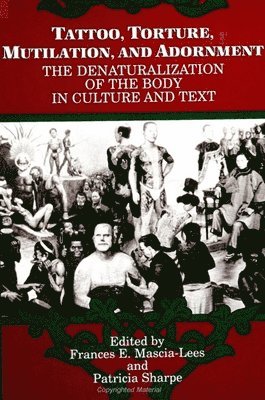
Tattoo, Torture, Mutilation, and Adornment
The Denaturalization of the Body in Culture and Text
Häftad, Engelska, 1992
356 kr
Skickas inom 11-20 vardagar
Analyzes the power of culture to encode its messages on the human form.Contemporary theory across a wide range of disciplines denaturalizes the body and reveals it to be a social construction. Cultural practices which deform, adorn, mutilate, and obliterate the body illustrate that it is an important site for the inscription of culture. The authors draw on cross currents in feminist theory, literary criticism, anthropology, and history to analyze several such cultural practices as examples of the power of culture to encode its messages on the human form.
608 kr
Skickas inom 3-6 vardagar
By shifting attention from the image of Jews as a textual community to the ways Jews understand and manage their bodies - for example, to their concerns with reproduction and sexuality, menstruation and childbirth- this volume contributes to a revisioning of what Jews and Judaism are and have been. The project of re-membering the Jewish body has both historical and constructive motivations. As a constructive project, this book describes, renews, and participates in the complex and ongoing modern discussion about the nature of Jewish bodies and the place of bodies in Judaism.
356 kr
Tillfälligt slut
Preparatory to restoring humaneness,Attunement Through the Body offers an innovative, philosophical model for overcoming mind-body dualism and its negative consequences through a systematic elucidation of the concept and the phenomenon of attunement. It invites readers to re-evaluate an undue emphasis placed on the cognitive, intellectual knowledge in the West.The book examines the concept of the lived body and then articulates the transformative dimension of our everyday mode of living our bodies vis-a-vis Yuasa Yasuo's concept of body-scheme, demonstrating that the unity disclosed can be brought to a higher degree. The book further describes the transformative dimension of our bodies in theoretical and practical aspects through the concept of the body emerging in the course of meditational self-cultivation that was practiced by Dogen Kigen, a medieval Japanese Zen master.It then develops an original philosophical theory that differs from various Western theories such as Idealism, Empiricism, and Materialism. This theory articulates modes of attunement reflecting degrees of somatic knowledge. The theory implies a lifestyle appropriate for the coming century.
562 kr
Tillfälligt slut
This book examines the figure of the virgin, a symbol central to many aspects of society and sexuality in nineteenth-century England, and its effects on the Victorian literary imagination. Studying the virgin as a social, sexual, and literary phenomenon, the volume contributes to current critical accounts of the relations among the body and language, gender, and discourse.These essays explore the ways in which virginity is not a natural ideal but a complex cultural and literary sign. The authors rethink the virginal as a textual counter-example to the idealization of "natural sexuality."
402 kr
Tillfälligt slut
One Blood offers a wealth of ethnographic material, skillfully using traditional Jamaican images and expressions to present a coherent and systematic depiction of the Jamaican body, of how it works and of how health is maintained. Sobo explains some of the more complex issues of medical anthropology in a clear and accessible fashion and shows how gender and kinship tensions are expressed through culturally constructed syndromes. The book explores the ways in which the body serves as a medium for the expression of ideas about the social and moral order. Childhood socializations and ideas about gender relations, kinship, social obligations, sorcery, and deceit are investigated in association with beliefs about nutrition, procreation, sexuality, cleanliness, bodily flow, and sickness.