• Fri frakt över 249 kr
  • •
  • Snabba leveranser
  • •
  • Billiga böcker
Kundservice

Du är på sajten för privatpersoner.

Företag, bibliotek eller offentlig verksamhet?

Du handlar på classic.bokus.com, där alla dina funktioner finns intakta.
Till classic.bokus.com
Bokus logotyp. Gå till startsidan.
  • Erbjudanden
  • Nyheter
  • Student
  • Topplistor
  • Barn & ungdom
  • Bokus Play
  • E-böcker
  • Pocketböcker
  • Spel & pussel

10% rabatt på allt med kod: NYSTART10 →

Sidfot

Mina sidor

    Hjälp

    • Kundservice
    • Vanliga frågor och svar
    • Frakt och leverans
    • Retur vid ångerrätt
    • Reklamera vara
    • Betalning
    • Köpvillkor
    • Allmänna villkor
    • Information om webbplatsens tillgänglighet

    Om Bokus

    • Om oss
    • Pressrum
    • För studenter
    • För företag
    • För bibliotek och offentlig verksamhet
    • För leverantörer
    • Hållbarhet

    Populärt

    • Aktuella erbjudanden
    • Presentkort
    • Studentlitteratur
    • Nya böcker
    • Topplistor
    • Signerade böcker
    • Engelska böcker

    Inspiration

    • Boktips
    • BookTok
    • Populära bokserier
    • Barnbokskaraktärer
    • Populära författare
    Logotyp för Bokus
    Följ oss på Facebook (extern länk)Följ oss på Instagram (extern länk)Följ oss på YouTube (extern länk)Följ oss på TikTok (extern länk)
    bokus @ CookiesAnpassa cookiesIntegritetspolicyKöpvillkor
    Till Citymail hemsida (extern länk)Till Budbee hemsida (extern länk)Till Postnord hemsida (extern länk)Till Schenker hemsida (extern länk)Till Early Bird hemsida (extern länk)Till Walleys hemsida (extern länk)
    1. Filosofi och religion
    2. Filosofi
    3. Filosofiska discipliner

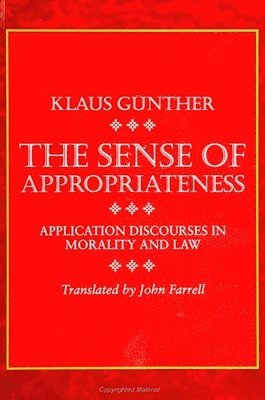
    Sense of Appropriateness

    Application Discourses in Morality and Law

    AvKlaus Günther

    Häftad, Engelska, 1993

    Del i serien SUNY series in Social and Political Thought

    410 kr

    Beställningsvara. Skickas inom 5-8 vardagar. Fri frakt över 249 kr.

    Beskrivning

    Günther's book demonstrates that most objections to moral and legal principles are directed not against the validity of principles but against the manner of their application. If one distinguishes between the justification of a principle and its appropriate application, then the claim that the application of the principle in each individual case follows automatically from its universal justification proves to be a misunderstanding. Günther develops this distinction with the help of Habermas's discourse theory of morality. He then employs it to extend Kohlberg's theory of moral development and to defend this against Gilligan's critique. In the third and fourth parts of the book, Günther shows-in debate with Hare, Dworkin, and others-how argumentation on the appropriate application of norms and principles in morality and law is possible.

    Produktinformation

    • Utgivningsdatum:1993-09-28
    • Mått:149 x 227 x 20 mm
    • Vikt:508 g
    • Format:Häftad
    • Språk:Engelska
    • Serie:SUNY series in Social and Political Thought
    • Antal sidor:353
    • Förlag:State University of New York Press
    • ISBN:9780791415528
    • Översättare:John Farrell

    Utforska kategorier

    • Filosofiska discipliner inom Filosofi och religion

    Mer om författaren

    Klaus Günther is Professor of Law at the University of Frankfurt.

    Recensioner i media

    "Does the justification of moral principle or rule of law justify its application to particular cases? This is the issue in Klaus Günther's The Sense of Appropriateness. It is handled with great skill and critical insight. This is an admirable performance which makes a serious advance in the Frankfurt approach to the study of rational practical discourse." — D. N. MacCormick, Center for Criminology and the Social and Philosophical Study of Law, The University of Edinburgh

    Innehållsförteckning

    • Translators IntroductionAuthor's PrefaceAuthor's IntroductionPart One: The Problem of Application in Discourse Ethics1. Justification and Application on the Presupposition of a Semantic Principle of Universalizability2. Justification and Application on the Presupposition of the Moral Principle (U)3. Two Versions of the Universalization Principle4. Application as Discourse5. Can Justification Discourses be Replaced by Application Discourses?6. The Application of the Moral PrinciplePart Two: The Problem of the Application of Norms n the Development of Moral Consciousness1. The "Free Application" of Indeterminate Norms as a Result of Societal Rationalization Processes (Durkheim)Excursus: The Emergence and Following of Rules in Social Processes1. The Emergence of Situation-independent Meanings in Social Situations (Mead)2. Rule-following as a "Custom" (Wittgenstein)2. Mead's Draft of a Universalist Ethics as a Method for the Constructive Formation of Appropriate Hypotheses3. The Differentiation Between Justification and Application at the Postconventional Level of Moral Consciousness (Piaget and Kohlberg)3.1 The Development of the Relation Between Equity and Equality in Piaget3.2 A Provisional Developmental Scenario3.3 The Development of the Relation Between Equity and Equality in Kohlberg4. Is There a Contextualist Alternative to "Stage 6"?—The Discovery that "it depends"5. Is Postconventional Moral Consciousness Rigoristic?6. Summary: Three Levels in the Development of Types of ApplicationExcursus: "Phronesis" as an Example of Context-bound Application1. The Aristotelian Theory2. Appropriate Understanding: HermeneuticsPart Three: Appropriateness Argumentation in Morality1. The Problem of a Conflict of Norms: Prima Facie and Definitive Norms2. Appropriateness Argumentation as an Experimental Procedure and as a Moral Learning Process3. Elements of a Logic of Appropriateness Argumentation3.1 Complete Description of a Situation3.2 Norm CoherencePart Four: Appropriateness Argumentation in Law1. Discourse Ethics' Reasons for the Distinction Between Law and Morality2. Systems Theory's Concept of Law2.1 Double Contingency2.2 Law as an Autopoietic System: Differentiation into Code and Programming3. The Indeterminacy of Legal Rules3.1 Hermeneutical Models3.2 "Integrity": In Search of the Best Justification (Dworkin)NotesBibliographyIndex