• Fri frakt över 249 kr
  • •
  • Snabba leveranser
  • •
  • Billiga böcker
Kundservice

Du är på sajten för privatpersoner.

Företag, bibliotek eller offentlig verksamhet?

Du handlar på classic.bokus.com, där alla dina funktioner finns intakta.
Till classic.bokus.com
Bokus logotyp. Gå till startsidan.
  • Erbjudanden
  • Nyheter
  • Student
  • Topplistor
  • Barn & ungdom
  • Bokus Play
  • E-böcker
  • Pocketböcker
  • Spel & pussel

10% rabatt på allt med kod: NYSTART10 →

Sidfot

Mina sidor

    Hjälp

    • Kundservice
    • Vanliga frågor och svar
    • Frakt och leverans
    • Retur vid ångerrätt
    • Reklamera vara
    • Betalning
    • Köpvillkor
    • Allmänna villkor
    • Information om webbplatsens tillgänglighet

    Om Bokus

    • Om oss
    • Pressrum
    • För studenter
    • För företag
    • För bibliotek och offentlig verksamhet
    • För leverantörer
    • Hållbarhet

    Populärt

    • Aktuella erbjudanden
    • Presentkort
    • Studentlitteratur
    • Nya böcker
    • Topplistor
    • Signerade böcker
    • Engelska böcker

    Inspiration

    • Boktips
    • BookTok
    • Populära bokserier
    • Barnbokskaraktärer
    • Populära författare
    Logotyp för Bokus
    Följ oss på Facebook (extern länk)Följ oss på Instagram (extern länk)Följ oss på YouTube (extern länk)Följ oss på TikTok (extern länk)
    bokus @ CookiesAnpassa cookiesIntegritetspolicyKöpvillkor
    Till Citymail hemsida (extern länk)Till Budbee hemsida (extern länk)Till Postnord hemsida (extern länk)Till Schenker hemsida (extern länk)Till Early Bird hemsida (extern länk)Till Walleys hemsida (extern länk)
    1. Filosofi och religion
    2. Filosofi
    3. Filosofiska discipliner

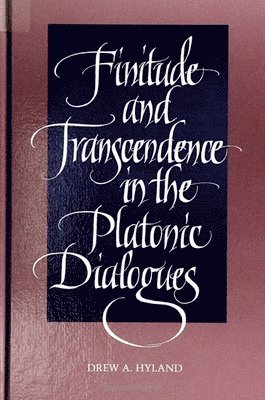
    Finitude and Transcendence in the Platonic Dialogues

    AvDrew A. Hyland

    Häftad, Engelska, 1995

    Del i serien SUNY series in Ancient Greek Philosophy

    390 kr

    Tillfälligt slut

    Fler format och utgåvor

    Inbunden

    Tillf. slut

    Beskrivning

    This book explains how to read Plato, emphasizing the philosophic importance of the dramatic aspects of the dialogues, and showing that Plato is an ironic thinker and that his irony is deeply rooted in his philosophy.
    Produktinformation

    • Utgivningsdatum:1995-08-10
    • Mått:150 x 227 x 13 mm
    • Vikt:327 g
    • Format:Häftad
    • Språk:Engelska
    • Serie:SUNY series in Ancient Greek Philosophy
    • Antal sidor:208
    • Förlag:State University of New York Press
    • ISBN:9780791425107

    Utforska kategorier

    • Filosofiska discipliner inom Filosofi och religion

    Mer om författaren

    Drew A. Hyland is Charles A. Dana Professor of Philosophy at Trinity College.

    Recensioner i media

    "Professor Hyland's thesis is that finitude, and the response to finitude that he calls 'finite transcendence,' is an informing theme of the Platonic dialogues. This important observation is confirmed in the course of seven chapters that treat distinct yet related features of some of the most familiar dialogues. The first chapter's discussion of the significance of place in the dialogues is provocative and original, and immediately engages the reader's interest. Subsequent chapters fill out the theme of finitude in a way that prepares the reader to be thoroughly persuaded by Hyland's discussion of his striking claim that Heidegger failed to provide a Heideggerian interpretation of Plato. Indeed, the success of Chapter 6—which I take to be the rhetorical culmination of the book—is a measure of the success of the book as a whole. Professor Hyland is a distinguished teacher, and his book will appeal to the next generation of scholars—today's graduate and undergraduate students—as well as to his peers in the academy." —Jacob A. Howland, University of Tulsa"Hyland argues in a clear and spirited way for an interpretive stance toward Plato that stresses the form and irony of the dialogues and the view these imply of the human condition. The form and irony of the dialogues are generally neglected in Plato scholarship, for the most part because our mainstream tradition of philosophical analysis does not prepare us to read in a way that takes context as seriously as concepts and arguments. Often, however, even those who take dialogue form as a pathway to the content of this or that particular text neglect the substantive significance, in its various aspects, of dialogue form itself. There are particularly interesting discussions of the structure of irony in the dialogues, of affinities of the view of the human condition in the dialogues with those to be found in tragedy and comedy, and of thematic analogies, missed by Heidegger himself, between his interpretation of aletheia and the way meaning emerges for a sensitive reader of the dialogues." — Mitchell Miller, Vassar College

    Innehållsförteckning

    • Preface Introduction 1. The Place of Philosophy 2. Republic, Book 2, and the Origins of Political Philosophy 3. Plato's "Three Waves" and the Question of Utopia 4. Irony as Finite Transcendence 5. The Whole Tragedy and Comedy of Philosophy 6. Truth and Finitude: On Heidegger's Reading of Plato 7. But What about the Ideas? Bibliography Index of Names Index of Subjects