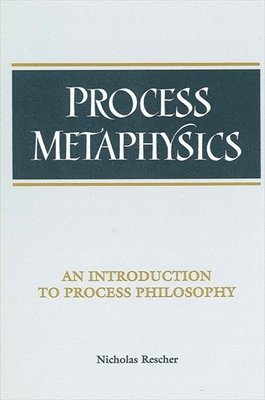
566 kr
Beställningsvara. Skickas inom 3-6 vardagar. Fri frakt över 249 kr.
Beskrivning
Produktinformation
- Utgivningsdatum:1996-02-15
- Mått:140 x 216 x 17 mm
- Vikt:272 g
- Format:Häftad
- Språk:Engelska
- Antal sidor:224
- Förlag:State University of New York Press
- ISBN:9780791428184
Utforska kategorier
Mer om författaren
Nicholas Rescher is University Professor of Philosophy at the University of Pittsburgh, where he also served as Chairman of the Department of Philosophy and as Director of the Center for Philosophy of Science. For over three decades, he has been editor of the American Philosophical Quarterly. He was elected to membership in both the Institut International de Philosophie and the Academie Internationale de Philosophie des Sciences. Rescher is the author of more than 60 books in various areas of philosophy, and his works have been translated into German, Spanish, French, Italian, and Japanese. He has held fellowships from the J.S. Guggenheim Foundation, the Ford Foundation, and the American Philosophical Society. He is a former president of the American Philosophical Association, the C.S. Peirce Society, and the G.W. Leibniz Society of America and has served as a member of the Board of Directors of the International Federation of Philosophical Societies. He was elected an honorary member of Corpus Christi College, Oxford and in 1983 he received an Alexander von Humboldt Humanities Prize, awarded under the auspices of the Federal Republic of Germany, "in recognition of the research accomplishments of humanistic scholars of international distinction."
Recensioner i media
"In this book, one of the nation's most literate, prolific, and respected philosophers brings his considerable analytic skills to bear on process philosophy. It is over 30 years since a philosopher of such national and international stature has chosen to focus on the main issues of this extensive but neglected philosophical school. Earlier evaluations of process philosophy by Strawson, Rorty, and Grünbaum, moreover, were partial, selective, and often rested upon serious misunderstandings. By contrast, Rescher aims at a comprehensive, fair, and impartial treatment of the main problems in analytic metaphysics, including now-standard problems in logic, language, and epistemology, to which a process-oriented approach offers substantive insights. Rescher offers a calm, thoughtful, and open-minded analysis of problems such as personhood and personal identity, the status of universals and particulars, our understanding of nature and of biological and cultural evolution, and brief discussions of philosophical approaches to the nature of scientific inquiry itself and to theology that coordinate the insights of process philosophy and with the work of many leading contemporary anglo-American philosophers."This is a masterly treatment and a monumental achievement, resulting in an eminently readable introduction and survey for specialists and a useful and instructive outline for students." — George R. Lucas, Jr., Georgetown University
Innehållsförteckning
- Preface Introduction 1. Historical Background 1. Prospect2. Heraclitus (6th Century B.C.)3. Plato and Aristotle4. Gottfried Wilhelm Leibniz (1646-1717)5. Georg Wilhelm Friedrich Hegel (1770-1831)6. Charles Sanders Peirce (1839-1914)7. William James (1842-1910)8. Henri Bergson (1859-1941)9. John Dewey (1859-1952)10. Alfred North Whitehead (1861-1947)11. Wilmon H. Shelfon (1875-1981)12. Retrospect 2. Basic Ideas 1. The Process Approach and Its Alternatives2. Key Concepts and Categories3. What Is a Process?4. Modes of Process5. The Priority of Process: Against the Process Reducibility Thesis6. Processes and Dispositions 3. Process and Particulars 1. Particulars2. Complexification3. Ongoing Identity as a Matter of Ongoing Reidentifiability: An Idealistic Perspective4.Against Strawson's Critique of Processism5. Difficulties of Substantialism6. The Origination of Particulars 4. Process and Universals 1. Process and "The Problem of Universals"2. Novelty, Innovation, Creativity3. Taxonomic Complexification 5. Process Philosophy of Nature 1. Basic Ideas of a Process Philosophy of Nature2. Process and Existence3. Process and the Laws of Nature4. Space-Time5. The Quantum Apsect6. Process Philosophy and Evolutionary Optimism7. Validation 6. Process and Persons 1. Difficulties of the Self and the Process Approach to Persons2. Mind and Matter in Processual Perspective3. Human Life as a Process: The General Idea of a Life Cycle4. Historical Process5. Transiency and Value 7. Process Logic and Epistemology 1. Truth and Knowledge: The Processual Perspective2. Aristotle and Truth-Value Indeterminacy3. The Processual Nature of Knowledge and the Cognitive Inexhaustibility of Things4. Process and Experience5. Process and Communication 8. A Processual View of Scientific Inquiry 1. Inquiry as a Productive Process: The Example of Science2. Difficulties in Predicting Future Science: In Natural Science, the Present Cannot Speak for the Future3. Scientific Progress Is Driven by Technological Escalation 9. Process Theology 1. God: Substance or Process?2. The Process View of God3. God in Time and Eternity: The Problem of Free Will4. God in and for Nature 10. Process in Philosophy 1. Philosophy in Process2. Is Process Philosophy Coherent?3. The State of Process Philosophy4. Process and Metaphilosophy5. The Bottom Line Appendix: Process Semantics Notes Bibliography Name Index
Du kanske också är intresserad av
- Signerad!
- Nyhet
- Signerad!
- Nyhet
- Nyhet
- Nyhet
- Nyhet
- Nyhet
- Signerad!
- Nyhet
- Nyhet
- Nyhet