• Fri frakt över 249 kr
  • •
  • Snabba leveranser
  • •
  • Billiga böcker
Kundservice

Du är på sajten för privatpersoner.

Företag, bibliotek eller offentlig verksamhet?

Du handlar på classic.bokus.com, där alla dina funktioner finns intakta.
Till classic.bokus.com
Bokus logotyp. Gå till startsidan.
  • Erbjudanden
  • Nyheter
  • Student
  • Topplistor
  • Barn & ungdom
  • Bokus Play
  • E-böcker
  • Pocketböcker
  • Spel & pussel

10% rabatt på allt med kod NYSTART10 →

Sidfot

Mina sidor

    Hjälp

    • Kundservice
    • Vanliga frågor och svar
    • Frakt och leverans
    • Retur vid ångerrätt
    • Reklamera vara
    • Betalning
    • Köpvillkor
    • Allmänna villkor
    • Information om webbplatsens tillgänglighet

    Om Bokus

    • Om oss
    • Pressrum
    • För studenter
    • För företag
    • För bibliotek och offentlig verksamhet
    • För leverantörer
    • Hållbarhet

    Populärt

    • Aktuella erbjudanden
    • Presentkort
    • Studentlitteratur
    • Nya böcker
    • Topplistor
    • Signerade böcker
    • Engelska böcker

    Inspiration

    • Boktips
    • BookTok
    • Populära bokserier
    • Barnbokskaraktärer
    • Populära författare
    Logotyp för Bokus
    Följ oss på Facebook (extern länk)Följ oss på Instagram (extern länk)Följ oss på YouTube (extern länk)Följ oss på TikTok (extern länk)
    bokus @ CookiesAnpassa cookiesIntegritetspolicyKöpvillkor
    Till Citymail hemsida (extern länk)Till Budbee hemsida (extern länk)Till Postnord hemsida (extern länk)Till Schenker hemsida (extern länk)Till Early Bird hemsida (extern länk)Till Walleys hemsida (extern länk)
    1. Samhälle och politik
    2. Samhälle och kultur
    3. Sociala och etiska frågor

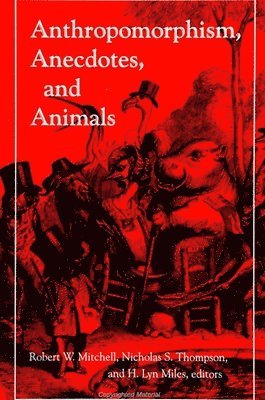
    Anthropomorphism, Anecdotes, and Animals

    AvRobert W. Mitchell,Nicholas S. Thompson

    Häftad, Engelska, 1996

    497 kr

    Beställningsvara. Skickas inom 5-8 vardagar. Fri frakt över 249 kr.

    Beskrivning

    Evaluates the significance and usefulness of anthropomorphism for the scientific understanding of animals by presenting diverse ideas from historians, philosophers, anthropologists, primatologists, psychologists, behaviorists, and ethologists.People commonly think that animals are psychologically like themselves (anthropomorphism), and describe what animals do in narratives (anecdotes) that support these psychological interpretations. This is the first book to evaluate the significance and usefulness of the practices of anthropomorphism and anecdotalism for understanding animals. Diverse perspectives are presented in thoughtful, critical essays by historians, philosophers, anthropologists, psychologists, behaviorists, biologists, primatologists, and ethologists. The nature of anthropomorphism and anecdotal analysis is examined; social, cultural, and historical attitudes toward them are presented; and scientific attitudes are appraised. Authors provide fascinating in-depth descriptions and analyses of diverse species of animals, including octopi, great apes, monkeys, dogs, sea lions, and, of course, human beings. Concerns about, and proposals for, evaluations of a variety of psychological aspects of animals are discussed, including mental state attribution, intentionality, cognition, consciousness, self-consciousness, and language.

    Produktinformation

    • Utgivningsdatum:1996-11-14
    • Mått:152 x 229 x 32 mm
    • Vikt:726 g
    • Format:Häftad
    • Språk:Engelska
    • Antal sidor:538
    • Förlag:State University of New York Press
    • ISBN:9780791431269

    Utforska kategorier

    • Sociala och etiska frågor inom Samhälle och politik
    • Antropologi inom Samhälle och politik
    • Psykologi inom Psykologi och pedagogik

    Mer om författaren

    Robert W. Mitchell is Associate Professor of Psychology at Eastern Kentucky University and co-edited Deception: Perspectives on Human and Nonhuman Deceit, also published by SUNY Press. Nicholas S. Thompson is Professor of Psychology and Ethology at Clark University and editor of the Perspectives in Ethology series of Plenum Press. H. Lyn Miles is UC Foundation Professor of Anthropology at the University of Tennessee, Chattanooga and Director of Project Chantek.

    Recensioner i media

    "…a thoughtful work which can provide valuable insights for the non-scientist." — H-Net Reviews (H-Nilas)"It is rare when opponents of anthropomorphism can be brought to offer explicit arguments for their stance yet, several have done so here. Just bringing the two sides together for a debate makes this anthology extremely valuable. Another tremendously valuable feature is the enormous breadth of the sub-topics covered, e.g., the articles that try to explain the nature and function of anthropomorphism, as opposed to the related topic of whether it is valid as a way of thinking about animals and explaining their behavior."The topic is very significant, both because of the controversy in fields that are devoted to explaining animal behavior and because of the wide-ranging ramifications going beyond animal mentality to the question of how we understand human behavior and mentality. Thus, I think it is also relevant to philosophy of mind which, until recently, treated as peripheral the question of animal mentality." — John Andrew Fisher, University of Colorado, Boulder"What I find compelling is that all of the essays have raised important challenges to the way we view ourselves and other species, and many of them have subsequently attempted to identify alternative approaches. This collection is intellectual in that the authors have attempted to explore their own belief systems, as well as challenged readers to do likewise." — Jo Liska, University of Colorado, Denver

    Innehållsförteckning

    • List of Illustrations ForewordFrans B. M. de Waal Acknowledgments PART I. ATTITUDES, HISTORY, AND CULTURE 1. Taking Anthropomorphism and Anecdotes SeriouslyRobert W. Mitchell, Nicholas S. Thompson, and H. Lyn Miles 2. Dogs, Darwinism, and English SensibilitiesElizabeth Knoll 3. Why Anthropomorphism Is Not Metaphor: Crossing Concepts and Cultures in Animal Behavior StudiesPamela J. Asquith PART II. THE NATURE OF ANTHROPOMORPHISM 4. Amorphism, Mechanomorphism, and AnthropomorphismEmanuela Cenami Spada 5. Anthropomorphism: A Definition and a TheoryStewart Elliott Guthrie 6. Why Anthropomorphize? Folk Psychology and Other StoriesLinnda R. Caporael and Cecilia M. Heyes PART III. ANTHROPOMORPHISM AND MENTAL STATE ATTRIBUTION 7. Anthropomorphism and the Evolution of Social Intelligence: A Comparative ApproachGordon G. Gallup Jr., Lori Marino, and Timothy J. Eddy 8. PanmorphismDaniel J. Povinelli 9. Anthropomorphism and Scientific Evidence for Animal Mental StatesHugh Lehman 10. Anthropomorphism in Mother-Infant Interaction: Cultural Imperative or Scientific Acumen?Robert L. Russell PART IV. ANECTODES AND ANTHROPOMORPHISM 11. Anecdote, Anthropomorphism, and Animal BehaviorBernard E. Rollin 12. What's the Use of Anecdotes? Distinguishing Psychological Mechanisms in Primate Tactical DeceptionRichard W. Byrne 13. Anthropomorphic Anecdotalism As MethodRobert W. Mitchell 14. A Pragmatic Approach to the Inference of Animal MindPaul S. Silverman PART V. INTENTIONALITY 15. Varieties of Purposive BehaviorRuth Garrett Millikan 16. Expressions of Mind in Animal BehaviorColin Beer PART VI. CONSCIOUSNESS AND SELF-CONSCIOUSNESS 17. Self-Awareness, with Specific References to Coleoid CephalopodsMartin H. Moynihan 18. Silent Partners? Observations on Some Systematic Relations among Observer Perspective, Theory, and BehaviorDuane Quiatt 19. Common Sense and the Mental Lives of Animals: An Empirical ApproachHarold A. Herzog and Shelley Galvin 20. Amending Tinbergen: A Fifth Aim for EthologyGordon M. Burghardt 21. A Phenomenological Approach to the Study of Nonhuman AnimalsKenneth J. Shapiro 22. Anthropomorphism, Anecdotes, and MirrorsKaryl B. Swartz and Siân Evans PART VII. COGNITION 23. Cognitive Ethology: Slayers, Skeptics, and ProponenetsMarc Bekoff and Colin Allen 24. Animal Cognition Versus Animal Thinking: The Anthropomorphic ErrorHank Davis 25. Anthropomorphism Is the Null Hypothesis and Recapitulationism Is the Bogeyman in Comparative Developmental Evolutionary StudiesSue Taylor Parker PART VIII. LANGUAGE 26. Anthropocentrism and the Study of Animal LanguageJudith Kiriazis and Con N. Slobodchikoff 27. Pinnipeds, Porpoises, and Parsimony: Animal Language Research Viewed from a Bottom-up PerspectiveRonald J. Schusterman and Robert C. Gisiner 28. Anthropomorphism, Apes, and LanguageH. Lyn Miles PART IX. COMPARING PERSPECTIVES 29. Anthropomorphism and Anecdotes: A Guide for the PerplexedRobert W. Mitchell List of Contributors References Indexes