Robert W. Mitchell - Böcker
Visar alla böcker från författaren Robert W. Mitchell. Handla med fri frakt och snabb leverans.
10 produkter
10 produkter
692 kr
Skickas inom 7-10 vardagar
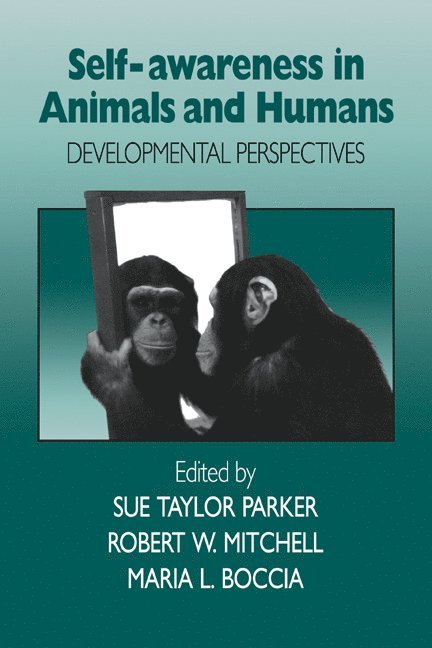
Self-Awareness in Animals and Humans, a collection of original articles on self-awareness in monkeys, apes, humans, and other species, focuses on controversies about how to measure self-awareness, which species are capable of self-awareness and which are not, and why. Several chapters focus on the controversial question of whether gorillas, like other great apes and human infants, are capable of mirror self-recognition (MSR) or whether they are anomalously unable to do so. Other chapters focus on whether macaque monkeys are capable of MSR. The focus of the chapters is both comparative and developmental: several contributors explore the value of frameworks from human developmental psychology for comparative studies. This dual focus - comparative and developmental - reflects the interdisciplinary nature of the volume, which brings together biological anthropologists, comparative and developmental psychologists, and cognitive scientists from Japan, France, Spain, Hungary, New Zealand, Scotland and the United States.
560 kr
Skickas inom 7-10 vardagar
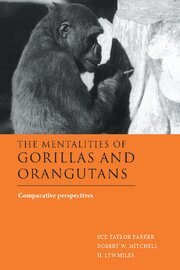
Research on the mental abilities of chimpanzees and bonobos has been widely celebrated and used in reconstructions of human evolution. In contrast, less attention has been paid to the abilities of gorillas and orangutans. This 1999 volume aims to help complete the picture of hominoid cognition by bringing together the work on gorillas and orangutans and setting it in comparative perspective. The introductory chapters set the evolutionary context for comparing cognition in gorillas and orangutans to that of chimpanzees, bonobos and humans. The remaining chapters focus primarily on the kinds and levels of intelligence displayed by orangutans and gorillas compared to other great apes, including performances in the classic domains of tool use and tool making, imitation, self-awareness, social communication and symbol use. All those wanting more information on the mental abilities of these sometimes neglected, but important primates will find this book a treasure trove.
560 kr
Skickas inom 7-10 vardagar
It is well known that children's activities are full of pretending and imagination, but it is less appreciated that animals can also show similar activities. Originally published in 2002, this book focuses on comparing and contrasting children's and animals' pretenses and imaginative activities. In the text, overviews of research present conflicting interpretations of children's understanding of the psychology of pretense, and describe sociocultural factors which influence children's pretenses. Studies of nonhuman primates provide examples of their pretenses and other simulative activities, explore their representational and imaginative capacities and compare their skills with children. Although the psychological requirements for pretending are controversial, evidence presented in this volume suggests that great apes and even monkeys may share capacities for imagination with children, and that children's early pretenses may be less psychological than they appear.
1 653 kr
Skickas inom 7-10 vardagar
Research on the mental abilities of chimpanzees and bonobos has been widely celebrated and used in reconstructions of human evolution. In contrast, less attention has been paid to the abilities of gorillas and orangutans. This 1999 volume aims to help complete the picture of hominoid cognition by bringing together the work on gorillas and orangutans and setting it in comparative perspective. The introductory chapters set the evolutionary context for comparing cognition in gorillas and orangutans to that of chimpanzees, bonobos and humans. The remaining chapters focus primarily on the kinds and levels of intelligence displayed by orangutans and gorillas compared to other great apes, including performances in the classic domains of tool use and tool making, imitation, self-awareness, social communication and symbol use. All those wanting more information on the mental abilities of these sometimes neglected, but important primates will find this book a treasure trove.
1 587 kr
Skickas inom 7-10 vardagar
It is well known that children's activities are full of pretending and imagination, but it is less appreciated that animals can also show similar activities. Originally published in 2002, this book focuses on comparing and contrasting children's and animals' pretenses and imaginative activities. In the text, overviews of research present conflicting interpretations of children's understanding of the psychology of pretense, and describe sociocultural factors which influence children's pretenses. Studies of nonhuman primates provide examples of their pretenses and other simulative activities, explore their representational and imaginative capacities and compare their skills with children. Although the psychological requirements for pretending are controversial, evidence presented in this volume suggests that great apes and even monkeys may share capacities for imagination with children, and that children's early pretenses may be less psychological than they appear.
1 390 kr
Skickas inom 7-10 vardagar
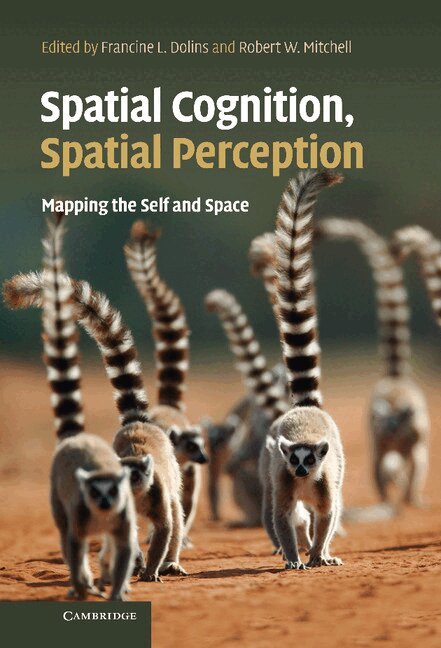
How does knowledge of the body in space relate to an understanding of space itself? Spatial cognition is discussed from two closely related perspectives: the internal mapping of external stimuli (e.g., landmarks and sensory perception of environmental information) and the internal mapping of internally perceived stimuli (e.g., kinesthetic and visual imagery), and their subsequent effects on behaviour. Clarification of what spatial information is present in most perceptual processes and how this is used cognitively in relation to the self in space is then established. Major points and controversies of the various models are discussed, along with evolutionary perspectives of spatial perception and object recognition and comparisons between human and non-human spatial cognitive abilities and behaviours. Written for postgraduate students and researchers, the authors present theoretical and experimental accounts at multiple levels of analysis - perceptual, behavioural and cognitive - providing a thorough review of the mechanisms of spatial cognition.
451 kr
Skickas inom 5-8 vardagar
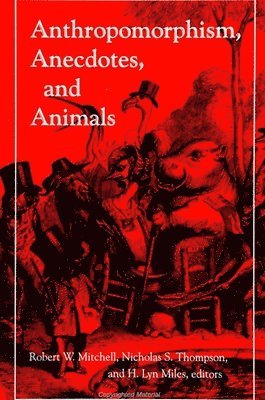
Evaluates the significance and usefulness of anthropomorphism for the scientific understanding of animals by presenting diverse ideas from historians, philosophers, anthropologists, primatologists, psychologists, behaviorists, and ethologists.People commonly think that animals are psychologically like themselves (anthropomorphism), and describe what animals do in narratives (anecdotes) that support these psychological interpretations. This is the first book to evaluate the significance and usefulness of the practices of anthropomorphism and anecdotalism for understanding animals. Diverse perspectives are presented in thoughtful, critical essays by historians, philosophers, anthropologists, psychologists, behaviorists, biologists, primatologists, and ethologists. The nature of anthropomorphism and anecdotal analysis is examined; social, cultural, and historical attitudes toward them are presented; and scientific attitudes are appraised. Authors provide fascinating in-depth descriptions and analyses of diverse species of animals, including octopi, great apes, monkeys, dogs, sea lions, and, of course, human beings. Concerns about, and proposals for, evaluations of a variety of psychological aspects of animals are discussed, including mental state attribution, intentionality, cognition, consciousness, self-consciousness, and language.
1 027 kr
Tillfälligt slut
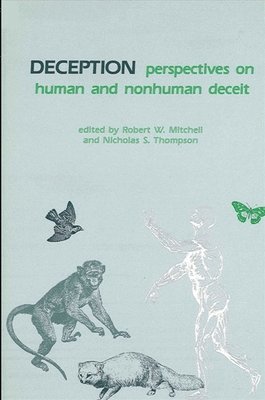
Mitchell and Thompson have compiled the first interdisciplinary study of deception and its manifestations in a variety of animal species. Deception is unique in that it presents detailed explorations of the broadest array of deceptive behavior, ranging from deceptive signaling in fireflies and stomatopods, to false-alarm calling by birds and foxes, to playful manipulating between people and dogs, to deceiving within intimate human relationships. It offers a historical overview of the problem of deception in related fields of animal behavior, philosophical analyses of the meaning and significance of deception in evolutionary and psychological theories, and diverse perspectives on deception-philosophical, ecological, evolutionary, ethological, developmental, psychological, anthropological, and historical.The contributions gathered herein afford scientists the opportunity to discover something about the formal properties of deception, enabling them to explore and evaluate the belief that one set of descriptive and perhaps explanatory structures is suitable for both biological and psychological phenomena.
404 kr
Tillfälligt slut
Mitchell and Thompson have compiled the first interdisciplinary study of deception and its manifestations in a variety of animal species. Deception is unique in that it presents detailed explorations of the broadest array of deceptive behavior, ranging from deceptive signaling in fireflies and stomatopods, to false-alarm calling by birds and foxes, to playful manipulating between people and dogs, to deceiving within intimate human relationships. It offers a historical overview of the problem of deception in related fields of animal behavior, philosophical analyses of the meaning and significance of deception in evolutionary and psychological theories, and diverse perspectives on deception-philosophical, ecological, evolutionary, ethological, developmental, psychological, anthropological, and historical.The contributions gathered herein afford scientists the opportunity to discover something about the formal properties of deception, enabling them to explore and evaluate the belief that one set of descriptive and perhaps explanatory structures is suitable for both biological and psychological phenomena.
850 kr
Skickas inom 7-10 vardagar
How does knowledge of the body in space relate to an understanding of space itself? Spatial cognition is discussed from two closely related perspectives: the internal mapping of external stimuli (e.g., landmarks and sensory perception of environmental information) and the internal mapping of internally perceived stimuli (e.g., kinesthetic and visual imagery), and their subsequent effects on behaviour. Clarification of what spatial information is present in most perceptual processes and how this is used cognitively in relation to the self in space is then established. Major points and controversies of the various models are discussed, along with evolutionary perspectives of spatial perception and object recognition and comparisons between human and non-human spatial cognitive abilities and behaviours. Written for postgraduate students and researchers, the authors present theoretical and experimental accounts at multiple levels of analysis - perceptual, behavioural and cognitive - providing a thorough review of the mechanisms of spatial cognition.