• Fri frakt över 249 kr
  • •
  • Snabba leveranser
  • •
  • Billiga böcker
Kundservice

Du är på sajten för privatpersoner.

Företag, bibliotek eller offentlig verksamhet?

Du handlar på classic.bokus.com, där alla dina funktioner finns intakta.
Till classic.bokus.com
Bokus logotyp. Gå till startsidan.
  • Erbjudanden
  • Nyheter
  • Student
  • Topplistor
  • Barn & ungdom
  • Bokus Play
  • E-böcker
  • Pocketböcker
  • Spel & pussel

10% rabatt på allt med kod NYSTART10 →

Sidfot

Mina sidor

    Hjälp

    • Kundservice
    • Vanliga frågor och svar
    • Frakt och leverans
    • Retur vid ångerrätt
    • Reklamera vara
    • Betalning
    • Köpvillkor
    • Allmänna villkor
    • Information om webbplatsens tillgänglighet

    Om Bokus

    • Om oss
    • Pressrum
    • För studenter
    • För företag
    • För bibliotek och offentlig verksamhet
    • För leverantörer
    • Hållbarhet

    Populärt

    • Aktuella erbjudanden
    • Presentkort
    • Studentlitteratur
    • Nya böcker
    • Topplistor
    • Signerade böcker
    • Engelska böcker

    Inspiration

    • Boktips
    • BookTok
    • Populära bokserier
    • Barnbokskaraktärer
    • Populära författare
    Logotyp för Bokus
    Följ oss på Facebook (extern länk)Följ oss på Instagram (extern länk)Följ oss på YouTube (extern länk)Följ oss på TikTok (extern länk)
    bokus @ CookiesAnpassa cookiesIntegritetspolicyKöpvillkor
    Till Citymail hemsida (extern länk)Till Budbee hemsida (extern länk)Till Postnord hemsida (extern länk)Till Schenker hemsida (extern länk)Till Early Bird hemsida (extern länk)Till Walleys hemsida (extern länk)
    1. Naturvetenskap och teknik
    2. Matematik och naturvetenskap
    3. Biologi
    4. Biovetenskap

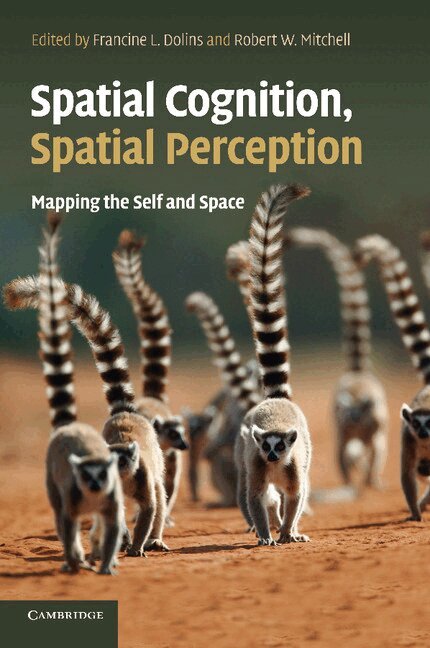
    Spatial Cognition, Spatial Perception

    Mapping the Self and Space

    AvFrancine L. Dolins,Robert W. Mitchell

    Häftad, Engelska, 2014

    906 kr

    Beställningsvara. Skickas inom 10-15 vardagar. Fri frakt över 249 kr.

    Beskrivning

    How does knowledge of the body in space relate to an understanding of space itself? Spatial cognition is discussed from two closely related perspectives: the internal mapping of external stimuli (e.g., landmarks and sensory perception of environmental information) and the internal mapping of internally perceived stimuli (e.g., kinesthetic and visual imagery), and their subsequent effects on behaviour. Clarification of what spatial information is present in most perceptual processes and how this is used cognitively in relation to the self in space is then established. Major points and controversies of the various models are discussed, along with evolutionary perspectives of spatial perception and object recognition and comparisons between human and non-human spatial cognitive abilities and behaviours. Written for postgraduate students and researchers, the authors present theoretical and experimental accounts at multiple levels of analysis - perceptual, behavioural and cognitive - providing a thorough review of the mechanisms of spatial cognition.

    Produktinformation

    • Utgivningsdatum:2014-07-31
    • Mått:154 x 230 x 35 mm
    • Vikt:1 840 g
    • Format:Häftad
    • Språk:Engelska
    • Antal sidor:606
    • Förlag:Cambridge University Press
    • ISBN:9781107646230

    Utforska kategorier

    • Biovetenskap inom Naturvetenskap och teknik
    • Kognitiv psykologi inom Psykologi och pedagogik

    Mer om författaren

    Francine L. Dolins is a Comparative Psychologist focusing on the spatial cognitive abilities of non-human and human primates in the field and laboratory, examining use of landmarks in large- and small-scale space and in simple and complex environments. Francine Dolins has related interests and publications in animal welfare, captive environmental enrichment, and conservation education, including an edited volume on societal attitudes to animals, and is currently guest editing a special issue of The American Journal of Primatology on conservation education. Her education was at the University's of Sussex and Stirling in the United Kingdom, and is currently employed at the University of Michigan. Robert W. Mitchell has engaged in laboratory studies of cognition in primates, cetaceans, and canids, including human interactions with these animals, and is currently studying play and other social behavior in Galápagos sea lions. His graduate education was at the University of Hawai'i and Clark University, and he is currently Foundation Professor of Psychology at Eastern Kentucky University. He has edited books on various forms of animal and human cognition, including deception, pretense, self-awareness and anthropomorphism, and is on the boards of editors of the Journal of Comparative Psychology and Society and Animals.

    Recensioner i media

    "A strength of this work, though, is its interdisciplinary focus. It approaches the topics from multiple theoretical orientations and methodologies. These include philosophy, history, evolution, anthropology, comparative psychology, cognitive psychology, and neuroscience. Investigators from each of these fields will find something of interest here. Spatial Cognition, Spatial Perception is worth getting and is a must read for any researcher in either of these areas. Due to its breadth of coverage, it serves more as a reference guide than as a single-themed or specialty area book, but any topic can be looked up in the index and compared across chapters if necessary." Jay Friedenberg, PsycCRITIQUES

    Innehållsförteckning

    • Introduction 1. Linking spatial cognition and spatial perception F. L. Dolins and R. W. Mitchell; Part I. What Do Animals Know and How Do They Represent External Space?: 2. Psychology and the philosophy of spatial perception: a history, or how the idea of spatial cognition in animals developed R. W. Mitchell and F. L. Dolins; 3. Common principles shared by spatial and other kinds of cognition K. Cheng; 4. To be buried in thought, lost in space or lost in action: is that the question? E. Menzel; Part II. Perception and Memory of Landmarks: Implications for Spatial Behaviour and Cognition: 5. The encoding of geometry in various vertebrate species C. Thinus-Blanc, V. Chabanne, L. Tommasi, P. Peruch and J. Vauclair; 6. The visually guided routes of ants T. Collett and P. Graham; 7. The role of landmarks in small and large scale navigation S. D. Healy and V. A. Braithwaite; 8. Examining spatial cognitive strategies in small-scale and large-scale space in tamarin monkeys P. A. Garber and F. L. Dolins; 9. Spatial learning and foraging in macaques C. Menzel; Part III. Evolutionary Perspectives of Cognitive Capacities in Spatial Perception and Object Recognition: 10. The evolution of human spatial cognition T. Wynn; 11. Egocentric and allocentric spatial learning in the nonhuman primate L. Rehbein, S. Schettler, R. Killiany and M. Moss; 12. Does the nature of cetacean perception make understanding object permanence unnecessary? R. W. Mitchell and E. Hoban; 13. Multimodal sensory integration and concurrent navigation strategies for spatial cognition in real and artificial organisms A. Arleo and L. Ronde-Reig; Part IV. Does Mapping of the Body Generate Understanding of External Space?: 14. Movement: the generative source of spatial perception and cognition M. Sheets-Johnstone; 15. Understanding the body: spatial perception and spatial cognition R. W. Mitchell; 16. The evolution of parietal areas involved in hand use in primates L. Krubitzer and E. Disbrow; 17. Body mapping and spatial transformations S. H. Creem-Regehr; 18. Understanding of external space generated by bodily re-mapping: an insight from the neurophysiology of tool-using monkeys A. Iriki; 19. Left-right spatial discrimination and the evolution of hemispheric specialization: some new thoughts on some old ideas W. D. Hopkins and C. Cantalupo; Part V. Comparisons of Human and Non-Human Primate Spatial Cognitive Abilities: 20. The geographical imagination R. Sambrook and D. Zurick; 21. Of chimps and children: use of spatial symbols by two species J. DeLoache and M. Bloom; 22. Chimpanzee spatial skills: a model for human performance on scale model tasks? S. Till Boysen and K. A. Bard; 23. The development of place learning in comparative perspective A. Learmonth and N. Newcombe; 24. Spatial cognition and memory in symbol-competent chimpanzees C. Menzel.