• Fri frakt över 249 kr
  • •
  • Snabba leveranser
  • •
  • Billiga böcker
Kundservice

Du är på sajten för privatpersoner.

Företag, bibliotek eller offentlig verksamhet?

Du handlar på classic.bokus.com, där alla dina funktioner finns intakta.
Till classic.bokus.com
Bokus logotyp. Gå till startsidan.
  • Erbjudanden
  • Student
  • Topplistor
  • Barn & ungdom
  • Bokus Play
  • E-böcker
  • Ljudböcker
  • Pocketböcker
  • Spel och pussel

Pocketfynda! Hundratals böcker för 49 kr/st →

Sidfot

Mina sidor

    Hjälp

    • Kundservice
    • Vanliga frågor och svar
    • Frakt och leverans
    • Retur vid ångerrätt
    • Reklamera vara
    • Betalning
    • Köpvillkor
    • Allmänna villkor
    • Information om webbplatsens tillgänglighet

    Om Bokus

    • Om oss
    • Pressrum
    • För studenter
    • För företag
    • För bibliotek och offentlig verksamhet
    • För leverantörer
    • Hållbarhet

    Populärt

    • Aktuella erbjudanden
    • Presentkort
    • Studentlitteratur
    • Nya böcker
    • Topplistor
    • Signerade böcker
    • Engelska böcker

    Inspiration

    • Boktips
    • BookTok
    • Barnbokskaraktärer
    • Populära författare
    Logotyp för Bokus
    Följ oss på Facebook (extern länk)Följ oss på Instagram (extern länk)Följ oss på YouTube (extern länk)Följ oss på TikTok (extern länk)
    bokus @ CookiesAnpassa cookiesIntegritetspolicyKöpvillkor
    Till Citymail hemsida (extern länk)Till Budbee hemsida (extern länk)Till Postnord hemsida (extern länk)Till Schenker hemsida (extern länk)Till Early Bird hemsida (extern länk)Till Walleys hemsida (extern länk)
    1. Skönlitteratur
    2. Litteraturvetenskap
    3. Litteraturvetenskap

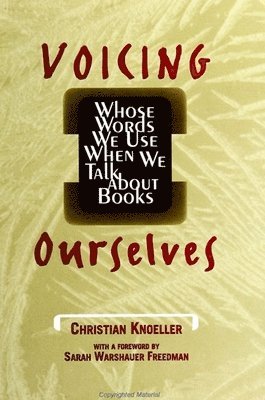
    Voicing Ourselves

    Whose Words We Use When We Talk about Books

    AvChristian Knoeller

    Häftad, Engelska, 1998

    Del i serien SUNY series, Literacy, Culture, and Learning: Theory and Practice

    447 kr

    Tillfälligt slut

    Beskrivning

    Using Bakhtinian theory, this study reveals how and why readers routinely refer to the words and ideas of others to interpret the meanings and implications of the books they read.In a public high school classroom in the San Francisco Bay area, a group of twelfth graders have decided themselves to enroll for Advanced-Placement English. Faced with unprecedented diversity for such a class in terms of academic and ethnic backgrounds, veteran teacher Joan Cone dared to trust her students to lead their own discussions of a variety of provocative authors including Baldwin, Didion, Malcolm X, and Woolf. Voicing Ourselves examines a year's worth of such sessions, revealing how a teacher's role is transformed, and, moreover, offering an important component in any teacher's repertoire of instructional strategies: student-led discussion. Above all, the book shows the startling success of students licensed to engage one another directly in talk about books, revealing the richly social tapestry of such conversations.

    Produktinformation

    • Utgivningsdatum:1998-03-19
    • Mått:150 x 226 x 16 mm
    • Vikt:386 g
    • Format:Häftad
    • Språk:Engelska
    • Serie:SUNY series, Literacy, Culture, and Learning: Theory and Practice
    • Antal sidor:274
    • Förlag:State University of New York Press
    • ISBN:9780791436585

    Utforska kategorier

    • Litteraturvetenskap inom Skönlitteratur
    • Pedagogik inom Psykologi och pedagogik

    Mer om författaren

    Christian Knoeller is Assistant Professor of English at the University of Wisconsin, Eau Claire. He has written two books, Office Communication, a textbook, and Song in Brown Bear Country, a book of poems.

    Recensioner i media

    "In Voicing Ourselves, Knoeller offers a concrete way to analyze how voices and voicing enter the writing and talk of students as they learn. He situates Bakhtin's theories alongside notions of voice put forth by composition theorists who have been writing about voice for the past several decades. In the end, Knoeller sorts through what is individual about voice—the voice that is part of our unique sense of self and our individual identity—and what is social—the voices that come from others and influence and shape who we are. Although Knoeller focuses on the interpretation of literature, the methods he develops for analyzing the influence of other voices on the individual learner could be applied to any kind of learning." — Sarah Warshauer Freedman, University of California, Berkeley, from the Foreword"I like the author's voice I hear—the presence I feel—as I read. The 'speaking personality' here cares very much about this work, about these students, about this teacher, about this classroom. He is genuinely interested in the interactions that occur in this community and how Bakhtin's notions of voice illuminate these. He's excited, engaged, and I am too."This study makes a major contribution to two areas of current interest in language education: (1) the social nature of text construction (oral and written), and (2) the potential of Bakhtin's insights for a reconsideration of classroom language events (the possibility of looking at classroom language events through a new and promising lens). The study is both insightful/creative and rigorous/disciplined. Insightfulness is the hallmark of this work." — Judith Lindfors, University of Texas at Austin.

    Innehållsförteckning

    • Foreword Sarah Warshauer FreedmanAcknowledgments 1. Why Voice Matters When Talking About Books Voice in WritingBakhtin's Theories of VoicingResponding to LiteratureRelationships Between Oral and Written Language2. How This Study Was Conducted Setting and ParticipantsData Collection ProceduresClassroom Discourse Data Analysis3. The Place of Voicing During Student-led Discussions Varieties of Voicing: Whose Words Are Represented?The Frequency of VoicingWhose Words Are Voiced: The Influence of Texts and TeachersWhy Patterns of Voicing Differ Across DiscussionsStudent Voices: Negotiating Interpretations4. The Art of Retelling: Voicing Authors The Textual CategoryAn Overview of Textual Voicing Across WorksVoicing AuthorsStudent Voices: Negotiating Interpretations5. The World of the Work: Voicing Characters and Groups Voicing CharactersVoicing Societal GroupsStudent Voices: Negotiating Interpretations6. Dialectic and Dialogue: Voicing Self and Other The Interactional CategoryAn Overview of Interactional Voicing Across WorksVoicing Other StudentsVoicing SelfPropositionsStudent Voices: Negotiating Interpretations7. The Work in the World: Contextual Voicing The Contextual CategoryThe Range of Contextual VoicesContextual Voicing in ContextStudent Voices: Negotiating Interpretations8. What Voicing Reveals About Teaching Orchestrating Student-led DiscussionsImplications of this StudyHow Voicing Shapes Classroom Talk and LearningAppendix A. Transcription Conventions Appendix B. Focal Student Selection Appendix C. The Great Divide Revisited: A Postscript for Linguists Works Cited Author Index Subject Index