• Fri frakt över 249 kr
  • •
  • Snabba leveranser
  • •
  • Billiga böcker
Kundservice

Du är på sajten för privatpersoner.

Företag, bibliotek eller offentlig verksamhet?

Du handlar på classic.bokus.com, där alla dina funktioner finns intakta.
Till classic.bokus.com
Bokus logotyp. Gå till startsidan.
  • Erbjudanden
  • Student
  • Topplistor
  • Barn & ungdom
  • Bokus Play
  • E-böcker
  • Ljudböcker
  • Pocketböcker
  • Spel & pussel

Upp till 25% på utvalda nyheter →

Sidfot

Mina sidor

    Hjälp

    • Kundservice
    • Vanliga frågor och svar
    • Frakt och leverans
    • Retur vid ångerrätt
    • Reklamera vara
    • Betalning
    • Köpvillkor
    • Allmänna villkor
    • Information om webbplatsens tillgänglighet

    Om Bokus

    • Om oss
    • Pressrum
    • För studenter
    • För företag
    • För bibliotek och offentlig verksamhet
    • För leverantörer
    • Hållbarhet

    Populärt

    • Aktuella erbjudanden
    • Presentkort
    • Studentlitteratur
    • Nya böcker
    • Topplistor
    • Signerade böcker
    • Engelska böcker

    Inspiration

    • Boktips
    • BookTok
    • Populära bokserier
    • Barnbokskaraktärer
    • Populära författare
    Logotyp för Bokus
    Följ oss på Facebook (extern länk)Följ oss på Instagram (extern länk)Följ oss på YouTube (extern länk)Följ oss på TikTok (extern länk)
    bokus @ CookiesAnpassa cookiesIntegritetspolicyKöpvillkor
    Till Citymail hemsida (extern länk)Till Budbee hemsida (extern länk)Till Postnord hemsida (extern länk)Till Schenker hemsida (extern länk)Till Early Bird hemsida (extern länk)Till Walleys hemsida (extern länk)
    1. Samhälle och politik
    2. Samhälle och kultur
    3. Sociala grupper och identitet
    4. Genusvetenskap

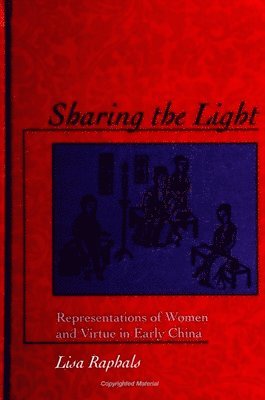
    Sharing the Light

    Representations of Women and Virtue in Early China

    AvLisa Raphals

    Häftad, Engelska, 1998

    Del i serien SUNY series in Chinese Philosophy and Culture

    410 kr

    Tillfälligt slut

    Fler format och utgåvor

    Inbunden

    Tillf. slut

    Beskrivning

    Explores historical and philosophical shifts in the depiction of women and virtue in the early years of the Chinese state. Includes an examination of the history of yin-yang theories.Sharing the Light explores historical and philosophical shifts in the depiction of women and virtue in the early centuries of the Chinese state. These changes had far-reaching effects on both the treatment of women in Chinese society and on the formation of Chinese philosophical discourse on ethics, cosmology, epistemology, and self-cultivation. Warring States and Han dynasty narratives frequently represented women as intellectually adroit, politically astute, and ethically virtuous; these histories, discourses, and life stories portray women as active participants within their own society, not inert victims of it. The women depicted resembled sages, ministers, and generals as the mainstays and destroyers of dynasties. These stories emphasized that sagacity, intellect, strategy, and statecraft were virtues proper to women, an emphasis that effectively disappeared from later collections and instruction texts by and for women. During the same period, there were also important changes in the understanding of two polarities that delineated what now is called gender. Han correlative cosmology included a range of hierarchical analogies between yin and yang and men and women, and the understanding of yin and yang shifted from complementarity toward hierarchy. Similarly, the doctrine of separate spheres (inner and outer, nei-wai) shifted from a notion of appropriate distinction between men and women toward physical, social, and intellectual separation and isolation.

    Produktinformation

    • Utgivningsdatum:1998-08-06
    • Mått:151 x 227 x 21 mm
    • Vikt:522 g
    • Format:Häftad
    • Språk:Engelska
    • Serie:SUNY series in Chinese Philosophy and Culture
    • Antal sidor:348
    • Förlag:State University of New York Press
    • ISBN:9780791438565

    Utforska kategorier

    • Genusvetenskap inom Samhälle och politik

    Mer om författaren

    Lisa Raphals is Assistant Professor of Asian Studies and Chair, Asian Studies Program, Bard College. She is the author of Knowing Words: Wisdom and Cunning in the Classical Traditions of China and Greece.

    Recensioner i media

    "This book challenges several widely held paradigms concerning women in traditional China that are in dire need of the kind of nuanced and sustained reassessment present throughout the work. It is a fine piece of scholarship." — Sarah A. Queen, Connecticut College

    Innehållsförteckning

    • List of Illustrations List of Tables Acknowledgments Note on Transcription Abbreviations Introduction: Gender and Virtue Women As Intellectual and Moral AgentsThe Differentiation of Men and WomenContents1. Women As Agents of Virtue and Destruction Women and Ministers: Ties That BindFemale Virtue and the Dynastic CycleThe Lienü zhuanThe Intellectual Virtue StoriesHeroization2. Women As Prescient Counselors InstructionSage IntelligenceBenevolent Wisdom and PrescienceSkill in Argument and AdmonitionIntellectual Virtue Stories in Other Warring States and Han WorksBiographical FormulaeTwo Modes of Thinking?Conclusions3. Demonic Beauties and Usurpatious Regents Warring States Legends of Destructive WomenEmpress LüVirtuous and Vicious Consorts of Han Cheng DiConclusions4. The Textual Matrix of the Lienü zhuan Lienü zhuan Stories in Warring States SourcesThe Lienü zhuan Text and Its Attribution to Liu XiangConclusions5. Talents Transformed in Ming Editions Ming PublishingShifting VirtuesIllustrated EditionsConclusions6. Yin and Yang Yin-Yang As Two of Six QiYin-Yang As (Ultimate) PolarityCorrelative CosmologyConclusions7. Yin-Yang in Medical Texts The Fifty-two Ailments and Mawangdui Medical LiteratureThe Twenty-five Cases of Chunyu YiThe Huang Di neijingConclusions8. Nei-wai : Distinctions between Men and Women Zhou Norms in the Changes and OdesCorrect Distinction between Men and Women Defines CivilizationConclusions9. Nei-wai in Ritual Texts and Social Practice Subordination of WomenMonogamy and Marriage ChoicePhysical Separation of Men and WomenNames, Ranks, Titles, and Social IdentityIntellectual Distinction between Men and WomenConclusions10. Instruction Texts Ban Zhao's Admonitions for WomenThe Decline of the "Learned Instructress" MotifThe Rise of Instruction TextsConclusionsAfterword Appendix 1: The Lienü zhuan Chapter TitlesDateable Incidents in the Life StoriesAppendix 2: The Intellectual Virtue Stories Synopsis of the Intellectual Virtue StoriesThe Learned Instructress MotifAppendix 3: Vicious and Depraved Women The Destructive Women of Lienü zhuan 7Biographies of Empress LüBiographical Formulae in the Lienü zhuan, Shi ji, and Han shuAppendix 4: The Textual Matrix for the Lienü zhuan Chronology of Lienü zhuan EditionsProvenance of the Lienü zhuan Intellectual Virtue StoriesAppendix 5: Ming Transformations The Intellectual Virtue Stories in Ming EditionsThe Gui fan Reclassification of the Lienü zhuan Intellectual Virtue StoriesAppendix 6: Yin-Yang in Warring States Texts Appendix 7: The Medical Cases of Shi ji 105 Summary of the Twenty-five CasesTreatment Methods and Outcomes of the Twenty-five CasesAppendix 8: Occupations and Activities Appendix 9: Traditional Reign Dates Bibliography Primary Sources and CollectaneaSecondary SourcesIndex