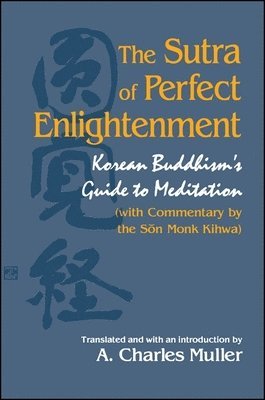
Inbunden, Engelska, 1999
Sūtra of Perfect Enlightenment
Korean Buddhism's Guide to Meditation (with Commentary by the Sǒn Monk Kihwa)
Del i serien SUNY series in Korean Studies
1087 kr
Tillfälligt slut
Beskrivning
Produktinformation
- Utgivningsdatum: 1999-02-25
- Mått: 152 x 229 x 23 mm
- Vikt: 612 g
- Format: Inbunden
- Språk: Engelska
- Serie: SUNY series in Korean Studies
- Antal sidor: 250
- Förlag: State University of New York Press
- ISBN: 9780791441015
- Översättare: A. Charles Muller
Utforska kategorier
Mer om författaren
A. Charles Muller is Professor of East Asian Philosophy and Religion at Toyo Gakuen University, Japan.
Recensioner i media
"One of the most attractive aspects of this work is simply that it is a well-done translation of an important text. Considering that the Sutra of Perfect Enlightenment is also of great importance in China and Korea, it is particularly welcome that Muller, one of a handful of recognized scholars of Korean Buddhism, has chosen to translate it. The Introduction provides an excellent overview of major issues in East Asian Buddhist thought, and Muller's ability to contextualize these issues in terms of both indigenous Chinese intellectual traditions as well as their Korean trajectories provides a healthy and rare alternative to the more typically narrow treatments of particular texts." — Jamie Hubbard, Smith College"What I like most about this book is its intercultural approach to the study of a Buddhist internal problem, and its lucid and accessible prose style. This book adds one nail to the coffin of interpretations of Zen that continue to portray it as an anti-intellectual, doctrineless protest against clear and rational thinking and analysis. It is a superb example of historical reconstruction in the fields of Buddhist studies and Korean religious studies, worthy of emulation." — John Goulde, Sweet Briar College
Betyg & recensioner
0 recensioner
Inga recensioner tillgängliga.