• Fri frakt över 249 kr
  • •
  • Snabba leveranser
  • •
  • Billiga böcker
Kundservice

Du är på sajten för privatpersoner.

Företag, bibliotek eller offentlig verksamhet?

Du handlar på classic.bokus.com, där alla dina funktioner finns intakta.
Till classic.bokus.com
Bokus logotyp. Gå till startsidan.
  • Erbjudanden
  • Nyheter
  • Student
  • Topplistor
  • Barn & ungdom
  • Bokus Play
  • E-böcker
  • Pocketböcker
  • Spel & pussel

10% rabatt på allt med kod: NYSTART10 →

Sidfot

Mina sidor

    Hjälp

    • Kundservice
    • Vanliga frågor och svar
    • Frakt och leverans
    • Retur vid ångerrätt
    • Reklamera vara
    • Betalning
    • Köpvillkor
    • Allmänna villkor
    • Information om webbplatsens tillgänglighet

    Om Bokus

    • Om oss
    • Pressrum
    • För studenter
    • För företag
    • För bibliotek och offentlig verksamhet
    • För leverantörer
    • Hållbarhet

    Populärt

    • Aktuella erbjudanden
    • Presentkort
    • Studentlitteratur
    • Nya böcker
    • Topplistor
    • Signerade böcker
    • Engelska böcker

    Inspiration

    • Boktips
    • BookTok
    • Populära bokserier
    • Barnbokskaraktärer
    • Populära författare
    Logotyp för Bokus
    Följ oss på Facebook (extern länk)Följ oss på Instagram (extern länk)Följ oss på YouTube (extern länk)Följ oss på TikTok (extern länk)
    bokus @ CookiesAnpassa cookiesIntegritetspolicyKöpvillkor
    Till Citymail hemsida (extern länk)Till Budbee hemsida (extern länk)Till Postnord hemsida (extern länk)Till Schenker hemsida (extern länk)Till Early Bird hemsida (extern länk)Till Walleys hemsida (extern länk)
    1. Filosofi och religion
    2. Filosofi
    3. Filosofiska discipliner

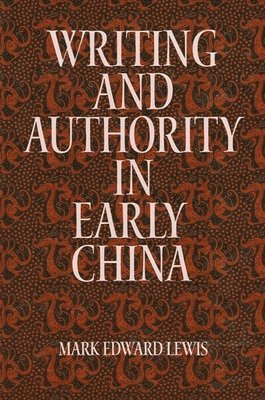
    Writing and Authority in Early China

    AvMark Edward Lewis

    Häftad, Engelska, 1999

    Del i serien SUNY series in Chinese Philosophy and Culture

    512 kr

    Beställningsvara. Skickas inom 5-8 vardagar. Fri frakt över 249 kr.

    Fler format och utgåvor

    Inbunden

    1 246 kr

    Beskrivning

    Traces the evolving uses of writing to command assent and authority in early China, an evolution that culminated in the establishment of a textual canon as the basis of imperial authority.This book traces the evolving uses of writing to command assent and obedience in early China, an evolution that culminated in the establishment of a textual canon as the foundation of imperial authority. Its central theme is the emergence of this body of writings as the textual double of the state, and of the text-based sage as the double of the ruler. The book examines the full range of writings employed in early China, such as divinatory records, written communications with ancestors, government documents, the collective writings of philosophical and textual traditions, speeches attributed to historical figures, chronicles, verse anthologies, commentaries, and encyclopedic compendia. Lewis shows how these writings served to administer populations, control officials, form new social groups, invent new models of authority, and create an artificial language whose mastery generated power and whose graphs became potent objects. Writing and Authority in Early China traces the enterprise of creating a parallel reality within texts that depicted the entire world. These texts provided models for the invention of a world empire, and one version ultimately became the first state canon of imperial China. This canon served to perpetuate the dream and the reality of the imperial system across the centuries.

    Produktinformation

    • Utgivningsdatum:1999-04-23
    • Mått:152 x 229 x 35 mm
    • Vikt:744 g
    • Format:Häftad
    • Språk:Engelska
    • Serie:SUNY series in Chinese Philosophy and Culture
    • Antal sidor:552
    • Förlag:State University of New York Press
    • ISBN:9780791441145

    Utforska kategorier

    • Filosofiska discipliner inom Filosofi och religion

    Mer om författaren

    Mark Edward Lewis is University Lecturer in Chinese Studies at the University of Cambridge. He is the author of Sanctioned Violence in Early China, also published by SUNY Press.

    Recensioner i media

    "This book is a masterful study of the ideology and uses of writing in early China. The scholarship is impeccable—indeed, stunning—the interpretation of an array of difficult texts is brilliant, and the conclusions are of central importance to all subsequent studies of this period. This book, in my opinion, is the single most valuable study in the field of early China scholarship since Angus Graham's Disputers of the Tao. It is certain to be read, cited, and disputed for many decades." — Stephen W. Durrant, author of the The Cloudy Mirror"Writing and Authority in Early China is a comprehensive presentation about the structure of society and authority in pre-imperial and early imperial China from a very important and heretofore unexplored perspective. I would not be surprised to see this book rise to a level of lasting importance that few modern works of scholarship, even good ones, can hope for." — William G. Boltz, University of Washington

    Innehållsförteckning

    • Acknowledgments INTRODUCTION Powers of WritingWriting and the Formation of the Chinese Empire 1. WRITING THE STATE The Archaic BackgroundLaws and RegistersReports, Tallies, and SealsWriting and the KingThe Offices of ZhouConclusion 2. WRITING THE MASTERS Scholarly TextsScholarly Traditions and the StateSocial and Economic Bases of the TraditionsThe Master as ModelConclusion 3. WRITING THE PAST The Past in SpeechesThe Past in Political PhilosophyThe Past in CosmogonyThe Past in ChronicleConclusion 4. WRITING THE SELF Composing the OdesSpeaking through the OdesThe Odes as Proof and SanctionAnthology and AuthorshipConclusion 5. THE POLITICAL HISTORY OF WRITING The Mythology of Fu XiThe Mythology of the Duke of ZhouThe Mythology of ConfuciusConclusion 6. THE NATURAL PHILOSOPHY OF WRITING Between Divination and PhilosophyThe Natural Philosophy of SignsImages and WritingNumbers and WritingConclusion 7. THE ENCYCLOPEDIC EPOCH Totality and TruthCanon and CommentaryState-Sponsored CompendiaSima Qian and Universal HistorySima Xiangru and Universal PoetryThe Liu Family and the Universal LibraryConclusion 8. THE EMPIRE OF WRITING Establishment of the CanonTriumph of the CanonConclusion Conclusion Notes Works Cited Index