• Fri frakt över 249 kr
  • •
  • Snabba leveranser
  • •
  • Billiga böcker
Kundservice

Du är på sajten för privatpersoner.

Företag, bibliotek eller offentlig verksamhet?

Du handlar på classic.bokus.com, där alla dina funktioner finns intakta.
Till classic.bokus.com
Bokus logotyp. Gå till startsidan.
  • Erbjudanden
  • Nyheter
  • Student
  • Topplistor
  • Barn & ungdom
  • Bokus Play
  • E-böcker
  • Pocketböcker
  • Spel & pussel

10% rabatt på allt med kod NYSTART10 →

Sidfot

Mina sidor

    Hjälp

    • Kundservice
    • Vanliga frågor och svar
    • Frakt och leverans
    • Retur vid ångerrätt
    • Reklamera vara
    • Betalning
    • Köpvillkor
    • Allmänna villkor
    • Information om webbplatsens tillgänglighet

    Om Bokus

    • Om oss
    • Pressrum
    • För studenter
    • För företag
    • För bibliotek och offentlig verksamhet
    • För leverantörer
    • Hållbarhet

    Populärt

    • Aktuella erbjudanden
    • Presentkort
    • Studentlitteratur
    • Nya böcker
    • Topplistor
    • Signerade böcker
    • Engelska böcker

    Inspiration

    • Boktips
    • BookTok
    • Populära bokserier
    • Barnbokskaraktärer
    • Populära författare
    Logotyp för Bokus
    Följ oss på Facebook (extern länk)Följ oss på Instagram (extern länk)Följ oss på YouTube (extern länk)Följ oss på TikTok (extern länk)
    bokus @ CookiesAnpassa cookiesIntegritetspolicyKöpvillkor
    Till Citymail hemsida (extern länk)Till Budbee hemsida (extern länk)Till Postnord hemsida (extern länk)Till Schenker hemsida (extern länk)Till Early Bird hemsida (extern länk)Till Walleys hemsida (extern länk)
    1. Samhälle och politik
    2. Samhälle och kultur
    3. Kultur och medier
    4. Kulturvetenskap

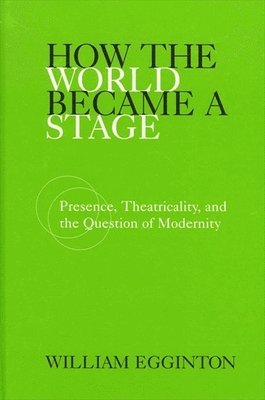
    How the World Became a Stage

    Presence, Theatricality, and the Question of Modernity

    AvWilliam Egginton

    Häftad, Engelska, 2002

    449 kr

    Beställningsvara. Skickas inom 5-8 vardagar. Fri frakt över 249 kr.

    Fler format och utgåvor

    Inbunden

    Tillf. slut

    Beskrivning

    Argues that the experience of modernity is fundamentally spatial rather than subjective.What is special, distinct, modern about modernity? In How the World Became a Stage, William Egginton argues that the experience of modernity is fundamentally spatial rather than subjective and proposes replacing the vocabulary of subjectivity with the concepts of presence and theatricality. Following a Heideggerian injunctive to search for the roots of epochal change not in philosophies so much as in basic skills and practices, he describes the spatiality of modernity on the basis of a close historical analysis of the practices of spectacle from the late Middle Ages to the early modern period, paying particular attention to stage practices in France and Spain. He recounts how the space in which the world is disclosed changed from the full, magically charged space of presence to the empty, fungible, and theatrical space of the stage.

    Produktinformation

    • Utgivningsdatum:2002-10-10
    • Mått:152 x 229 x 12 mm
    • Vikt:299 g
    • Format:Häftad
    • Språk:Engelska
    • Antal sidor:216
    • Förlag:State University of New York Press
    • ISBN:9780791455463

    Utforska kategorier

    • Kulturvetenskap inom Samhälle och politik

    Mer om författaren

    William Egginton is Assistant Professor of Modern Languages and Literatures at the University at Buffalo, State University of New York and the translator of Lisa Block de Behar's Borges: The Passion of an Endless Quotation, also published by SUNY Press.

    Recensioner i media

    "…Egginton's account of theatricality provides one useful place to begin a needed reassessment of modernity that will free us from the grip of the 'subject' as the sole way to understand and criticize modern institutions." — Theatre Research International"The author brings philosophical scholarship of a very high order to bear on concrete questions in the history of drama. Such a leap has to be made with clarity and rigor if it is going to be persuasive, and Egginton brings it off elegantly. He addresses the perennial issue of whether philosophical thinking can have a productive relationship to real issues—and answers it with a resounding yes. A highly original, fascinating book." — John McCumber, Northwestern University"I like the book's challenging breadth of theoretical investigation. It offers a way of thinking about the transition from medieval to early modern that is at once familiar and quite new. The implications are important for thinking about theater, about presence, about signs." — David Bevington, University of Chicago"The strength of Egginton's book lies in its originality. I am not familiar with any other work in this area that shows this combination of original insight and theoretical strength. It will be a reference for scholars in Romance studies in general." — Joan Ramon Resina, Cornell University

    Innehållsförteckning

    • Acknowledgments Introduction: The Legend of Saint Genesius 1. Actors, Agents, and Avatars AvatarsPerformativityTheatricality 2. Real Presence, Sympathetic Magic, and the Power of Gesture MagicPresencePerformancesReligious SpectaclePolitical SpectacleSeeds of Theatricality 3. Saint Genesius on the Stage of the World Diderot's ParadoxMetatheaterActors and Martyrs 4. A Tale of Two Cities: The Evolution of Renaissance Stage Practices in Madrid and Paris Italian InnovationsTheories and Theaters in ParisTheories and Theaters in MadriTales from the CryptTrue Pretense: Lope's Lo fingido verdadero and the Structure of Theatrical Space 5. Theatricality versus Subjectivi ty Philosophical SubjectivityPolitical SubjectivityAesthetic SubjectivitTheatricality and Media Theory Epilogue Notes Index