• Fri frakt över 249 kr
  • •
  • Snabba leveranser
  • •
  • Billiga böcker
Kundservice

Du är på sajten för privatpersoner.

Företag, bibliotek eller offentlig verksamhet?

Du handlar på classic.bokus.com, där alla dina funktioner finns intakta.
Till classic.bokus.com
Bokus logotyp. Gå till startsidan.
  • Erbjudanden
  • Nyheter
  • Student
  • Topplistor
  • Barn & ungdom
  • Bokus Play
  • E-böcker
  • Pocketböcker
  • Spel & pussel

10% rabatt på allt med kod: NYSTART10 →

Sidfot

Mina sidor

    Hjälp

    • Kundservice
    • Vanliga frågor och svar
    • Frakt och leverans
    • Retur vid ångerrätt
    • Reklamera vara
    • Betalning
    • Köpvillkor
    • Allmänna villkor
    • Information om webbplatsens tillgänglighet

    Om Bokus

    • Om oss
    • Pressrum
    • För studenter
    • För företag
    • För bibliotek och offentlig verksamhet
    • För leverantörer
    • Hållbarhet

    Populärt

    • Aktuella erbjudanden
    • Presentkort
    • Studentlitteratur
    • Nya böcker
    • Topplistor
    • Signerade böcker
    • Engelska böcker

    Inspiration

    • Boktips
    • BookTok
    • Populära bokserier
    • Barnbokskaraktärer
    • Populära författare
    Logotyp för Bokus
    Följ oss på Facebook (extern länk)Följ oss på Instagram (extern länk)Följ oss på YouTube (extern länk)Följ oss på TikTok (extern länk)
    bokus @ CookiesAnpassa cookiesIntegritetspolicyKöpvillkor
    Till Citymail hemsida (extern länk)Till Budbee hemsida (extern länk)Till Postnord hemsida (extern länk)Till Schenker hemsida (extern länk)Till Early Bird hemsida (extern länk)Till Walleys hemsida (extern länk)
    1. Historia och arkeologi
    2. Historia
    3. Asiens historia

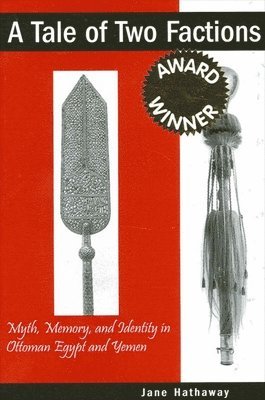
    Tale of Two Factions

    Myth, Memory, and Identity in Ottoman Egypt and Yemen

    AvJane Hathaway

    Inbunden, Engelska, 2003

    Del i serien SUNY series in the Social and Economic History of the Middle East

    1 108 kr

    Tillfälligt slut

    Fler format och utgåvor

    Häftad

    Tillf. slut

    Beskrivning

    Reevaluates the foundation myths of two rival factions in Egypt during the Ottoman era.Winner of the 2003 Ohio Academy of History Outstanding Publication Award This revisionist study reevaluates the origins and foundation myths of the Faqaris and Qasimis, two rival factions that divided Egyptian society during the seventeenth and eighteenth centuries, when Egypt was the largest province in the Ottoman Empire. In answer to the enduring mystery surrounding the factions' origins, Jane Hathaway places their emergence within the generalized crisis that the Ottoman Empire-like much of the rest of the world-suffered during the early modern period, while uncovering a symbiosis between Ottoman Egypt and Yemen that was critical to their formation. In addition, she scrutinizes the factions' foundation myths, deconstructing their tropes and symbols to reveal their connections to much older popular narratives. Drawing on parallels from a wide array of cultures, she demonstrates with striking originality how rituals such as storytelling and public processions, as well as identifying colors and emblems, could serve to reinforce factional identity.

    Produktinformation

    • Utgivningsdatum:2003-10-09
    • Mått:153 x 229 x 17 mm
    • Vikt:526 g
    • Format:Inbunden
    • Språk:Engelska
    • Serie:SUNY series in the Social and Economic History of the Middle East
    • Antal sidor:311
    • Förlag:State University of New York Press
    • ISBN:9780791458839

    Utforska kategorier

    • Asiens historia inom Historia och arkeologi
    • Allmän historia och världshistoria inom Historia och arkeologi

    Mer om författaren

    Jane Hathaway is Associate Professor of History at Ohio State University, the author of The Politics of Households in Ottoman Egypt: The Rise of the Qazdaglis, and editor of Rebellion, Repression, Reinvention: Mutiny in Comparative Perspective.

    Recensioner i media

    "…with skill, tact, and intellectual rigor [Hathaway] show[s] how Egypt functioned as an integral part of the Ottoman Empire in which multiple cultural and political forces … combined and intertwined to produce a specific kind of multilayered Ottoman social, cultural, and political milieu … It adds much to our understanding of one of the most significant social phenomena of Ottoman Egypt—the Faqari-Qasimi rivalry—and traces the important connections between Egypt and Yemen." — MIT Electronic Journal of Middle East Studies"Rather than simply laying out alternative narratives and interpretations of the evolution of faction and myth, Hathaway untangles some of the puzzles of identification that inhabit these narratives. Her work will prove significant not only for Ottoman and Mamluk specialists seeking concrete scholarly documentation but also for those exploring the historiography, literature, and politics of notables in other regions." — Journal of Early Modern History"Her work will prove significant not only for Ottoman and Mamluk specialists seeking concrete scholarly documentation but also for those exploring the historiography, literature, and politics of notables in other regions." — Journal of Early Modern History"An outstanding and original piece of historical work that is a tremendous addition to the historiography of the early modern Ottoman Empire." — Gabriel Piterberg, author of An Ottoman Tragedy: History and Historiography at Play"Hathaway addresses a number of important questions: How do we understand the formation of political identities in the early modern period? In what ways do public rituals, folklore, and myths of origin factor into the formation of these identities? She elegantly draws us into the cultural world of an era that is gone and opens up new avenues for research on political culture in the early modern period." — Dina Rizk Khoury, author of State and Provincial Society in the Ottoman Empire: Mosul, 1540–1834

    Innehållsförteckning

    • Abbreviations Note on Transliteration List of Illustrations Acknowledgments Introduction Appendix: Origin Myths of the Factions 1. Bilateral Factionalism in Ottoman Egypt 2. Bir Varmis, Bir Yokmus: Folklore and Binary Oppositions in the Factional Origin Myths 3. Sa'd and Haram: The Factions' Bedouin Equivalents 4. The Yemeni Connection to Egypt's Factions 5. Red and White: The Colors of the Factions' Banners 6. The Knob and the Disk—The Factions' Standards 7. Selim and Sudun in the Origin Myths 8. The Mulberry Tree in the Origin Myths 9. The Competitive Feasts of Qasim and Dhu'l-Faqar Beys 10. Qasimi Genesis? Qansuh's Slave Troop and Ridvan's Circassian Genealogy 11. Faqari Genesis? 'Ali Bey's Mosque and the Ottoman Dhu'l-Faqar Sword Conclusion Notes BibliographyIndex