• Fri frakt över 249 kr
  • •
  • Snabba leveranser
  • •
  • Billiga böcker
Kundservice

Du är på sajten för privatpersoner.

Företag, bibliotek eller offentlig verksamhet?

Du handlar på classic.bokus.com, där alla dina funktioner finns intakta.
Till classic.bokus.com
Bokus logotyp. Gå till startsidan.
  • Erbjudanden
  • Nyheter
  • Student
  • Topplistor
  • Barn & ungdom
  • Bokus Play
  • E-böcker
  • Pocketböcker
  • Spel & pussel

10% rabatt på allt med kod NYSTART10 →

Sidfot

Mina sidor

    Hjälp

    • Kundservice
    • Vanliga frågor och svar
    • Frakt och leverans
    • Retur vid ångerrätt
    • Reklamera vara
    • Betalning
    • Köpvillkor
    • Allmänna villkor
    • Information om webbplatsens tillgänglighet

    Om Bokus

    • Om oss
    • Pressrum
    • För studenter
    • För företag
    • För bibliotek och offentlig verksamhet
    • För leverantörer
    • Hållbarhet

    Populärt

    • Aktuella erbjudanden
    • Presentkort
    • Studentlitteratur
    • Nya böcker
    • Topplistor
    • Signerade böcker
    • Engelska böcker

    Inspiration

    • Boktips
    • BookTok
    • Populära bokserier
    • Barnbokskaraktärer
    • Populära författare
    Logotyp för Bokus
    Följ oss på Facebook (extern länk)Följ oss på Instagram (extern länk)Följ oss på YouTube (extern länk)Följ oss på TikTok (extern länk)
    bokus @ CookiesAnpassa cookiesIntegritetspolicyKöpvillkor
    Till Citymail hemsida (extern länk)Till Budbee hemsida (extern länk)Till Postnord hemsida (extern länk)Till Schenker hemsida (extern länk)Till Early Bird hemsida (extern länk)Till Walleys hemsida (extern länk)
    1. Skönlitteratur
    2. Litteraturvetenskap
    3. Litteraturteori

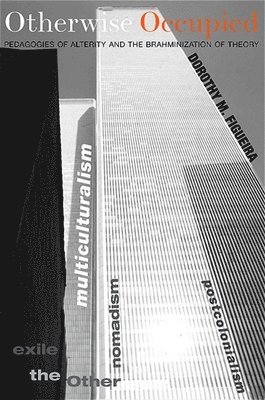
    Otherwise Occupied

    Pedagogies of Alterity and the Brahminization of Theory

    AvDorothy M. Figueira

    Häftad, Engelska, 2009

    440 kr

    Tillfälligt slut

    Fler format och utgåvor

    Inbunden

    Tillf. slut

    Beskrivning

    Questions whether current theories and pedagogies of alterity have allowed us truly to engage the Other.Tracing the historical development of recent identity-based trends in literary theory to their roots in structuralism, Dorothy M. Figueira questions the extent to which theories and pedagogies of alterity have actually enabled us to engage the Other. She tracks academic attempts to deal with alterity from their inception in critical thought in the 1960s to the present. Focusing on multiculturalism and postcolonialism as professional and institutional practices, Figueira examines how such theories and pedagogies informed the academic and public discourse regarding September 11. She also investigates the theories and pedagogies of alterity as crucial elements in the bureaucratization of diversity within academe and discusses their impact on affirmative action.

    Produktinformation

    • Utgivningsdatum:2009-07-01
    • Mått:152 x 229 x 9 mm
    • Vikt:249 g
    • Format:Häftad
    • Språk:Engelska
    • Antal sidor:171
    • Förlag:State University of New York Press
    • ISBN:9780791475744

    Utforska kategorier

    • Litteraturteori inom Skönlitteratur

    Mer om författaren

    Dorothy M. Figueira is Professor of Comparative Literature at the University of Georgia. She is the author of several books, including Aryans, Jews, Brahmins: Theorizing Authority through Myths of Identity; The Exotic: A Decadent Quest; and Translating the Orient: The Reception of Sakuntala in Nineteenth-Century Europe, all published by SUNY Press.

    Recensioner i media

    "…a forceful polemic against some of the major intellectual strands within the 'theory' revolution of the last thirty years." — Literary Research"This book bespeaks an extraordinarily broad and penetrating understanding of contemporary literary theory in the usual sense, but far more importantly, it presents an extremely clear, lucid, and compelling analysis of its political implications for the classroom, the department, the university as an educational institution, and the body politic of the United States in general. It is not only a courageous investigation and critique of the political positions but also a ringing condemnation of the disingenuous and ultimately shallow and superficial appropriation of the mantle of multiculturalism, trans-culturalism, and similar specialties by monolingual members of academe whose experience outside of the received environment is at best secondhand and all too often condescending and patronizing." — Steven P. Sondrup, Brigham Young University

    Innehållsförteckning

    • AcknowledgmentsIntroduction1. Critical Background to Postructuralist Theories and Pedagogies of Alterity2. MulticulturalismSimulated BattlesThe Institutionalization of MulticulturalismThe Methodology of MulticulturalismMarketing the MarginMasking the Metanarrative of Race3. Postcolonial Criticism and Identitarian PoliticsDefinitions and the Scope of Postcolonial CriticismHistory and Postcolonial SubjectivityThe Postcolonial CriticThe Repressive Allure of Postcolonial Criticism4. The Brahminization of Theory: Commodity Fetishism and False ConsciousnessIntroductionPostcolonial Criticism’s Disciplinary RootsCommodifying Postcolonial Theory and Type-Casting the CriticFalse ConsciousnessCommodity Fetishism and Brahminization5. The Romance of ExileIntroductionSpokespersonshipThe ExileThe NomadA Wand’ring Minstrel I, A Thing of Shreds and Patches6. OccidentalismTheory Confronts RealityRhetoricThe Fallaci AffairFinal Beliefs7. Gestures of InclusionIntroductionPositive Discrimination in IndiaAffirmative Action in the United StatesCosmetic EnhancementConclusion: The Collecting of the OtherNotesBibliographyIndex