• Fri frakt över 249 kr
  • •
  • Snabba leveranser
  • •
  • Billiga böcker
Kundservice

Du är på sajten för privatpersoner.

Företag, bibliotek eller offentlig verksamhet?

Du handlar på classic.bokus.com, där alla dina funktioner finns intakta.
Till classic.bokus.com
Bokus logotyp. Gå till startsidan.
  • Erbjudanden
  • Nyheter
  • Student
  • Topplistor
  • Barn & ungdom
  • Bokus Play
  • E-böcker
  • Pocketböcker
  • Spel & pussel

10% rabatt på allt med kod: NYSTART10 →

Sidfot

Mina sidor

    Hjälp

    • Kundservice
    • Vanliga frågor och svar
    • Frakt och leverans
    • Retur vid ångerrätt
    • Reklamera vara
    • Betalning
    • Köpvillkor
    • Allmänna villkor
    • Information om webbplatsens tillgänglighet

    Om Bokus

    • Om oss
    • Pressrum
    • För studenter
    • För företag
    • För bibliotek och offentlig verksamhet
    • För leverantörer
    • Hållbarhet

    Populärt

    • Aktuella erbjudanden
    • Presentkort
    • Studentlitteratur
    • Nya böcker
    • Topplistor
    • Signerade böcker
    • Engelska böcker

    Inspiration

    • Boktips
    • BookTok
    • Populära bokserier
    • Barnbokskaraktärer
    • Populära författare
    Logotyp för Bokus
    Följ oss på Facebook (extern länk)Följ oss på Instagram (extern länk)Följ oss på YouTube (extern länk)Följ oss på TikTok (extern länk)
    bokus @ CookiesAnpassa cookiesIntegritetspolicyKöpvillkor
    Till Citymail hemsida (extern länk)Till Budbee hemsida (extern länk)Till Postnord hemsida (extern länk)Till Schenker hemsida (extern länk)Till Early Bird hemsida (extern länk)Till Walleys hemsida (extern länk)
    1. Naturvetenskap och teknik
    2. Teknik och industri
    3. Maskinteknik och material

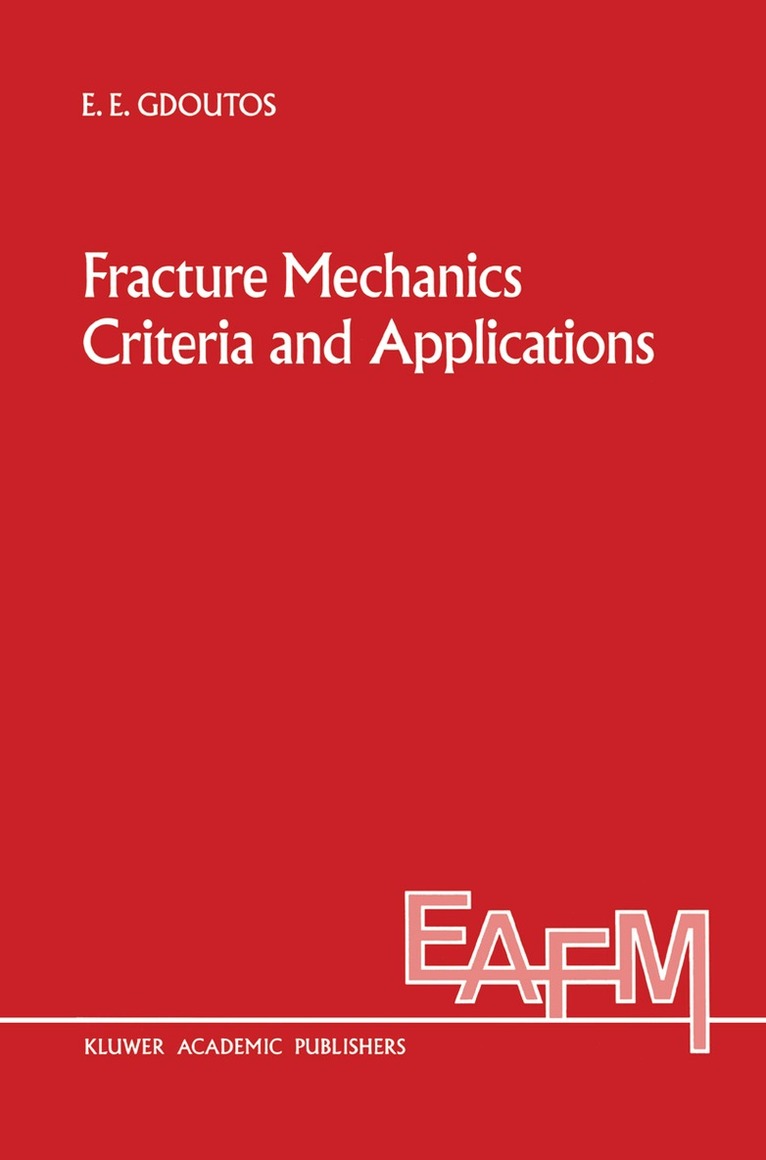
    Fracture Mechanics Criteria and Applications

    AvE.E. Gdoutos

    Inbunden, Engelska, 1990

    Del 10 i serien Engineering Applications of Fracture Mechanics

    1 626 kr

    Beställningsvara. Skickas inom 10-15 vardagar. Fri frakt över 249 kr.

    Fler format och utgåvor

    E-bok

    2 044 kr

    Häftad

    1 626 kr

    Beskrivning

    It is difficult to do justice to fracture mechanics in a textbook, for the subject encompasses so many disciplines. A general survey of the field would serve no purpose other than give a collection of references. The present book by Professor E. E. Gdoutos is refreshing because it does not fall into the esoteric tradition of outlining equations and results. Basic ideas and underlying principles are clearly explained as to how they are used in application. The presentations are concise and each topic can be understood by advanced undergraduates in material science and continuum mechanics. The book is highly recommended not only as a text in fracture mechanics but also as a reference to those interested in the general aspects of failure analysis. In addition to providing an in-depth review of the analytical methods for evaluating the fundamental quantities used in linear elastic fracture mechanics, various criteria are discussed re:O. ecting their limitations and applications. Par­ ticular emphases are given to predicting crack initiation, subcritical growth and the onset of rapid fracture from a single criterion. Those models in which it is assumed that the crack extends from tip to tip rely on the specific surface energy concept. The differences in the global and energy states before and after crack extension were associated with the energy required to create a unit area of crack surface. Applications were limited by the requirement of self-similar crack growth.

    Produktinformation

    • Utgivningsdatum:1990-11-30
    • Mått:156 x 234 x 23 mm
    • Vikt:664 g
    • Format:Inbunden
    • Språk:Engelska
    • Serie:Engineering Applications of Fracture Mechanics
    • Antal sidor:314
    • Upplaga:1990
    • Förlag:Kluwer Academic Publishers
    • ISBN:9780792306054

    Utforska kategorier

    • Maskinteknik och material inom Naturvetenskap och teknik

    Recensioner i media

    ' The book is recommended for engineers and research workers interested in modern mechanics of materials...In addition, there is a very rich and up-to-date collection of references that is very useful for readers wishing to improve their knowledge of any specific topic in fracture mechanics.' Meccanica 27:143-145 1992

    Innehållsförteckning

    • 1. Introductory chapter.- 1.1. Conventional failure criteria.- 1.2. Characteristic brittle failures.- 1.3. Griffith’s work.- 1.4. Fracture mechanics.- References.- 2. Linear elastic stress field in cracked bodies.- 2.1. Introduction.- 2.2. Crack deformation modes and basic concepts.- 2.3. Eigenfunction expansion method for a semi-infinite crack.- 2.4. Westergaard method.- 2.5. Singular stress and displacement fields.- 2.6. Method of complex potentials.- 2.7. Numerical methods.- 2.8. Experimental methods.- 2.9. Three-dimensional crack problems.- 2.10. Cracks in bending plates and shells.- References.- 3. Elastic-plastic stress field in cracked bodies.- 3.1. Introduction.- 3.2. Approximate determination of the crack-tip plastic zone.- 3.3. Small-scale yielding solution for antiplane mode.- 3.4. Complete solution for antiplane mode.- 3.5. Irwin’s model.- 3.6. Dugdale’s model.- 3.7. Singular solution for a work-hardening material.- 3.8. Numerical solutions.- References.- 4. Crack growth based on energy balance.- 4.1. Introduction.- 4.2. Energy balance during crack growth.- 4.3. Griffith theory.- 4.4. Graphical representation of the energy balance equation.- 4.5. Equivalence between strain energy release rate and stress intensity factor.- 4.6. Compliance.- 4.7. Critical stress intensity factor fracture criterion.- 4.8. Experimental determination of KIc.- 4.9. Crack stability.- 4.10. Crack growth resistance curve (R-curve) method.- 4.11. Mixed-mode crack propagation.- References.- 5. J-Integral and crack opening displacement fracture criteria.- 5.1. Introduction.- 5.2. Path-independent integrals.- 5.3. J-integral.- 5.4. Relationship between the J-integral and potential energy.- 5.5. J-integral fracture criterion.- 5.6. Experimental determination of the J-integral.- 5.7.Stable crack growth studied by the J-integral.- 5.8. Mixed-mode crack growth.- 5.9. Crack opening displacement (COD) fracture criterion.- References.- 6. Strain energy density failure criterion.- 6.1. Introduction.- 6.2. Volume strain energy density.- 6.3. Basic hypotheses.- 6.4. Two-dimensional linear elastic crack problems.- 6.5. Uniaxial extension of an inclined crack.- 6.6. Three-dimensional linear elastic crack problems.- 6.7. Bending of cracked plates.- 6.8. Ductile fracture.- 6.9. Failure initiation in bodies without pre-existing cracks.- 6.10. Other criteria based on energy density.- References.- 7. Dynamic fracture.- 7.1. Introduction.- 7.2. Mott’s model.- 7.3. Stress field around a rapidly propagating crack.- 7.4. Strain energy release rate.- 7.5. Transient response of cracks to impact loads.- 7.6. Standing plane waves interacting with a crack.- 7.7. Crack branching.- 7.8. Crack arrest.- 7.9. Experimental determination of crack velocity and dynamic stress intensity factor.- References.- 8. Fatigue and environment-assisted fracture.- 8.1. Introduction.- 8.2. Fatigue crack propagation laws.- 8.3. Fatigue life calculations.- 8.4. Variable amplitude loading.- 8.5. Mixed-mode fatigue crack propagation.- 8.6. Nonlinear fatigue analysis based on the strain energy density theory.- 8.7. Environment-assisted fracture.- References.- 9. Engineering applications.- 9.1. Introduction.- 9.2. Fracture mechanics design philosophy.- 9.3. Design example problems.- 9.4. Fiber-reinforced composites.- 9.5. Concrete.- 9.6. Crack detection methods.- References.- Author Index.