• Fri frakt över 249 kr
  • •
  • Snabba leveranser
  • •
  • Billiga böcker
Kundservice

Du är på sajten för privatpersoner.

Företag, bibliotek eller offentlig verksamhet?

Du handlar på classic.bokus.com, där alla dina funktioner finns intakta.
Till classic.bokus.com
Bokus logotyp. Gå till startsidan.
  • Erbjudanden
  • Nyheter
  • Student
  • Topplistor
  • Barn & ungdom
  • Bokus Play
  • E-böcker
  • Pocketböcker
  • Spel & pussel

10% rabatt på allt med kod: NYSTART10 →

Sidfot

Mina sidor

    Hjälp

    • Kundservice
    • Vanliga frågor och svar
    • Frakt och leverans
    • Retur vid ångerrätt
    • Reklamera vara
    • Betalning
    • Köpvillkor
    • Allmänna villkor
    • Information om webbplatsens tillgänglighet

    Om Bokus

    • Om oss
    • Pressrum
    • För studenter
    • För företag
    • För bibliotek och offentlig verksamhet
    • För leverantörer
    • Hållbarhet

    Populärt

    • Aktuella erbjudanden
    • Presentkort
    • Studentlitteratur
    • Nya böcker
    • Topplistor
    • Signerade böcker
    • Engelska böcker

    Inspiration

    • Boktips
    • BookTok
    • Populära bokserier
    • Barnbokskaraktärer
    • Populära författare
    Logotyp för Bokus
    Följ oss på Facebook (extern länk)Följ oss på Instagram (extern länk)Följ oss på YouTube (extern länk)Följ oss på TikTok (extern länk)
    bokus @ CookiesAnpassa cookiesIntegritetspolicyKöpvillkor
    Till Citymail hemsida (extern länk)Till Budbee hemsida (extern länk)Till Postnord hemsida (extern länk)Till Schenker hemsida (extern länk)Till Early Bird hemsida (extern länk)Till Walleys hemsida (extern länk)
    1. Naturvetenskap och teknik
    2. Matematik och naturvetenskap
    3. Matematik

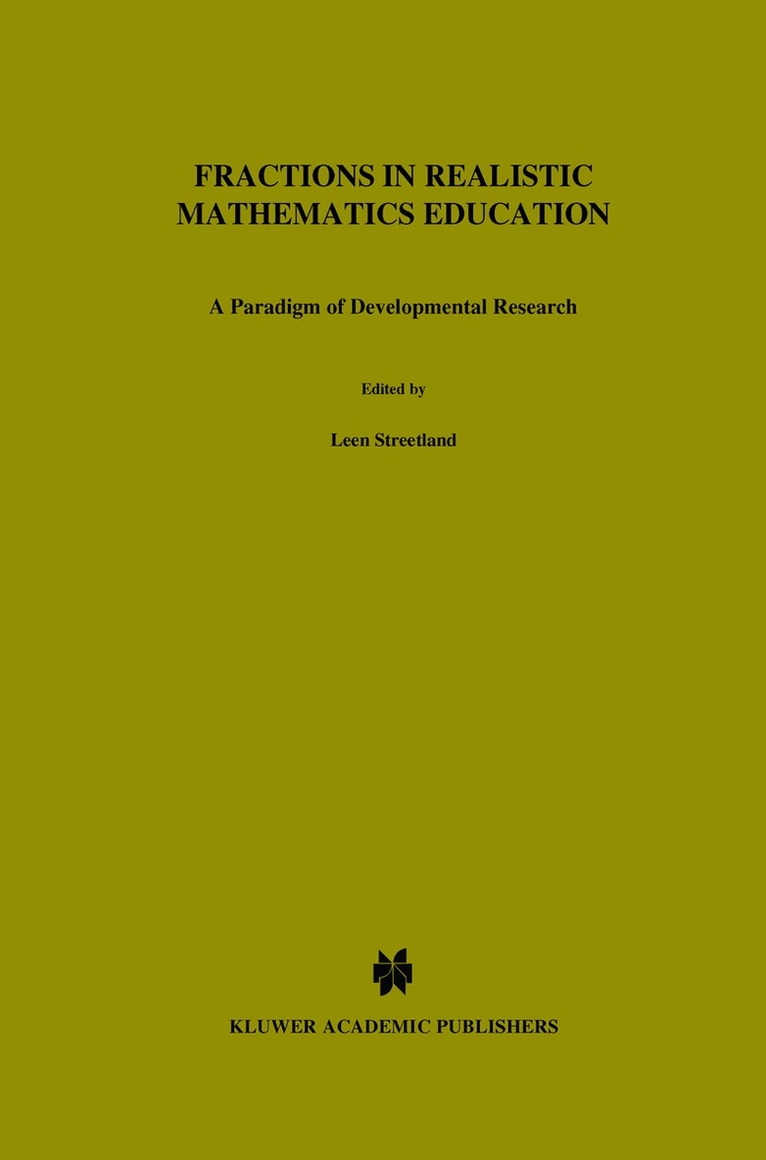
    Fractions in Realistic Mathematics Education

    A Paradigm of Developmental Research

    AvLeen Streefland

    Inbunden, Engelska, 1991

    Del 8 i serien Mathematics Education Library

    2 165 kr

    Beställningsvara. Skickas inom 10-15 vardagar. Fri frakt över 249 kr.

    Fler format och utgåvor

    Häftad

    2 381 kr

    E-bok

    2 833 kr

    Produktinformation

    • Utgivningsdatum:1991-06-30
    • Mått:155 x 235 x 25 mm
    • Vikt:717 g
    • Format:Inbunden
    • Språk:Engelska
    • Serie:Mathematics Education Library
    • Antal sidor:355
    • Upplaga:1991
    • Förlag:Kluwer Academic Publishers
    • ISBN:9780792312826

    Utforska kategorier

    • Matematik inom Naturvetenskap och teknik
    • Undervisning i specifika ämnen inom Psykologi och pedagogik

    Recensioner i media

    ' Streefland is to be congratulated on his thoroughness in presenting a far reaching study with many ramifications. I predict that any reader will find many of the author's premises as well as generalizations thought evoking. ' Zentrallblatt fur Didaktik der Mathematik, 5

    Innehållsförteckning

    • and overview.- Notes Introduction.- 1 Description of the fraction problem.- 1.1 Introduction and overview.- 1.2 Pointing out the problem.- 1.3 Description of the problem.- 1.4 Overview and outlook.- Notes chapter 1.- 2 Currents-standpoint-proposal.- 2.1 Introduction and overview.- 2.2 Currents.- 2.3 Standpoint.- 2.4 Proposal.- 2.5 Review and outlook.- Notes chapter 2.- 3 The context of the research.- 3.1 Introduction and overview.- 3.2 Starting from the construction principle.- 3.3 Development research.- 3.4 Design and method.- 3.5 The research group.- 3.6 The researcher’s position.- 3.7 Conclusion.- Notes chapter 3.- 4 The course in theory and practice.- 4.1 Introduction and overview.- 4.2 Global outline of the fraction course.- 4.3 Producing fractions: the teaching experiment.- 4.4 In view of mathematization.- 4.5 Review and outlook.- Notes chapter 4.- 5 Individual portraits of the fraction researchers.- 5.1 Introduction and overview.- 5.2 Indicators for the (improvement in) quality of the individual learning processes.- 5.3 The student portraits.- 5.4 Review and outlook.- Notes chapter 5.- 6 Internal evaluation of the learning process.- 6.1 Introduction and overview.- 6.2 Yielding to and building up resistance to IN-distractors.- 6.3 Progression in schematizating through abbreviations.- 6.4 Models and diagrams.- 6.5 Acquiring representations fitting formally posed problems.- 6.6 Constructions and productions on a symbolic level.- 6.7 The framework of the level-theory and the course construction.- 6.8 Review and outlook.- Notes chapter 6.- 7 External or summative evaluation.- 7.1 Introduction and overview.- 7.2 Weighing the groups.- 7.3 Comparing and characterizing the programs.- 7.4 The tests.- 7.5 Results.- 7.6 Summary and conclusions.- 7.7 Realistic andmechanistic: a difference in effects?.- 7.8 A look ahead.- Notes chapter 7.- 8 Theoretical review.- 8.1 Introduction and overview.- 8.2 Teaching and learning fractions.- 8.3 Conclusion.- Notes chapter 8.- Epilogue: Sketch of a new course -fractions, an integrated perspective-.