• Fri frakt över 249 kr
  • •
  • Snabba leveranser
  • •
  • Billiga böcker
Kundservice

Du är på sajten för privatpersoner.

Företag, bibliotek eller offentlig verksamhet?

Du handlar på classic.bokus.com, där alla dina funktioner finns intakta.
Till classic.bokus.com
Bokus logotyp. Gå till startsidan.
  • Erbjudanden
  • Nyheter
  • Student
  • Topplistor
  • Barn & ungdom
  • Bokus Play
  • E-böcker
  • Pocketböcker
  • Spel & pussel

10% rabatt på allt med kod NYSTART10 →

Sidfot

Mina sidor

    Hjälp

    • Kundservice
    • Vanliga frågor och svar
    • Frakt och leverans
    • Retur vid ångerrätt
    • Reklamera vara
    • Betalning
    • Köpvillkor
    • Allmänna villkor
    • Information om webbplatsens tillgänglighet

    Om Bokus

    • Om oss
    • Pressrum
    • För studenter
    • För företag
    • För bibliotek och offentlig verksamhet
    • För leverantörer
    • Hållbarhet

    Populärt

    • Aktuella erbjudanden
    • Presentkort
    • Studentlitteratur
    • Nya böcker
    • Topplistor
    • Signerade böcker
    • Engelska böcker

    Inspiration

    • Boktips
    • BookTok
    • Populära bokserier
    • Barnbokskaraktärer
    • Populära författare
    Logotyp för Bokus
    Följ oss på Facebook (extern länk)Följ oss på Instagram (extern länk)Följ oss på YouTube (extern länk)Följ oss på TikTok (extern länk)
    bokus @ CookiesAnpassa cookiesIntegritetspolicyKöpvillkor
    Till Citymail hemsida (extern länk)Till Budbee hemsida (extern länk)Till Postnord hemsida (extern länk)Till Schenker hemsida (extern länk)Till Early Bird hemsida (extern länk)Till Walleys hemsida (extern länk)
    1. Juridik
    2. Rättsvetenskap

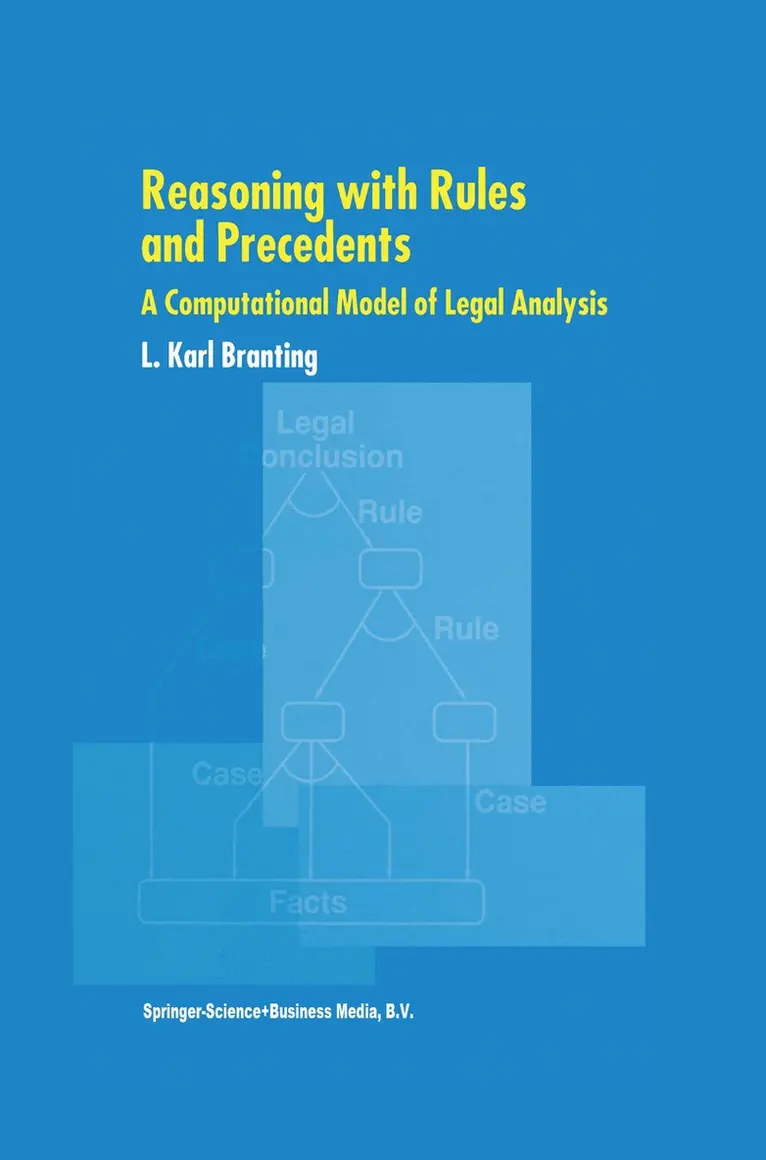
    Reasoning with Rules and Precedents

    A Computational Model of Legal Analysis

    AvL. Karl Branting

    Inbunden, Engelska, 1999

    998 kr

    Beställningsvara. Skickas inom 10-15 vardagar. Fri frakt över 249 kr.

    Fler format och utgåvor

    Häftad

    998 kr

    E-bok

    1 300 kr

    Beskrivning

    Few areas of human expertise are so well understood that they can be completely reduced to general principles. Similarly, there are few domains in which experience is so extensive that every new problem precisely matches a previous problem whose solution is known. When neither rules nor examples are individually sufficient, problem-solving expertise depends on integrating both. This book presents a computational framework for the integration of rules and cases for analytic tasks typified by legal analysis. The book uses the framework for integrating cases and rules as a basis for a new model of legal precedents. This model explains how the theory under which a case is decided controls the case's precedential effect. The framework for integrating rules and cases is implemented in GREBE, a system for legal analysis. The book presents techniques for representing, indexing, and comparing complex cases and for converting justification structures based on rules and case into natural-language text. This book will interest researchers in artificial intelligence, particularly those involved in case-based reasoning, artificial intelligence and law, and formal models of argumentation, and to scholars in legal philosophy, jurisprudence, and analogical reasoning.

    Produktinformation

    • Utgivningsdatum:1999-12-31
    • Mått:155 x 235 x 18 mm
    • Vikt:530 g
    • Format:Inbunden
    • Språk:Engelska
    • Antal sidor:219
    • Upplaga:2000
    • Förlag:Kluwer Academic Publishers
    • ISBN:9780792361053

    Utforska kategorier

    • Rättsvetenskap inom Juridik
    • Artificiell intelligens inom Data och IT

    Innehållsförteckning

    • 1. Introduction.- 2. A Framework for Integrating Rules and Exemplars.- 3. A Formal Model of Ratio Decidendi.- 4. Grebe: Integrating Rules and Precedents for Legal Analysis.- 5. Examples of GREBE’s Legal Analysis.- 6. Evaluation.- 7. Related Work.- 8. Research Contributions.- References.- Appendices.- A—GREBE’s Analysis of 7 Worker’s Compensation Hypotheticals.- B—Legal Precedents in the Worker’s Compensation Knowledge Base.- C—Predicates Having Precedents as Warrants.- D—21 Hypothetical Cases.- E—GREBE’s Relation Vocabulary.- F—GREBE’s Structure Matching Algorithm.