• Fri frakt över 249 kr
  • •
  • Snabba leveranser
  • •
  • Billiga böcker
Kundservice

Du är på sajten för privatpersoner.

Företag, bibliotek eller offentlig verksamhet?

Du handlar på classic.bokus.com, där alla dina funktioner finns intakta.
Till classic.bokus.com
Bokus logotyp. Gå till startsidan.
  • Erbjudanden
  • Nyheter
  • Student
  • Topplistor
  • Barn & ungdom
  • Bokus Play
  • E-böcker
  • Pocketböcker
  • Spel & pussel

Må bättre, för mindre! Upp till 50% rabatt på hälsoböcker

Sidfot

Mina sidor

    Hjälp

    • Kundservice
    • Vanliga frågor och svar
    • Frakt och leverans
    • Retur vid ångerrätt
    • Reklamera vara
    • Betalning
    • Köpvillkor
    • Allmänna villkor
    • Information om webbplatsens tillgänglighet

    Om Bokus

    • Om oss
    • Pressrum
    • För studenter
    • För företag
    • För bibliotek och offentlig verksamhet
    • För leverantörer
    • Hållbarhet

    Populärt

    • Aktuella erbjudanden
    • Presentkort
    • Studentlitteratur
    • Nya böcker
    • Topplistor
    • Signerade böcker
    • Engelska böcker

    Inspiration

    • Boktips
    • BookTok
    • Populära bokserier
    • Barnbokskaraktärer
    • Populära författare
    Logotyp för Bokus
    Följ oss på Facebook (extern länk)Följ oss på Instagram (extern länk)Följ oss på YouTube (extern länk)Följ oss på TikTok (extern länk)
    bokus @ CookiesAnpassa cookiesIntegritetspolicyKöpvillkor
    Till Citymail hemsida (extern länk)Till Budbee hemsida (extern länk)Till Postnord hemsida (extern länk)Till Schenker hemsida (extern länk)Till Early Bird hemsida (extern länk)Till Walleys hemsida (extern länk)
    1. Naturvetenskap och teknik
    2. Matematik och naturvetenskap
    3. Fysik

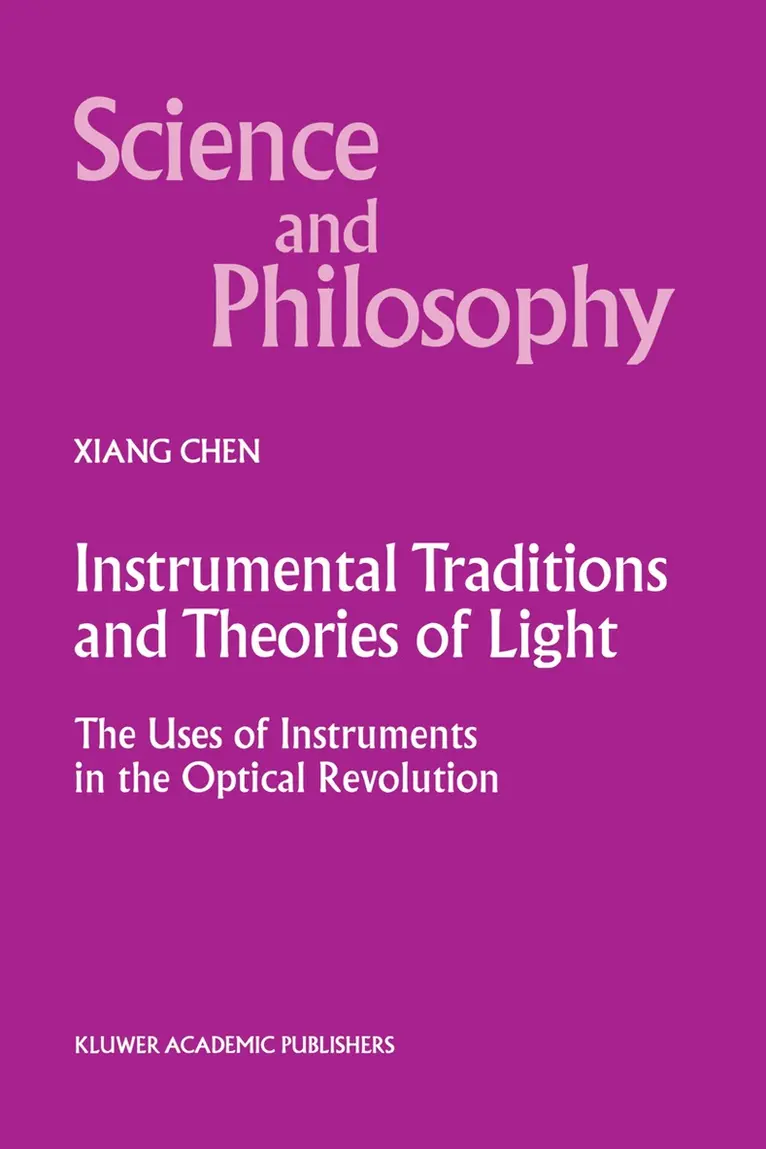
    Instrumental Traditions and Theories of Light

    The Uses of Instruments in the Optical Revolution

    AvXiang Chen

    Inbunden, Engelska, 2000

    Del 9 i serien Science and Philosophy

    1 086 kr

    Beställningsvara. Skickas inom 10-15 vardagar. Fri frakt över 249 kr.

    Fler format och utgåvor

    Häftad

    1 086 kr

    E-bok

    1 455 kr

    Beskrivning

    An analysis of the optical revolution in the context of early 19th century Britain. Far from merely involving the replacement of one optical theory by another, the revolution also involved substantial changes in instruments and the practices that surrounded them. People's judgements about classification, explanation and evaluation were affected by the way they used such optical instruments as spectroscopes, telescopes, polarisers, photometers, gratings, prisms and apertures. There were two instrumental traditions in this historical period, each of which nurtured a body of practice that exemplified how optical instruments should be operated, and especially how the eye should be used. These traditions functioned just like paradigms, shaping perspectives and even world views. Readership: Scholars and graduate students in the history of science, history of instrument, philosophy of science and science studies. Can also be used as a textbook in graduate courses on 19th century physics.

    Produktinformation

    • Utgivningsdatum:2000-06-30
    • Mått:170 x 244 x 18 mm
    • Vikt:535 g
    • Format:Inbunden
    • Språk:Engelska
    • Serie:Science and Philosophy
    • Antal sidor:213
    • Upplaga:2000
    • Förlag:Kluwer Academic Publishers
    • ISBN:9780792363491

    Utforska kategorier

    • Fysik inom Naturvetenskap och teknik
    • Naturvetenskapens historia inom Naturvetenskap och teknik

    Innehållsförteckning

    • 1. Comparisons of Explanatory Power.- 1. Introducing the wave theory to Britain.- 2. Comparing the explanatory powers.- 3. The reflection of a particle theorist.- 4. Improving the explanatory power of the particle theory.- 5. The problem of selective absorption.- 2. Explanatory Power and Classification.- 1. The Newtonian taxonomic systems.- 2. Herschel’s synthetic attempt.- 3. Lloyd’s dichotomous design.- 3. Classification and the Use of Instruments.- 1. Brewster’s plate polarizers and crystal analyzers.- 2. Fresnel’s innovative uses of crystal analyzers.- 3. Herschel’s understanding of partial polarization.- 4. Lloyd and conical polarization.- 4. The Dispute over Dispersion.- 1. Powell’s formulas of dispersion.- 2. Fraunhofer’s theodolites and spectral lines.- 3. Powell’s hollow prisms and spectral lines.- 4. Brewster’s telescope and spectral lines.- 5. The difficulties of making gratings.- 6. The impasse in the debate.- 5. The Discovery of the “Polarity of Light”.- 1. The discovery of the “polarity of light”.- 2. Brewster’s classification.- 3. The wave explanations.- 4. The setback of the wave theory.- 5. Powell’s hollow prism.- 6. Stokes’s solution.- 6. The Measurements of the Intensity of Light.- 1. Potter’s reflecting photometer.- 2. Potter’s measurements of metallic mirrors.- 3. Potter’s measurements of glass mirrors.- 4. Potter’s comparative photometer.- 5. The debate on the reliability of the eye.- 6. Potter’s attack on the wave account of diffraction.- 7. Instrumental Traditions.- 1. Optical instruments as image-making devices.- 2. The eye as an optical instrument.- 3. Optical instruments as measuring devices.- 4. Whewell on optical measurements.- 5. The visual tradition.- 6. The geometric tradition.- 8. The GeometricTradition and the Wave Theory of Light.- 1. Humboldtian sciences: measuring nature.- 2. The shortage of scientific manpower in optics.- 3. A new generation of physicists.- 4. Stokes’s experiments on fluorescence.- 5. Measuring the velocity of light.- 6. The status of the wave theory.- 9. The Visual Tradition and the Closure of the Optical Revolution.- 1. Stereoscopes and the studies of space perception.- 2. Stroboscopes and the studies of visual persistence.- 3. Kaleidoscopes and the making of “philosophical toys”.- 4. Binocular cameras and the photographic industry.- 5. The end of the optical revolution.- Conclusion.- Notes.- References.- Name Index.