• Fri frakt över 249 kr
  • •
  • Snabba leveranser
  • •
  • Billiga böcker
Kundservice

Du är på sajten för privatpersoner.

Företag, bibliotek eller offentlig verksamhet?

Du handlar på classic.bokus.com, där alla dina funktioner finns intakta.
Till classic.bokus.com
Bokus logotyp. Gå till startsidan.
  • Erbjudanden
  • Nyheter
  • Student
  • Topplistor
  • Barn & ungdom
  • Bokus Play
  • E-böcker
  • Pocketböcker
  • Spel & pussel

10% rabatt på allt med kod NYSTART10 →

Sidfot

Mina sidor

    Hjälp

    • Kundservice
    • Vanliga frågor och svar
    • Frakt och leverans
    • Retur vid ångerrätt
    • Reklamera vara
    • Betalning
    • Köpvillkor
    • Allmänna villkor
    • Information om webbplatsens tillgänglighet

    Om Bokus

    • Om oss
    • Pressrum
    • För studenter
    • För företag
    • För bibliotek och offentlig verksamhet
    • För leverantörer
    • Hållbarhet

    Populärt

    • Aktuella erbjudanden
    • Presentkort
    • Studentlitteratur
    • Nya böcker
    • Topplistor
    • Signerade böcker
    • Engelska böcker

    Inspiration

    • Boktips
    • BookTok
    • Populära bokserier
    • Barnbokskaraktärer
    • Populära författare
    Logotyp för Bokus
    Följ oss på Facebook (extern länk)Följ oss på Instagram (extern länk)Följ oss på YouTube (extern länk)Följ oss på TikTok (extern länk)
    bokus @ CookiesAnpassa cookiesIntegritetspolicyKöpvillkor
    Till Citymail hemsida (extern länk)Till Budbee hemsida (extern länk)Till Postnord hemsida (extern länk)Till Schenker hemsida (extern länk)Till Early Bird hemsida (extern länk)Till Walleys hemsida (extern länk)
    1. Ekonomi och Ledarskap
    2. Nationalekonomi

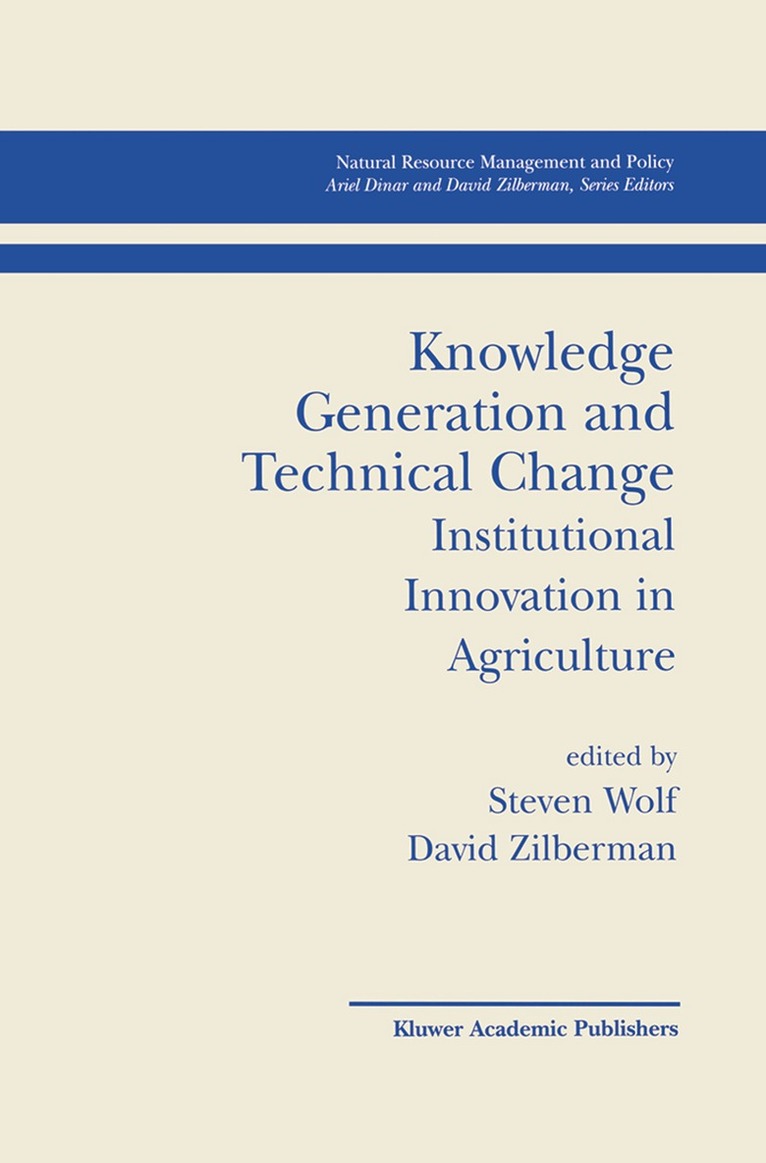
    Knowledge Generation and Technical Change

    Institutional Innovation in Agriculture

    AvSteven Wolf,David Zilberman

    Inbunden, Engelska, 2001

    Del i serien Natural Resource Management and Policy

    1 085 kr

    Beställningsvara. Skickas inom 10-15 vardagar. Fri frakt över 249 kr.

    Beskrivning

    Knowledge generation and transfer mechanisms are being transformed in important and controversial ways. Investment in research and development has increased in response to recognition that scientific productivity is tightly connected to economic dynamism. Patent protection has been expanded in order to stimulate higher levels of private investment. Intellectual property rights held by public organizations and researchers are now increasingly transferred to private organizations to accelerate the diffusion and enhance the value of knowledge produced by public agencies and universities. Additionally, new institutions such as university offices of technology transfer, venture capital markets, and a variety of consortia in knowledge-intensive industries are being established throughout the US and in other parts of the world. These changes have led to a repositioning of the state in systems of innovation and an increase in the proprietary character of technical information.The purpose of this book is to review and analyze i) contemporary transitions in agricultural knowledge generation and extension arrangements from an empirical perspective, and ii) emerging and contradictory perspectives as to how knowledge systems can be assessed effectively. The authors aim to provide the reader with a better understanding of: the implications of new biotechnologies and new intellectual property rights regimes on public- private relations in science, the extent to which benefits from scientific knowledge are being appropriated by private sector actors; the diversity and possible outcomes of privatization initiatives in extension; and prospects for public goods production and ecological sustainability given contemporary trends. The book presents contrasting views on the degree of complementarity and substitution between private and public sector investments in research and extension. Recognizing that the labels "public" and "private" are incomplete and at times misleading descriptions of the structure and function of coordinating bodies in social systems, the analyses highlight ways in which public and private spaces and modes of functioning combine.

    Produktinformation

    • Utgivningsdatum:2001-09-30
    • Mått:155 x 235 x 26 mm
    • Vikt:761 g
    • Format:Inbunden
    • Språk:Engelska
    • Serie:Natural Resource Management and Policy
    • Antal sidor:371
    • Upplaga:2001
    • Förlag:Kluwer Academic Publishers
    • ISBN:9780792374480

    Utforska kategorier

    • Nationalekonomi inom Ekonomi och Ledarskap
    • Agronomi och lantbruk inom Naturvetenskap och teknik
    • Lantbruk, fiske och skogsbruk inom Ekonomi och Ledarskap

    Innehållsförteckning

    • I. Context and Analytic Principles.- 1. Beyond the Endless Frontier: From the Land Grant to the Entrepreneurial University.- 2. Generation and Commercialization of Knowledge: Trends, Implications, and Models for Public and Private Agricultural Research and Education.- 3. Public Research/Private Alignments.- 4. Challenges for Public Agricultural Research and Extension in A World of Proprietary Science and Technology.- 5. Finance, Organization, and Impacts of U.S. Agricultural Research: Future Prospects.- 6. Agricultural Knowledge Systems: Issues of Accountability.- 7. Institutional Innovation in Natural Resource Management: A Conceptualization and Some Australian Examples.- II. Empirical Studies.- 8. Land-Grant/Industry Relationships and the Institutional Relations of Technological Innovation in Agriculture: Longitudinal Evidence from National Surveys of Agricultural Scientists.- 9. Structure of Public-Private Knowledge Networks in Plant Biotechnology: An EU-US Comparison.- 10. Offices of Technology Transfer: Privatizing University Innovations for Agriculture.- 11. Origins of Public-Private Knowledge Flows and Current State-of-the-Art: Can Agriculture Learn from Industry?.- 12. Institutional Relations in Agricultural Information Systems.- 13. Innovative Models of Technology Generation and Transfer: Lessons Learned from the South.- 14. Whither Agricultural Extension Worldwide? Reforms and Prospects.- 15. Agricultural Extension: Generic Challenges and the Ingredients for Solutions.- III. Conclusion.- 16. Institutional Dimensions of Knowledge System Design and Analysis.