• Fri frakt över 249 kr
  • •
  • Snabba leveranser
  • •
  • Billiga böcker
Kundservice

Du är på sajten för privatpersoner.

Företag, bibliotek eller offentlig verksamhet?

Du handlar på classic.bokus.com, där alla dina funktioner finns intakta.
Till classic.bokus.com
Bokus logotyp. Gå till startsidan.
  • Erbjudanden
  • Nyheter
  • Student
  • Topplistor
  • Barn & ungdom
  • Bokus Play
  • E-böcker
  • Pocketböcker
  • Spel & pussel

10% rabatt på allt med kod NYSTART10 →

Sidfot

Mina sidor

    Hjälp

    • Kundservice
    • Vanliga frågor och svar
    • Frakt och leverans
    • Retur vid ångerrätt
    • Reklamera vara
    • Betalning
    • Köpvillkor
    • Allmänna villkor
    • Information om webbplatsens tillgänglighet

    Om Bokus

    • Om oss
    • Pressrum
    • För studenter
    • För företag
    • För bibliotek och offentlig verksamhet
    • För leverantörer
    • Hållbarhet

    Populärt

    • Aktuella erbjudanden
    • Presentkort
    • Studentlitteratur
    • Nya böcker
    • Topplistor
    • Signerade böcker
    • Engelska böcker

    Inspiration

    • Boktips
    • BookTok
    • Populära bokserier
    • Barnbokskaraktärer
    • Populära författare
    Logotyp för Bokus
    Följ oss på Facebook (extern länk)Följ oss på Instagram (extern länk)Följ oss på YouTube (extern länk)Följ oss på TikTok (extern länk)
    bokus @ CookiesAnpassa cookiesIntegritetspolicyKöpvillkor
    Till Citymail hemsida (extern länk)Till Budbee hemsida (extern länk)Till Postnord hemsida (extern länk)Till Schenker hemsida (extern länk)Till Early Bird hemsida (extern länk)Till Walleys hemsida (extern länk)
    1. Samhälle och politik
    2. Samhälle och kultur
    3. Sociala grupper och identitet
    4. Genusvetenskap

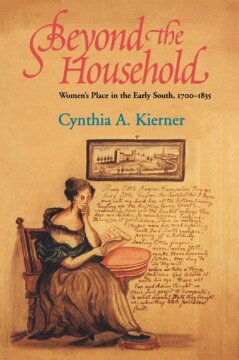
    Beyond the Household

    Women's Place in the Early South, 1700–1835

    AvCynthia A. Kierner

    Inbunden, Engelska, 1998

    1 666 kr

    Beställningsvara. Skickas inom 10-15 vardagar. Fri frakt över 249 kr.

    Fler format och utgåvor

    Häftad

    508 kr

    Beskrivning

    Much has been written about the "southern lady," that pervasive and enduring icon of antebellum regional identity. But how did the lady get on her pedestal—and were the lives of white southern women always so different from those of their northern contemporaries? In her ambitious new book, Cynthia A. Kierner charts the evolution of the lives of white southern women through the colonial, revolutionary, and early republican eras. Using the lady on her pedestal as the end—rather than the beginning—of her story, she shows how gentility, republican political ideals, and evangelical religion successively altered southern gender ideals and thereby forced women to reshape their public roles. Kierner concludes that southern women continually renegotiated their access to the public sphere—and that even the emergence of the frail and submissive lady as icon did not obliterate women's public role.Kierner draws on a strong overall command of early American and women's history and adds to it research in letters, diaries, newspapers, secular and religious periodicals, travelers' accounts, etiquette manuals, and cookery books. Focusing on the issues of work, education, and access to the public sphere, she explores the evolution of southern gender ideals in an important transitional era. Specifically, she asks what kinds of changes occurred in women's relation to the public sphere from 1700 to 1835. In answering this major question, she makes important links and comparisons, across both time and region, and creates a chronology of social and intellectual change that addresses many key questions in the history of women, the South, and early America.

    Produktinformation

    • Utgivningsdatum:1998-09-22
    • Mått:152 x 229 x 27 mm
    • Vikt:907 g
    • Format:Inbunden
    • Språk:Engelska
    • Antal sidor:320
    • Förlag:Cornell University Press
    • ISBN:9780801434532

    Utforska kategorier

    • Genusvetenskap inom Samhälle och politik
    • Amerikas historia inom Historia och arkeologi
    • Socialhistoria och kulturhistoria inom Historia och arkeologi

    Mer om författaren

    Cynthia A. Kierner is Professor of History at George Mason University. She is the author of Traders and Gentlefolk: The Livingstons of New York, 1675–1790, also from Cornell; Scandal at Bizarre: Rumor and Reputation in Jefferson's America; Revolutionary America; and Southern Women in Revolution, 1776–1800: Personal and Political Narratives.

    Recensioner i media

    A richly textured study.- Christie Anne Farnham, Iowa State University (The Journal of American History) Historians of southern women have always had to confront the image of the 'southern lady' that permeates the field of American history like recalcitrant mildew. No matter how often they assert the existence of real women whose lives were nothing like that of the mythic lady, her shadowy self continues to reappear—despite the repainting provided by countless scholars and their detailed studies of southern women. Cynthia A Kierner synthesizes much of this recent scholarship to provide a useful and accessible study of real women and their lives in those areas with the largest populations, the most complex societies, many of the oldest settlements, the best-kept historical collections, and the most readily available sources: Virginia and the Carolinas.(American Historical Review) Kierner debunks the myth of the delicate flower of Southern womanhood.(Publishers Weekly) Students and scholars of women's history will appreciate the important connections Kierner makes between southern and northern women and the impact of social and intellectual changes in southern women's lives.- Diane C. Vecchio, Furman University (The North Carolina Historical Review) Subtle and sophisticated.... it bridges a gap between some of the best new scholarship on women in the colonial period and on women in the nineteenth century.(Virginia Libraries) This study will be a useful resource for general courses on southern history. The richest new material appears in its chapters on women's wartime political correspondence and their postwar participation in public celebrations.(Choice)