• Fri frakt över 249 kr
  • •
  • Snabba leveranser
  • •
  • Billiga böcker
Kundservice

Du är på sajten för privatpersoner.

Företag, bibliotek eller offentlig verksamhet?

Du handlar på classic.bokus.com, där alla dina funktioner finns intakta.
Till classic.bokus.com
Bokus logotyp. Gå till startsidan.
  • Erbjudanden
  • Nyheter
  • Student
  • Topplistor
  • Barn & ungdom
  • Bokus Play
  • E-böcker
  • Pocketböcker
  • Spel & pussel

10% rabatt på allt med kod NYSTART10 →

Sidfot

Mina sidor

    Hjälp

    • Kundservice
    • Vanliga frågor och svar
    • Frakt och leverans
    • Retur vid ångerrätt
    • Reklamera vara
    • Betalning
    • Köpvillkor
    • Allmänna villkor
    • Information om webbplatsens tillgänglighet

    Om Bokus

    • Om oss
    • Pressrum
    • För studenter
    • För företag
    • För bibliotek och offentlig verksamhet
    • För leverantörer
    • Hållbarhet

    Populärt

    • Aktuella erbjudanden
    • Presentkort
    • Studentlitteratur
    • Nya böcker
    • Topplistor
    • Signerade böcker
    • Engelska böcker

    Inspiration

    • Boktips
    • BookTok
    • Populära bokserier
    • Barnbokskaraktärer
    • Populära författare
    Logotyp för Bokus
    Följ oss på Facebook (extern länk)Följ oss på Instagram (extern länk)Följ oss på YouTube (extern länk)Följ oss på TikTok (extern länk)
    bokus @ CookiesAnpassa cookiesIntegritetspolicyKöpvillkor
    Till Citymail hemsida (extern länk)Till Budbee hemsida (extern länk)Till Postnord hemsida (extern länk)Till Schenker hemsida (extern länk)Till Early Bird hemsida (extern länk)Till Walleys hemsida (extern länk)
    1. Samhälle och politik
    2. Samhälle och kultur
    3. Sociala grupper och identitet
    4. Genusvetenskap

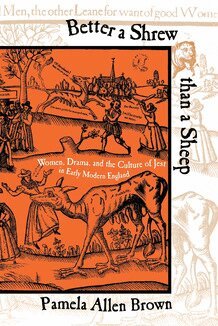
    Better a Shrew Than a Sheep

    Women, Drama, and the Culture of Jest in Early Modern England

    AvPamela Allen Brown

    Häftad, Engelska, 2003

    407 kr

    Beställningsvara. Skickas inom 10-15 vardagar. Fri frakt över 249 kr.

    Fler format och utgåvor

    Inbunden

    1 860 kr

    Beskrivning

    In a study that explodes the assumption that early modern comic culture was created by men for men, Pamela Allen Brown shows that jest books, plays, and ballads represented women as laugh-getters and sought out the laughter of ordinary women. Disputing the claim that non-elite women had little access to popular culture because of their low literacy and social marginality, Brown demonstrates that women often bested all comers in the arenas of jesting, gaining a few heady moments of agency. Juxtaposing the literature of jest against court records, sermons, and conduct books, Brown employs a witty, entertaining style to propose that non-elite women used jests to test the limits of their subjection. She also shows how women's mocking laughter could function as a means of social control in closely watched neighborhoods. While official culture beatified the sheep-like wife and disciplined the scold, jesting culture often applauded the satiric shrew, whether her target was priest, cuckold, or rapist. Brown argues that listening for women's laughter can shed light on both the dramas of the street and those of the stage: plays from The Massacre of the Innocents to The Merry Wives of Windsor to The Woman's Prize taught audiences the importance of gossips' alliances as protection against slanderers, lechers, tyrants, and wife-beaters. Other jests, ballads, jigs, and plays show women reveling in tales of female roguery or scoffing at the perverse patience of Griselda. As Brown points out, some women found Griselda types annoying and even foolish: better be a shrew than a sheep.

    Produktinformation

    • Utgivningsdatum:2003-01-08
    • Mått:152 x 229 x 19 mm
    • Vikt:454 g
    • Format:Häftad
    • Språk:Engelska
    • Antal sidor:280
    • Förlag:Cornell University Press
    • ISBN:9780801488368

    Utforska kategorier

    • Genusvetenskap inom Samhälle och politik
    • Litteraturvetenskap inom Skönlitteratur

    Mer om författaren

    Pamela Allen Brown is Assistant Professor of English at the University of Connecticut, Stamford.

    Recensioner i media

    Better a Shrew does a brilliant job of locating female jesting within a network of the social practices that made up the early modern neighborhood.... It is one of those rare scholarly books that combines thorough research in a new field with conclusions that make us reconsider long-held convictions. It will be a potent force in future discussions of both early modern jesting literature and the daily lives of women in the period.- Mary Bly (Renaissance Quarterly) Better a Shrew than a Sheep is an engaging read and sheds much-needed light on the seemingly divergent issues of women's literacy and the culture of jest in early modern England.- Jennifer Money (Women's Studies) Brown's book represents historicist analysis of the best possible kind. Chapters on Merry Wives, on the ale-house, cuckold jokes, female gossip as a way of countering domestic violence, cony-catching pamphlets, and the cultural reverberations around the idea of Patient Griselda fruitfully cross and recross the boundaries of literary and popular culture in early modern England.- Dympna Callaghan (Studies in English Literature) Brown's writing is clear and witty, her mission provocative, and her topic rich with unexpected nuance and variations.... The book is brilliantly structured so that topics discussed early on—such as gossip, neighborhoods, marriage, and horning—return with added significance in later chapters.- Donnalee Dox, Texas A and M University (Prolepsis: The Heidelberg Review of English Studies) While it may be the case that women's place in jesting culture has been overlooked up to this point, this book will assuredly persuade many other scholars to follow the evidentiary trail that Brown has blazed here.- Regina Buccola (Early Theatre) Witty and unruly women are all subjects of discussion in Pamela Allen Brown's engrossing and meticulously researched study of the ways in which women might resist, through jokes and ridicule, the models of virtuous and submissive behavior aimed at them from the pulpit, the theatre and the print-shop.... Tracing the connection between a female comic tradition and popular culture at large, she draws also on the lives of women such as Alice Mustian, contrasting dramas of everyday life with those presented on the stage.- Lucy Munro (Times Literary Supplement)

    Innehållsförteckning

    • Introduction : sauce for the gander -- Near neighbors, women's wars, and merry wives -- Ale and female : gossips as players, alehouse as theater -- Between women, or All is fair at horn fair -- "O such a rogue would be hang'd!" : shrews versus wife beaters -- Scandalous pleasures : a coney-catcher and her public -- Griselda the fool -- Epilogue : the problem of fun.