• Fri frakt över 249 kr
  • •
  • Snabba leveranser
  • •
  • Billiga böcker
Kundservice

Du är på sajten för privatpersoner.

Företag, bibliotek eller offentlig verksamhet?

Du handlar på classic.bokus.com, där alla dina funktioner finns intakta.
Till classic.bokus.com
Bokus logotyp. Gå till startsidan.
  • Erbjudanden
  • Nyheter
  • Student
  • Topplistor
  • Barn & ungdom
  • Bokus Play
  • E-böcker
  • Pocketböcker
  • Spel & pussel

10% rabatt på allt med kod: NYSTART10 →

Sidfot

Mina sidor

    Hjälp

    • Kundservice
    • Vanliga frågor och svar
    • Frakt och leverans
    • Retur vid ångerrätt
    • Reklamera vara
    • Betalning
    • Köpvillkor
    • Allmänna villkor
    • Information om webbplatsens tillgänglighet

    Om Bokus

    • Om oss
    • Pressrum
    • För studenter
    • För företag
    • För bibliotek och offentlig verksamhet
    • För leverantörer
    • Hållbarhet

    Populärt

    • Aktuella erbjudanden
    • Presentkort
    • Studentlitteratur
    • Nya böcker
    • Topplistor
    • Signerade böcker
    • Engelska böcker

    Inspiration

    • Boktips
    • BookTok
    • Populära bokserier
    • Barnbokskaraktärer
    • Populära författare
    Logotyp för Bokus
    Följ oss på Facebook (extern länk)Följ oss på Instagram (extern länk)Följ oss på YouTube (extern länk)Följ oss på TikTok (extern länk)
    bokus @ CookiesAnpassa cookiesIntegritetspolicyKöpvillkor
    Till Citymail hemsida (extern länk)Till Budbee hemsida (extern länk)Till Postnord hemsida (extern länk)Till Schenker hemsida (extern länk)Till Early Bird hemsida (extern länk)Till Walleys hemsida (extern länk)
    1. Samhälle och politik
    2. Social välfärd och brottslighet
    3. Brottslighet och kriminologi

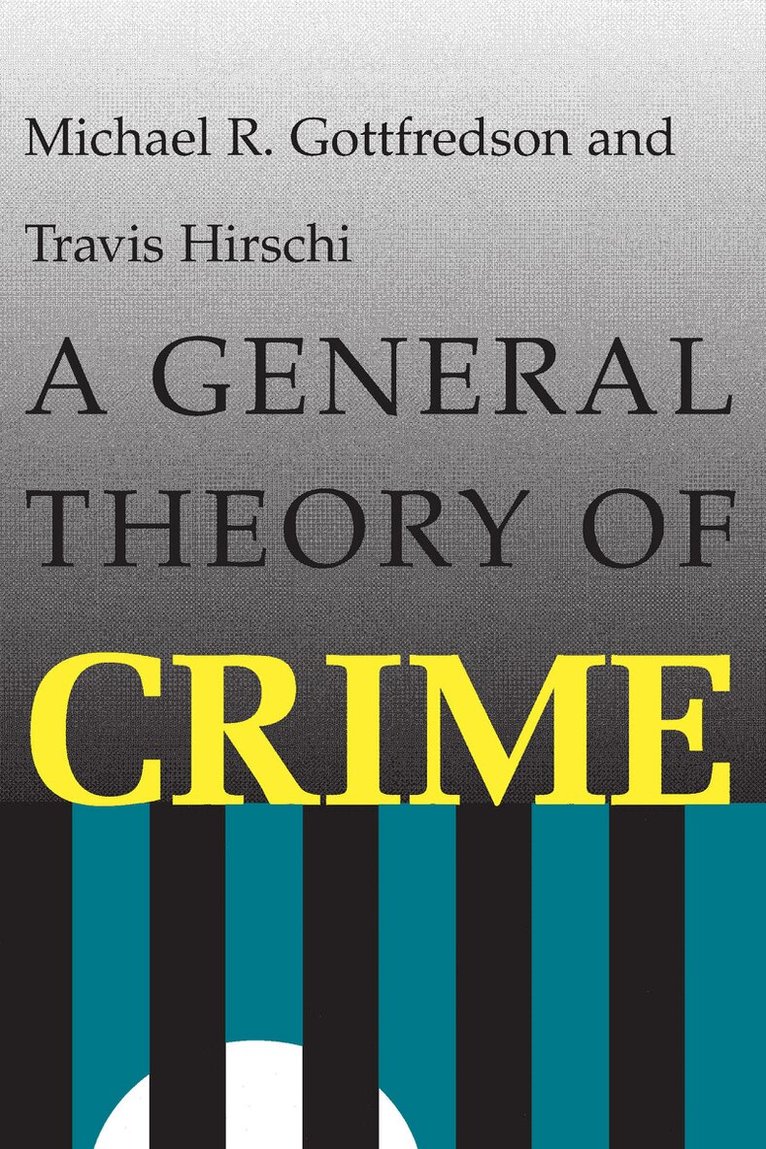
    General Theory of Crime

    AvMichael R. Gottfredson,Travis Hirschi

    Häftad, Engelska, 1990

    328 kr

    Skickas . Fri frakt över 249 kr.

    Beskrivning

    By articulating a general theory of crime and related behavior, the authors present a new and comprehensive statement of what the criminological enterprise should be about. They argue that prevalent academic criminology—whether sociological, psychological, biological, or economic—has been unable to provide believable explanations of criminal behavior.The long-discarded classical tradition in criminology was based on choice and free will, and saw crime as the natural consequence of unrestrained human tendencies to seek pleasure and to avoid pain. It concerned itself with the nature of crime and paid little attention to the criminal. The scientific, or disciplinary, tradition is based on causation and determinism, and has dominated twentieth-century criminology. It concerns itself with the nature of the criminal and pays little attention to the crime itself. Though the two traditions are considered incompatible, this book brings classical and modern criminology together by requiring that their conceptions be consistent with each other and with the results of research.The authors explore the essential nature of crime, finding that scientific and popular conceptions of crime are misleading, and they assess the truth of disciplinary claims about crime, concluding that such claims are contrary to the nature of crime and, interestingly enough, to the data produced by the disciplines themselves. They then put forward their own theory of crime, which asserts that the essential element of criminality is the absence of self-control. Persons with high self-control consider the long-term consequences of their behavior; those with low self-control do not. Such control is learned, usually early in life, and once learned, is highly resistant to change. In the remainder of the book, the authors apply their theory to the persistent problems of criminology. Why are men, adolescents, and minorities more likely than their counterparts to commit criminal acts? What is the role of the school in the causation of delinquincy? To what extent could crime be reduced by providing meaningful work? Why do some societies have much lower crime rates than others? Does white-collar crime require its own theory? Is there such a thing as organized crime? In all cases, the theory forces fundamental reconsideration of the conventional wisdom of academians and crimina justic practitioners. The authors conclude by exploring the implications of the theory for the future study and control of crime.

    Produktinformation

    • Utgivningsdatum:1990-03-01
    • Mått:155 x 230 x 30 mm
    • Vikt:440 g
    • Format:Häftad
    • Språk:Engelska
    • Antal sidor:316
    • Förlag:Stanford University Press
    • ISBN:9780804717748

    Utforska kategorier

    • Brottslighet och kriminologi inom Samhälle och politik

    Recensioner i media

    "[The authors] present a tour de force critique of past research and offer nothing less than a theory that 'explains all crime, at all times.' . . . The intellectual weight of Gottfredson and Hirschi's efforts is . . . a 'must read' . . . provocative, brilliantly argued, and always challenging."—Robert J. Sampson, University of Chicago "Most researchers who formulate theories of crime are timid, seeking to explain a small piece of the puzzle (e.g., gangs, female delinquency) at a specific point in time. Not so with Michael Gottfredson and Travis Hirschi. In A General Theory of Crime they present a tour de force critique of the past research and offer nothing less than a theory that "explains all crime, at all times." Normally such a claim would be dimissed by criminologists as wishful thinking, perhaps worse. But the intellectual weight of Gottfredson and Hirschi's efforts is forcing criminologists to take notice and rethink some cherished assumptions. Indeed, this book is a "must read" that is provocative, brilliantly argued, and always challenging."—University of Chicago "This book is well worthy of study and provides a comprehensive and challenging reading of theory and data."—British Journal of Criminology "This book presents powerful arguments, turns many neat phrases, shows that much criminology is confused about its purpose or blind to its inconsistencies, demonstrates the profound implications of its argument for criminology, generally, and for the ways it is studied, specifically, and will almost convince a reader that black is white. . . .This is an excellent book. Nobody interested in crime and deviance can afford to ignore it."—American Journal of Sociology "A General Theory of Crime effectively battles misconceptions about crime, criminals, and appropriate law-enforcement techniques that have all too long dominated thinking in the United States."—Criminal Law Bulletin "This book is clearly the most thought-provoking general criminological work since James Q. Wilson and Richard Herrnstein's Crime and Human Nature."—American Library Association "[Out] of the various psychological theories of crime, none has had the comprehensive and cogent nature of this general self-control theory. This book is the most significant reconsideration of crime in decades. . . .Must reading for all social scientists interested in crime."—Contemporary Psychology

    Innehållsförteckning

    • Preface Part I. Crime: 1. Classical theory and the idea of crime 2. The nature of crime Part II. Criminality: 3. Biological positivism 4. Psychological, economic, and sociological positivism 5. The nature of criminality: low self-control Part II. Applications of the Theory: 6. Criminal events and individual propensities: age, gender, and race 7. The social consequences of low self-control 8. Culture and crime 9. White-collar crime 10. Organization and crime Part IV. Research and Policy: 11. Research design and measurement 12. Implications for public policy Index.