• Fri frakt över 249 kr
  • •
  • Snabba leveranser
  • •
  • Billiga böcker
Kundservice

Du är på sajten för privatpersoner.

Företag, bibliotek eller offentlig verksamhet?

Du handlar på classic.bokus.com, där alla dina funktioner finns intakta.
Till classic.bokus.com
Bokus logotyp. Gå till startsidan.
  • Erbjudanden
  • Nyheter
  • Student
  • Topplistor
  • Barn & ungdom
  • Bokus Play
  • E-böcker
  • Pocketböcker
  • Spel & pussel

10% rabatt på allt med kod NYSTART10 →

Sidfot

Mina sidor

    Hjälp

    • Kundservice
    • Vanliga frågor och svar
    • Frakt och leverans
    • Retur vid ångerrätt
    • Reklamera vara
    • Betalning
    • Köpvillkor
    • Allmänna villkor
    • Information om webbplatsens tillgänglighet

    Om Bokus

    • Om oss
    • Pressrum
    • För studenter
    • För företag
    • För bibliotek och offentlig verksamhet
    • För leverantörer
    • Hållbarhet

    Populärt

    • Aktuella erbjudanden
    • Presentkort
    • Studentlitteratur
    • Nya böcker
    • Topplistor
    • Signerade böcker
    • Engelska böcker

    Inspiration

    • Boktips
    • BookTok
    • Populära bokserier
    • Barnbokskaraktärer
    • Populära författare
    Logotyp för Bokus
    Följ oss på Facebook (extern länk)Följ oss på Instagram (extern länk)Följ oss på YouTube (extern länk)Följ oss på TikTok (extern länk)
    bokus @ CookiesAnpassa cookiesIntegritetspolicyKöpvillkor
    Till Citymail hemsida (extern länk)Till Budbee hemsida (extern länk)Till Postnord hemsida (extern länk)Till Schenker hemsida (extern länk)Till Early Bird hemsida (extern länk)Till Walleys hemsida (extern länk)
    1. Skönlitteratur
    2. Litteraturvetenskap
    3. Litteraturvetenskap

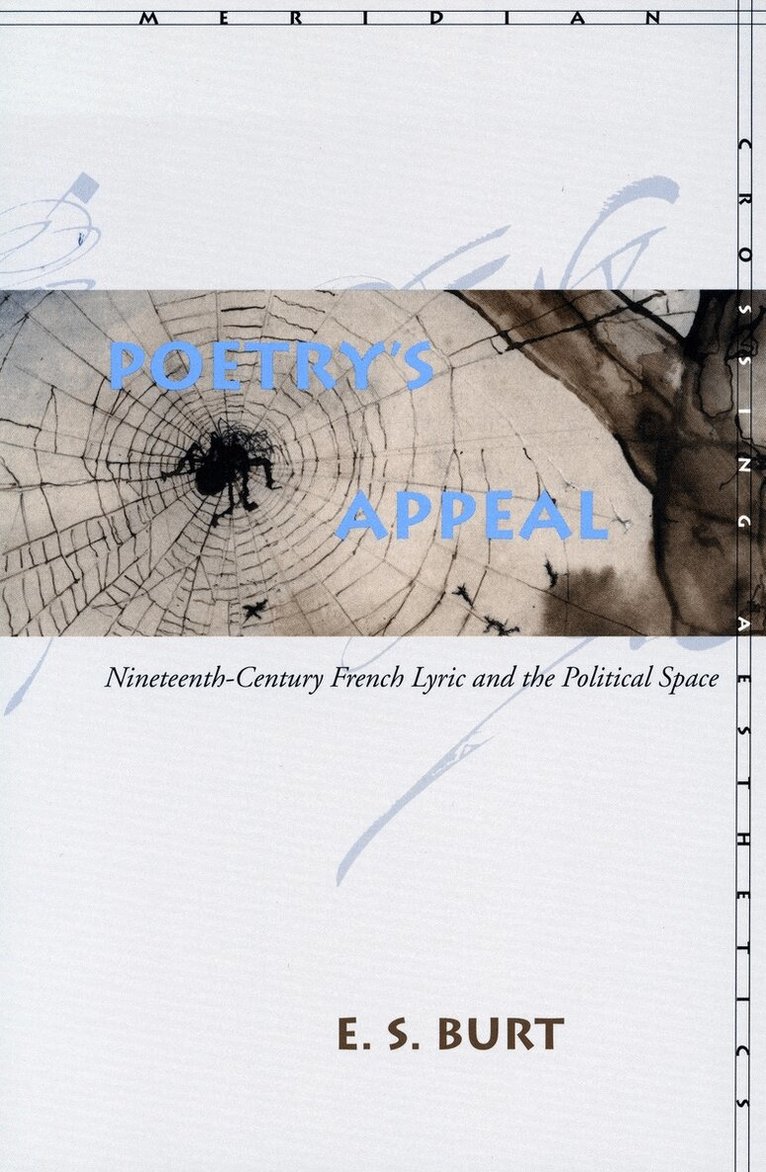
    Poetry's Appeal

    Nineteenth-Century French Lyric and the Political Space

    AvE. S. Burt

    Inbunden, Engelska, 2000

    Del i serien Meridian: Crossing Aesthetics

    1 669 kr

    Beställningsvara. Skickas inom 10-15 vardagar. Fri frakt över 249 kr.

    Fler format och utgåvor

    Häftad

    386 kr

    Beskrivning

    Socrates banished poetry from the ideal republic, adopting the philosophical position that poetic language operates outside the conventions of public discourse and is private in expression. But what does the banished language of poetry say about its relation to public space? Is it possible to draw a line severing the language of beauty from the language of truth? Derrida asks whether the line ought rather to pass between Western metaphysics, with its logic of polar opposites, and another way that does not organize everything in oppositional terms. The verbal economy organized around the poem as inscription, for instance, fits awkwardly with a division between a public discourse under the aegis of truth and a private one regulated by aesthetic pleasure.Poetry's Appeal takes the reemergence of a viable poetry in the politicized culture of revolutionary and post-revolutionary France as a signal that poetry's sentence of exile from the public arena is unresolved. It finds that poetry addresses history and the political through a disjunction between its illusory status as a song of private, lyrical intent and its actual state as a material inscription, inevitably public in character.The book confronts several issues raised by the gap between poetry's aesthetic status and its material state. It shows that this gap allows poetry to make a strong critique of symbols as weapons for waging ideological warfare. As lyric, a poem naturalizes linguistic structures whose artificiality, as inscription, it makes manifest. Inscription thus enables the poem to act subversively against the ideology it supposedly supports. Furthermore, the chances and economies of the letter, the mark, and the page can have productive, positing power in poetry. The author argues that the zones and pockets that emerge thanks to nonsignifying elements of language have analogies for reading the city space.In chapters on Chénier, Hugo, Baudelaire, Mallarmé, and Valéry, the book details some of the struggles between the ideological and material sides of poetry with the nineteenth-century remappings of political space: memory and the archive, the censorship of material history, the propping of founding performatives, the legibility of founding texts, the need to redefine action where technique is productive, and the recognition and assimilation of zones owed to technique.

    Produktinformation

    • Utgivningsdatum:2000-04-01
    • Mått:152 x 229 x 21 mm
    • Vikt:608 g
    • Format:Inbunden
    • Språk:Engelska
    • Serie:Meridian: Crossing Aesthetics
    • Antal sidor:312
    • Förlag:Stanford University Press
    • ISBN:9780804734905

    Utforska kategorier

    • Litteraturvetenskap inom Skönlitteratur

    Mer om författaren

    E. S. Burt is Associate Professor of French at the University of California, Irvine.

    Recensioner i media

    "Poetry's Appeal situates itself in what might be considered the single most significant critical debate in Romanticism over the last two or so decades. Its principal concern being the relation between (poetic) language and history, it reconsiders what has been characterized as the retreat of literature, and in particular the lyric, from politics. . . . Burt's readings follow in the line of important critics such as Paul de Man, Barbara Johnson, and Kevin Newmark, who have brought the most finely tuned rhetorical readings to nineteenth-century French literature."—European Romantic Review

    Innehållsförteckning

    • Part I. On Shifting Ground: Poetry's Orders: 1. (Dis)arming Minerva: of performatives and prosthetics in Chenier's 'La Jeune captive'; 2. Mallarmes 'bound action': the orders of the garter; Part II. Memories of the Poem: Histories, Chances: 3. Cracking the code: the poetical and political legacy of Chenier's 'antique verse'; 4. Hallucinatory history: Hugo's Revolution; 5. 'An immoderate taste for truth': censoring history in Baudelaire's 'les bijoux'; Notes; Bibliography; Index.