386 kr
Meridian: Crossing Aesthetics – serie
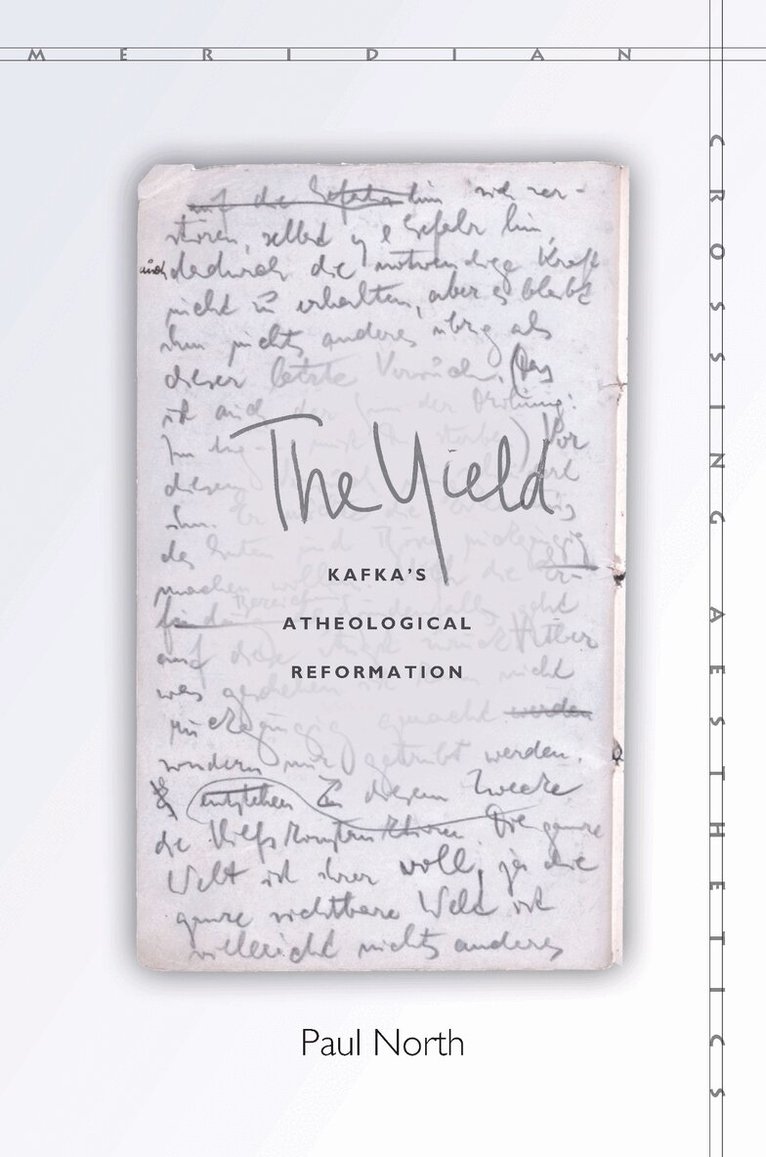
- Häftad, Engelska, 2015The Yield is a once-in-a-generation reinterpretation of the oeuvre of Franz Kafka. At the same time, it is a powerful new entry in the debates about the supposed secularity of the modern age. Kafka is one of the most admired writers of the last century, but this book presents us with a Kafka few will recognize. It does so through a fine-grained analysis of the three hundred "thoughts" the writer penned near the end of World War I, when he had just been diagnosed with tuberculosis.Since they were discovered after Kafka's death, the meaning of the so-called "Zürau aphorisms" has been open to debate. Paul North's elucidation of what amounts to Kafka's only theoretical work shows them to contain solutions to problems Europe has faced throughout modernity. Kafka offers responses to phenomena of violence, discrimination, political repression, misunderstanding, ethnic hatred, fantasies of technological progress, and the subjugation of the worker, among other problems. Reflecting on secular modernity and the theological ideas that continue to determine it, he critiques the ideas of sin, suffering, the messiah, paradise, truth, the power of art, good will, and knowledge. Kafka's controversial alternative to the bad state of affairs in his day? Rather than fight it, give in. Developing some of Kafka's arguments, The Yield describes the ways that Kafka envisions we can be good by "yielding" to our situation instead of striving for something better.
- Häftad, Engelska, 2008
296 kr
Skickas inom 5-8 vardagar
Quod non est in actis, non est in mundo. (What is not on file is not in the world.) Once files are reduced to the status of stylized icons on computer screens, the reign of paper files appears to be over. With the epoch of files coming to an end, we are free to examine its fundamental influence on Western institutions. From a media-theoretical point of view, subject, state, and law reveal themselves to be effects of specific record-keeping and filing practices. Files are not simply administrative tools; they mediate and process legal systems. The genealogy of the law described in Vismann's Files ranges from the work of the Roman magistrates to the concern over one's own file, as expressed in the context of the files kept by the East German State Security. The book concludes with a look at the computer architecture in which all the stacks, files, and registers that had already created order in medieval and early modern administrations make their reappearance. - Häftad, Engelska, 2000
322 kr
Skickas inom 5-8 vardagar
This book, by one of the most innovative and challenging contemporary thinkers, consists of an extensive essay from which the book takes its title and five shorter essays that are internally related to "Being Singular Plural."One of the strongest strands in Nancy's philosophy is his attempt to rethink community and the very idea of the social in a way that does not ground these ideas in some individual subject or subjectivity. The fundamental argument of the book is that being is always "being with," that "I" is not prior to "we," that existence is essentially co-existence. Nancy thinks of this "being-with" not as a comfortable enclosure in a pre-existing group, but as a mutual abandonment and exposure to each other, one that would preserve the "I" and its freedom in a mode of imagining community as neither a "society of spectacle" nor via some form of authenticity.The five shorter essays impressively translate the philosophical insight of "Being Singular Plural" into sophisticated discussions of national sovereignty, war and technology, identity politics, the Gulf War, and the tragic plight of Sarajevo. The essay "Eulogy for the Mêlée," in particular, is a brilliant discussion of identity and hybridism that resonates with many contemporary social concerns.As Nancy moves through the exposition of his central concern, being-with, he engages a number of other important issues, including current notions of the "other" and "self" that are relevant to psychoanalytic, political, and multicultural concepts. He also offers astonishingly original reinterpretations of major philosophical positions, such as Nietzsche's doctrine of "eternal recurrence," Descartes's "cogito," and the nature of language and meaning. - Häftad, Engelska, 1997
419 kr
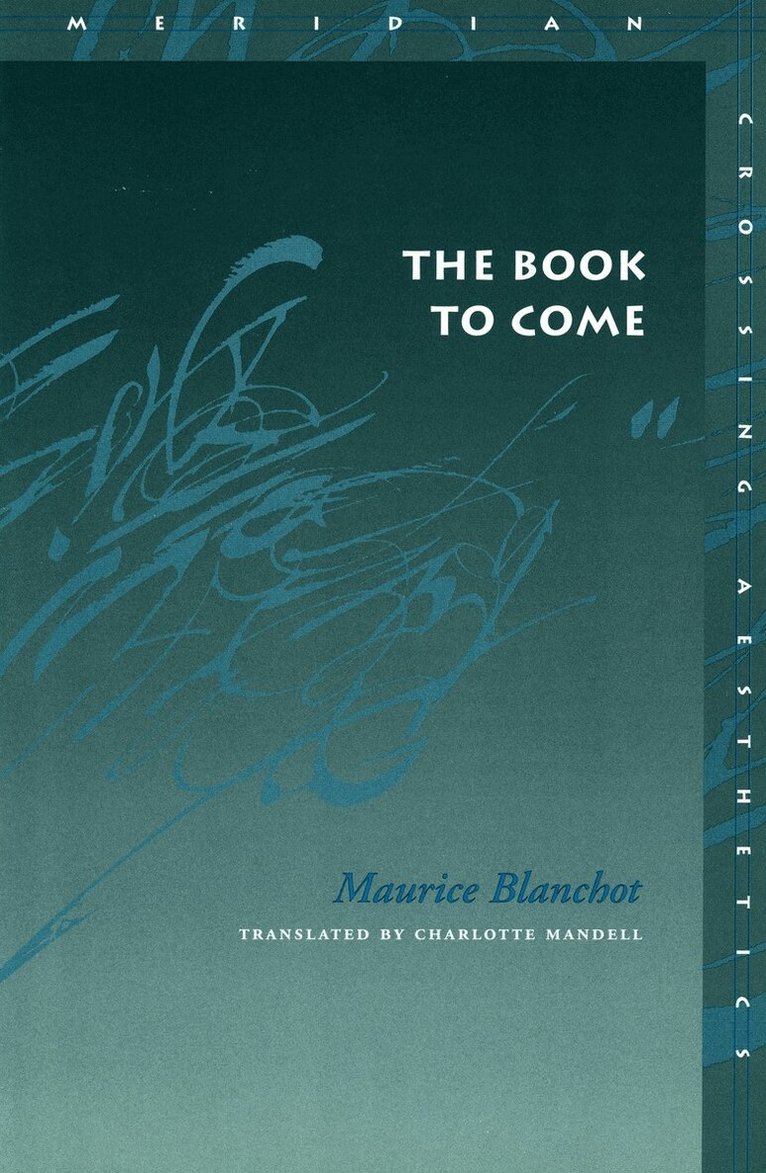
For the past half century, Maurice Blanchot has been an extraordinarily influential figure on the French literary and cultural scene. He is arguably the key figure after Sartre in exploring the relation between literature and philosophy.This collection of 29 critical essays and reviews on art, politics, literature, and philosophy documents the wide range of Blanchot's interests, from the enigmatic paintings in the Lascaux caves to the atomic era. Essays are devoted to works of fiction (Louis-René des Forêts, Pierre Klossowski, Roger Laporte, Marguerite Duras), to autobiographies or testimonies (Michel Leiris, Robert Antelme, André Gorz, Franz Kafka), or to authors who are more than ever contemporary (Jean Paulhan, Albert Camus).Several essays focus on questions of Judaism, as expressed in the works of Edmond Jabès, Emmanuel Levinas, and Martin Buber. Among the other topics covered are André Malraux's "imaginary museum," the Pléiade Encyclopedia project of Raymond Queneau, paperback publishing, the work of Claude Lévi-Strauss, Benjamin's "Task of the Translator," Marx and communism, writings on the Holocaust, and the difference between art and writing. The book concludes with an eloquent invocation to friendship on the occasion of the death of Georges Bataille. - Häftad, Engelska, 2005
302 kr
Skickas
Using the philosophy of Jean-Luc Nancy as an anchoring point, Jacques Derrida in this book conducts a profound review of the philosophy of the sense of touch, from Plato and Aristotle to Jean-Luc Nancy, whose ground-breaking book Corpus he discusses in detail. Emmanuel Levinas, Maurice Merleau-Ponty, Edmund Husserl, Didier Franck, Martin Heidegger, Francoise Dastur, and Jean-Louis Chrétien are discussed, as are René Descartes, Diderot, Maine de Biran, Félix Ravaisson, Immanuel Kant, Sigmund Freud, and others. The scope of Derrida's deliberations makes this book a virtual encyclopedia of the philosophy of touch (and the body).Derrida gives special consideration to the thinking of touch in Christianity and, in discussing Jean-Luc Nancy's essay "Deconstruction of Christianity," devotes a section of the book to the sense of touch in the Gospels. Another section concentrates on "the flesh," as treated by Merleau-Ponty and others in his wake. Derrida's critique of intuitionism, notably in the phenomenological tradition, is one of the guiding threads of the book.On Touching includes a wealth of notes that provide an extremely useful bibliographical resource. Personal and detached all at once, this book, one of the first published in English translation after Jacques Derrida's death, serves as a useful and poignant retrospective on the work of the philosopher. A tribute by Jean-Luc Nancy, written a day after Jacques Derrida's death, is an added feature. - Häftad, Engelska, 2008
352 kr
Skickas inom 5-8 vardagar
What exactly does "Europe" mean for philosophy today? Putting aside both Eurocentrism and anti-Eurocentrism, Gasché returns to the old name "Europe" to examine it as a concept or idea in the work of four philosophers from the phenomenological tradition: Husserl, Heidegger, Patočka, and Derrida. Beginning with Husserl, the idea of Europe became central to such issues as rationality, universality, openness to the other, and responsibility. Europe, or The Infinite Task tracks the changes these issues have undergone in phenomenology in order to investigate "Europe's" continuing potential for critical and enlightened resistance in a world that is progressively becoming dominated by the mono-perspectivism of global market economics. Rather than giving up on the idea of Europe as an anachronism, Gasché aims to show that it still has philosophical legs. - Häftad, Engelska, 2005
252 kr
Skickas inom 5-8 vardagar
In The Time That Remains, Agamben seeks to separate the Pauline texts from the history of the Church that canonized them, thus revealing them to be "the fundamental messianic texts of the West." He argues that Paul's letters are concerned not with the foundation of a new religion but rather with the "messianic" abolition of Jewish law. Situating Paul's texts in the context of early Jewish messianism, this book is part of a growing set of recent critiques devoted to the period when Judaism and Christianity were not yet fully distinct, placing Paul in the context of what has been called "Judaeo-Christianity." Agamben's philosophical exploration of the problem of messianism leads to the other major figure discussed in this book, Walter Benjamin. Advancing a claim without precedent in the vast literature on Benjamin, Agamben argues that Benjamin's philosophy of history constitutes a repetition and appropriation of Paul's concept of "remaining time." Through a close reading and comparison of Benjamin's "Theses on the Philosophy of History" and the Pauline Epistles, Agamben discerns a number of striking and unrecognized parallels between the two works. - Häftad, Engelska, 1997
302 kr
Skickas inom 5-8 vardagar
This book, by one of the most challenging contemporary thinkers, begins with an essay that introduces the principal concern sustained in the four succeeding ones: Why are there several arts and not just one? This question focuses on the point of maximal tension between the philosophical tradition and contemporary thinking about the arts: the relation between the plurality of the human senses—to which the plurality of the arts has most frequently been referred—and sense or meaning in general.Throughout the five essays, Nancy's argument hinges on the culminating formulation of this relation in Hegel's Aesthetics and The Phenomenology of Spirit—art as the sensible presentation of the Idea. Demonstrating once again his renowned ability as a reader of Hegel, Nancy scrupulously and generously restores Hegel's historical argument concerning art as a thing of the past, as that which is negated by the dialectic of Spirit in the passage from aesthetic religion to revealed religion to philosophy. - Häftad, Engelska, 1999
276 kr
This volume contains the speech given by Derrida at Emmanuel Levinas's funeral on December 27, 1995, and his contribution to a colloquium organized to mark the first anniversary of Levinas's death. For both thinkers, the word adieu names a fundamental characteristic of human being: the salutation or benediction prior to all constative language (in certain circumstances, one can say adieu at the moment of meeting) and that given at the moment of separation, sometimes forever, as at the moment of death, it is also the a-dieu, for God or to God before and in any relation to the other. In this book, Derrida extends his work on Levinas in previously unexplored directions via a radical rereading of Totality and Infinity and other texts, including the lesser-known talmudic readings. He argues that Levinas, especially in Totality and Infinity, bequeaths to us an "immense treatise of hospitality," a meditation on the welcome offered to the other. The conjunction of an ethics of pure prescription with the idea of an infinite and absolute hospitality confronts us with the most pressing political, juridical, and institutional concerns of our time. What, then, is an ethics and what is a politics of hospitality? And what, if it ever is, would be a hospitality surpassing any ethics and any politics we know?As always, Derrida raises these questions in the most explicit of terms, moving back and forth between philosophical argument and the political discussion of immigration laws, peace, the state of Israel, xenophobia—reminding us with every move that thinking is not a matter of neutralizing abstraction, but a gesture of hospitality for what happens and still may happen. - Häftad, Engelska, 1998
260 kr
Skickas inom 5-8 vardagar
In the three essays that make up this stimulating and often startling book, Jacques Derrida argues against the notion that the basic ideas of psychoanalysis have been thoroughly worked through, argued, and assimilated. The continuing interest in psychoanalysis is here examined in the various "resistances" to analysis—conceived not only as a phenomenon theorized at the heart of psychoanalysis, but as psychoanalysis's resistance to itself, an insusceptibility to analysis that has to do with the structure of analysis itself. Derrida not only shows how the interest of psychoanalysis and psychoanalytic writing can be renewed today, but these essays afford him the opportunity to revisit and reassess a subject he first confronted (in an essay on Freud) in 1966. They also serve to clarify Derrida's thinking about the subjects of the essays—Freud, Lacan, and Foucault—a thinking that, especially with regard to the last two, has been greatly distorted and misunderstood.The first essay, on Freud, is a tour de force of close reading of Freud's texts as philosophical reflection. By means of the fine distinctions Derrida makes in this analytical reading, particularly of The Interpretation of Dreams, he opens up the realm of analysis into new and unpredictable forms—such as meeting with an interdiction (when taking an analysis further is "forbidden" by a structural limit).Following the essay that might be dubbed Derrida's "return to Freud," the next is devoted to Lacan, the figure for whom that phrase was something of a slogan. In this essay and the next, on Foucault, Derrida reencounters two thinkers to whom he had earlier devoted important essays, which precipitated stormy discussions and numerous divisions within the intellectual milieus influenced by their writings. In this essay, which skillfully integrates the concept of resistance into larger questions, Derrida asks in effect: What is the origin and nature of the text that constitutes Lacanian psychoanalysis, considering its existence as an archive, as teachings, as seminars, transcripts, quotations, etc.?Derrida's third essay may be called not simply a criticism but an appreciation of Foucault's work: an appreciation not only in the psychological and rhetorical sense, but also in the sense that it elevates Foucault's thought by giving back to it ranges and nuances lost through its reduction by his readers, his own texts, and its formulaic packaging. - Inbunden, Engelska, 2020
1 771 kr
Skickas inom 5-8 vardagar
Two Studies of Friedrich Hölderlin shows how the poet enacts a radical theory of meaning that culminates in a unique and still groundbreaking concept of revolution, one that begins with a revolutionary understanding of language. The product of an intense engagement with both Walter Benjamin and Jacques Derrida, the book presents Werner Hamacher's major attempts at developing a critical practice commensurate with the immensity of Hölderlin's late writings. These essays offer an incisive and innovative combination of critical theory and deconstruction while also identifying where influential critics like Heidegger fail to do justice to the poet's astonishing radicality. Readers will not only come away with a new appreciation of Hölderlin's poetic and political-theoretical achievements but will also discover the motivating force behind Hamacher's own achievements as a literary scholar and political theorist. An introduction by Julia Ng and an afterword by Peter Fenves provide further information about these studies and the academic and theoretical context in which they were composed. - Häftad, Engelska, 2007
318 kr
Skickas inom 5-8 vardagar
Psyche: Inventions of the Other is the first publication in English of the twenty-eight essay collection Jacques Derrida published in two volumes in 1998 and 2003. In Volume I, Derrida advances his reflection on many topics: psychoanalysis, theater, translation, literature, representation, racism, and nuclear war, among others. The essays in this volume also carry on Derrida's engagement with a number of key thinkers and writers: Barthes, Benjamin, de Man, Flaubert, Freud, Heidegger, Lacoue-Labarthe, Levinas, and Ponge. Included in this volume are new or revised translations of seminal essays (for example, "Psyche: Invention of the Other," "The Retrait of Metaphor," "At This Very Moment in This Work Here I Am," "Tours de Babel" and "Racism's Last Word"), as well as three essays that appear here in English for the first time. - Häftad, Engelska, 2007
386 kr
Skickas inom 5-8 vardagar
Open Secrets identifies an ethos of affirmative reticence and recessive action in Mme de Lafayette's La Princesse de Clèves (1678), Jane Austen's Mansfield Park (1814), and poems by William Wordsworth, Emily Dickinson, and Thomas Hardy. The author argues that these works locate fulfillment not in narrative fruition, but in grace understood both as a simplicity of formal means and a freedom from work, in particular that of self-concealment and self-presentation. Declining the twin pressures of self-actualization and self-denial defining modernity's call to make good on one's talents, the subjects of the "literature of uncounted experience" do nothing so heroic as renounce ambitions of self-expression; they simply set aside the fantasy of the all-responsible subject. The originality of Open Secrets is thus to imagine the non-instrumental without casting it as a heavy ethical burden. Non-appropriation emerges not as what is difficult to do but as the path of least resistance. The book offers a valuable counterpoint to recent anti-Enlightenment revaluations of passivity that have made non-mastery and non-appropriation the fundamental task of the ethical subject. - Häftad, Engelska, 2008
307 kr
Skickas inom 5-8 vardagar
In Housing Problems, Susan Bernstein studies the actual houses of Goethe, Walpole, and Freud alongside textual articulations of the architectonic problems of design, containment, shelter, and fragmentation. The linking of "text" and "house" brings into focus the historical tradition that has established a symmetry between design and instance, interior and exterior, author and house—an often unexamined fantasy of historicism. Taking as its point of departure Goethe's efforts to establish such a synthesis through the concept of Bildung, the book traces the destabilization of this symmetry between house and self in Gothic literature and in narratives surrounding the founding of psychoanalysis. The interest in architecture holds open the tension between the generalizing figures of architectonics and the singular quality of housing features. These continue to mark theoretical thinking even as they dissolve and withdraw, as in Heidegger's "house of Being." - Häftad, Engelska, 2010
335 kr
Skickas inom 5-8 vardagar
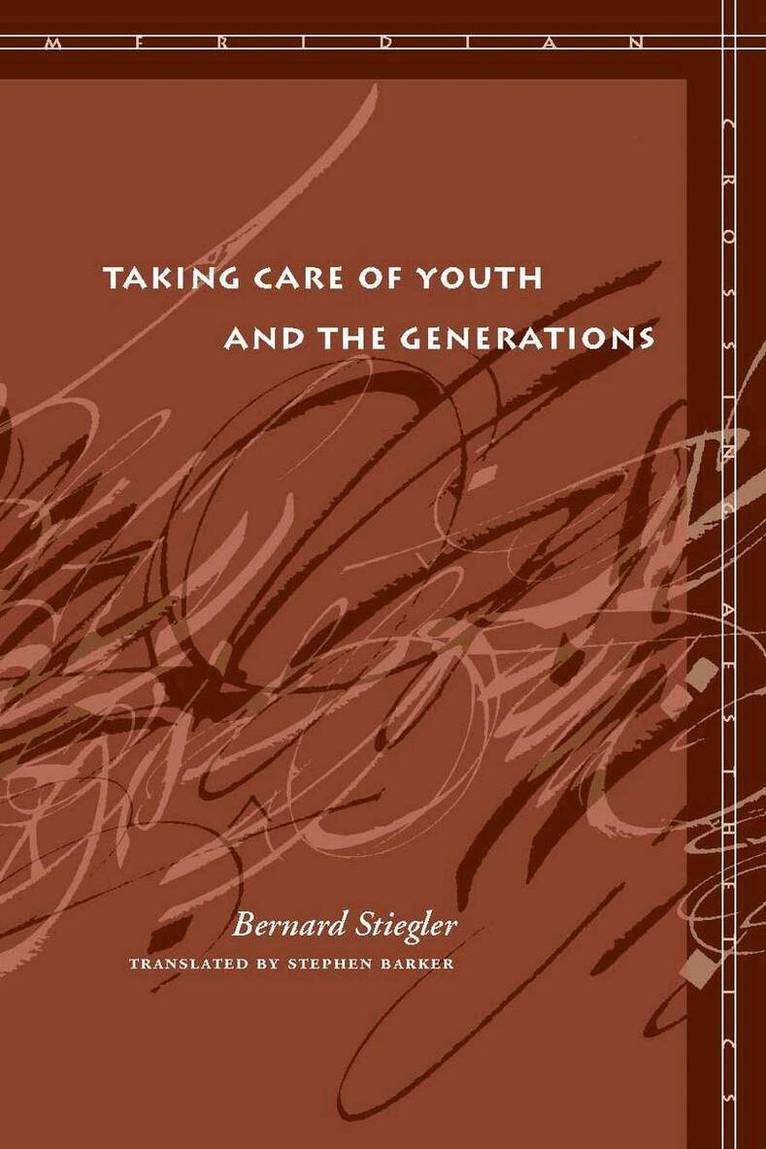
Bernard Stiegler works systematically through the current crisis in education and family relations resulting from the mesmerizing power of marketing technologies. He contends that the greatest threat to social and cultural development is the destruction of young people's ability to pay critical attention to the world around them. This phenomenon, prevalent throughout the first world, is the calculated result of technical industries and their need to capture the attention of the young, making them into a target audience and reversing the relationship between adults and children.Taking Care exposes the carelessness of these industries and urges the reader to re-enter the "battle for intelligence" against the drive-oriented culture of short-term ("short-circuited") attention characteristic of the negative aspects of the new technologies. Long-term attention, Stiegler shows, produces retentions of cultural memory mandatory for social development—and for the counteracting of ADD and ADHD. Examining the history of education from Plato to the current quagmires in France and the United States, he tracks the notion of critical thinking from its Enlightenment apotheosis to its current eradication. Stiegler is unique in combining the most radical of theoretical constructs—such as "grammatization"—with quite traditional values, values he proposes we re-address in our not-so-brave new world. - Häftad, Engelska, 2008
315 kr
Skickas
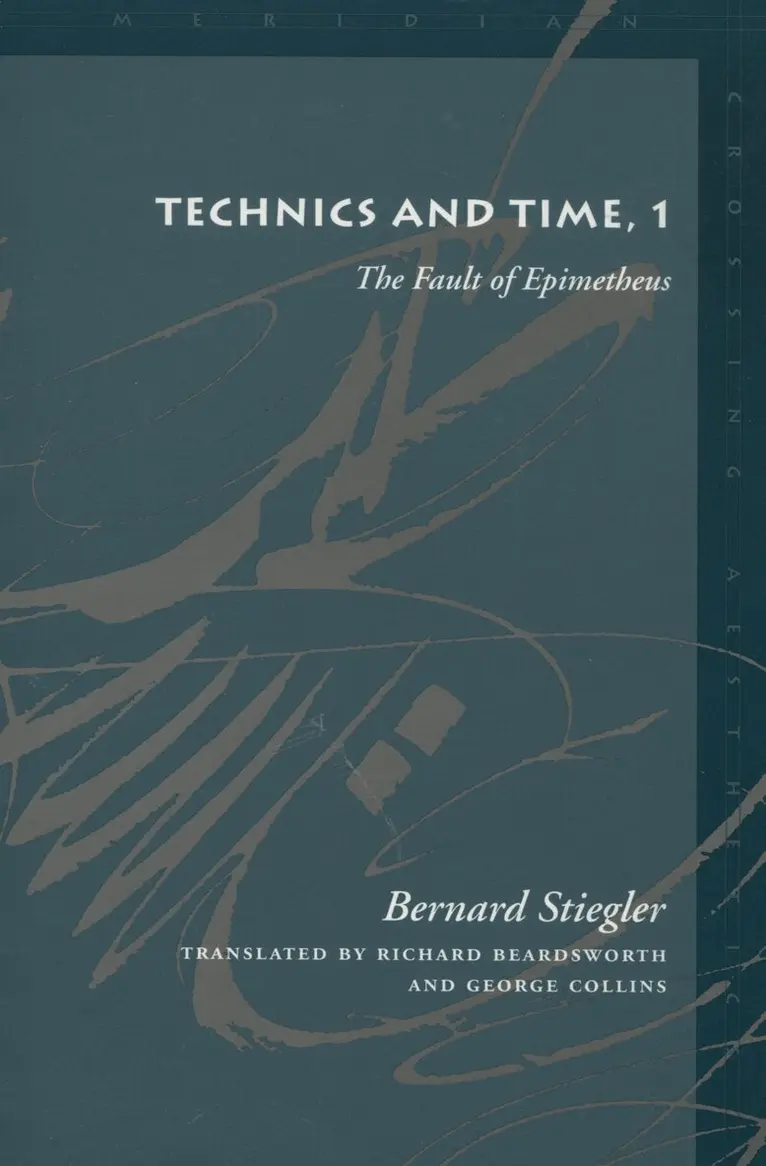
Disorientation is the first publication in English of the second volume of Technics and Time, in which French philosopher Bernard Stiegler engages in a close dialogue with Husserl, Derrida, and other philosophers who have devoted their energies to technics, such as Heidegger and Simondon.The author's broad intent is to respond to Western philosophy's historical exclusion of technics and techniques from its metaphysical questionings, and in so doing to rescue critical and philosophical thinking. For many years, Stiegler has explored the origins and philosophical, ethical, and political stakes of a global process he calls "the industrial temporalization of consciousness." Here, demonstrating that technology—including alphabetical writing—is memory, he argues that through new technologies of retention and inscription we have come to live in a world where time devours space, a disoriented world in which we have lost our bearings. Immersed in the multimedia of an over-connected world, with time and space as we know them abolished, we no longer find "cardinal points" to guide us and may even be led where we do not wish to go. We must therefore prepare to confront new spheres of ideological control and discover new possibilities in the digital environment. - Häftad, Engelska, 1998
352 kr
Skickas inom 5-8 vardagar
What is a technical object? At the beginning of Western philosophy, Aristotle contrasted beings formed by nature, which had within themselves a beginning of movement and rest, and man-made objects, which did not have the source of their own production within themselves. This book, the first of three volumes, revises the Aristotelian argument and develops an innovative assessment whereby the technical object can be seen as having an essential, distinct temporality and dynamics of its own.The Aristotelian concept persisted, in one form or another, until Marx, who conceived of the possibility of an evolution of technics. Lodged between mechanics and biology, a technical entity became a complex of heterogeneous forces. In a parallel development, while industrialization was in the process of overthrowing the contemporary order of knowledge as well as contemporary social organization, technology was acquiring a new place in philosophical questioning. Philosophy was for the first time faced with a world in which technical expansion was so widespread that science was becoming more and more subject to the field of instrumentality, with its ends determined by the imperatives of economic struggle or war, and with its epistemic status changing accordingly. The power that emerged from this new relation was unleashed in the course of the two world wars.Working his way through the history of the Aristotelian assessment of technics, the author engages the ideas of a wide range of thinkers—Rousseau, Husserl, and Heidegger, the paleo-ontologist Leroi-Gourhan, the anthropologists Vernant and Detienne, the sociologists Weber and Habermas, and the systems analysts Maturana and Varela. - Häftad, Engelska, 2010
315 kr
Skickas inom 5-8 vardagar
In the first two volumes of Technics and Time, Bernard Stiegler worked carefully through Heidegger's and Husserl's relationship to technics and technology. Here, in volume three, he turns his attention to the prolematic relationship to technics he finds in Kant's Critique of Pure Reason, particularly in the two versions of the Transcendental Deduction. Stiegler relates this problematic to the "cinematic nature" of time, which precedes cinema itself but reaches an apotheosis in it as the exteriorization process of schema, through tertiary retentions and their mechanisms. The book focuses on the relationship between these themes and the "culture industry"— as defined by Adorno and Horkheimer—that has supplanted the educational institutions on which genuine cultural participation depends. This displacement, Stiegler says, has produced a malaise from which current global culture suffers. The result is potentially catastrophic. - Häftad, Engelska, 2006
267 kr
Skickas inom 5-8 vardagar
Written between 1910 and 1929, Traces is considered Ernst Bloch's most important work next to The Principle of Hope and The Spirit of Utopia. This book, which collects aphorisms, essays, stories, and anecdotes, enacts Bloch's interest in showing how attention to "traces"—to the marks people make or to natural marks—can serve as a mode of philosophizing. In an elegant example of how the literary can become a privileged medium for philosophy, Bloch's chief philosophical invention is to begin with what gives an observer pause—what seems strange and astonishing. He then follows such traces into an awareness of the individual's relations to himself or herself and to history, conceived as a thinking into the unknown, the "not yet," and thus as utopian in essence.Traces, a masterwork of twentieth-century philosophy, is the most modest and beautiful proof of Bloch's utopian hermeneutics, taking as its source and its result the simplest, most familiar, and yet most striking stories and anecdotes. - Häftad, Engelska, 1995
404 kr
Skickas inom 5-8 vardagar
This volume collects twenty-three interviews given over the course of the last two decades by Jacques Derrida. It illustrates the extraordinary breadth of his concerns, touching upon such subjects as the teaching of philosophy, sexual difference and feminine identity, the media, AIDS, language and translation, nationalism, politics, and Derrida's early life and the history of his writings. Often, as in the interview on Heidegger, or that on drugs, or on the nature of poetry, these interviews offer not only an introduction to other discussions, but something available nowhere else in his work.When did feminist discourse become an indispensable consideration for deconstruction? What was the impact on Derrida's work of his being an Algerian Jew growing up during World War II? Is there an ineradicable gap between language-based attitude such as those found in a deconstruction and subjectivity-oriented critical models such as those developed by Foucault and Lacan? Such questions as these are answered with great thoughtfulness and intensity.Derrida's oral style is patient, generous, and helpful. His tone varies with the questioners and the subject matter—militant, playful, strategic, impassioned, analytic: difference in modulation can sometimes be heard within the same dialogue. The informality of the interview process frequently leads to the most succinct and lucid explications to be found of many of the most important and influential aspects of Derrida's thought. Sixteen of the interviews appear here for the first time in English, including an interview, conducted especially for this volume, concerning the recent exchange of letters in the New York Review of Books. - Inbunden, Engelska, 1996
1 413 kr
Skickas inom 10-15 vardagar
Friedrich Neitzsche imagined himself belonging to a society of visionaries, thinkers, architects, poets, musicians, and artists running ahead of the mainstream. They were condemned to be misunderstood or ignored in the present, but their work would become significant in the future. To them he addressed the aphorism from which Massimo Cacciari's book takes its name, saying "It is only after death that we will enter our life and come alive, oh, very much alive, we posthumous people!"Cacciari isolates Vienna as the European capitol of posthumous people at a crucial turning point in Western thinking, as the nineteenth century ended. There he finds Ludwig Wittgenstein, together with Peter Altenberg, Robert Walser, Lou Andreas-Salomé, Adolf Loos, Martin Buber, Egon Schiele, Karl Kraus, Gustav Klimt, and many others. Cacciari treats this extraordinarily rich concentration of activity as the hub upon which European culture wheeled into the twentieth century. He reaches directly to the intellectual content in each of the various figures he discusses. - Häftad, Engelska, 2000
276 kr
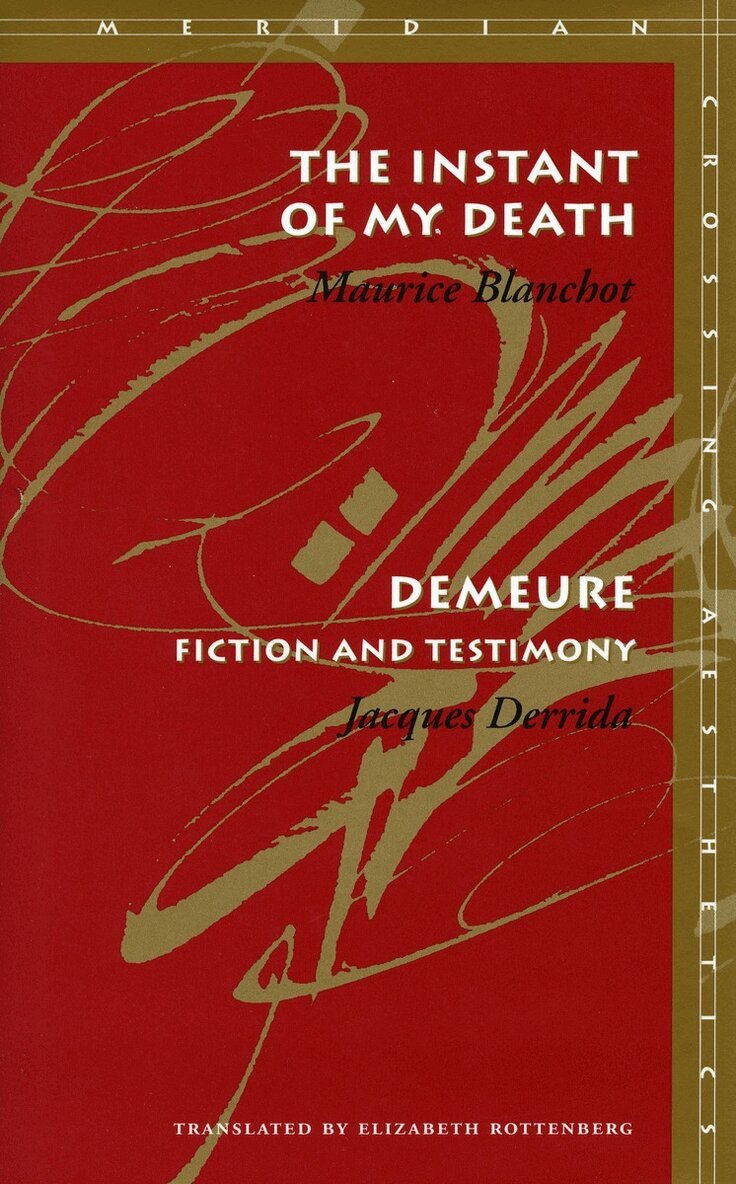
This volume records a remarkable encounter in critical and philosophical thinking: a meeting of two of the great pioneers in contemporary thought, Maurice Blanchot and Jacques Derrida, who are also bound together by friendship and a complex relation to their own pasts. More than a literary text with critical commentary, it constitutes an event of central significance for contemporary philosophical, literary, and political concerns.The book consists of The Instant of My Death, a powerful short prose piece by Blanchot, and an extended essay by Derrida that reads it in the context of questions of literature and of bearing witness. Blanchot's narrative concerns a moment when a young man is brought before a firing squad during World War II and then suddenly finds himself released from his near death. The incident, written in the third person, is suggestively autobiographical—from the title, several remarks in the text, and a letter Blanchot wrote about a similar incident in his own life—but only insofar as it raises questions for Blanchot about what such an experience might mean. The accident of near death becomes, in the instant the man is released, the accident of a life he no longer possesses. The text raises the question of what it means to write about a (non)experience one cannot claim as one's own, and as such is a text of testimony or witness.Derrida's reading of Blanchot links the problem of testimony to the problem of the secret and to the notion of the instant. It thereby provides the elements of a more expansive reassessment of literature, testimony, and truth. In addressing the complex relation between writing and history, Derrida also implicitly reflects on questions concerning the relation between European intellectuals and World War II. - Häftad, Engelska, 1998
246 kr
Skickas inom 5-8 vardagar
The powerful thesis of this book is that in order to achieve full selfhood we must all repeatedly and endlessly kill the phantasmatic image of ourselves instilled in us by our parents. We must all combat what the author calls "primary narcissism," a projection of the child our parents wanted. This idea—that each of us carries as a burden an unconscious secret of our parents, a hidden desire that we are made to live out but that we must kill in order to "be born"—touches on some of the fundamental issues of psychoanalytic theory. Around it, the author builds an intricate analysis of the relation between primary narcissism and the death drive.Each of the book's five chapters begins with one or more case studies drawn from the author's clinical experience as a psychoanalyst. In these studies he links his central concern—the image of the child created by the unconscious desire of the parents—to other issues, such as the question of love, the concept of the subject, and the death drive. In the penultimate chapter, on transference, the author challenges the commonplace understanding of the analyst's impassivity. What does such impassivity imply, especially in the context of a "transferential love" between a female patient and a male analyst? In replying to this question, the author forcefully reassesses the relation of psychoanalysis to femininity, to the question "What does a woman want?"Serge Leclaire's overarching thesis leads to a provocative rereading of the Oedipal configuration. Leclaire suggests that he is inhabited, pursued, haunted, and debilitated by the child who should have died in order that Oedipus might have been born into life. - Häftad, Engelska, 1993
251 kr
Skickas
"My death—is it possible?"That is the question asked, explored, and analyzed in Jacques Derrida's new book. "Is my death possible?" How is this question to be understood? How and by whom can it be asked, can it be quoted, can it be an appropriate question, and can it be asked in the appropriate moment, the moment of "my death"? One of the aporetic experiences touched upon in this seminal essay is the impossible, yet unavoidable experience that "my death" can never subject to an experience that would be properly mine, that I can have, and account for, yet that there is, at the same time, nothing closer to me and more properly mine than "my death."This book bears a special significance because in it Derrida focuses on an issue that has informed the whole of his work up to the present. For the last thirty years, Derrida has repeatedly, in various contexts and various ways, broached the question of aporia. Making it his central concern here Derrida stakes out a new frontier, at which the debate with his work must take place from now on: the debate about the aporia between singularity and generality, about the national, linguistic, and cultural specificity of experience and the trans-national, trans-cultural law that protects this specificity of experience and of the necessity to continue working in the tradition of critique and of the idea of critique, yet the corresponding necessity to transcend it without compromising it; the aporetical obligation to host the foreigner and the alien and yet to respect him, her, or it as foreign.The foreign or the foreigner has always been considered a figure of death, and death a figure of the foreign. How this figure has been treated in the analytic of death in Heidegger's Being in Time is explored by Derrida in analytical tour de force that will not fail to set new standards for the discussion of Heidegger and for dealing with philosophical texts, with their limits and their aporias. The detailed discussion of the theoretical presuppositions of recent cultural histories of death (Ariès, for example) and of psychological theorizations of death (including Freud's) broaden the scope of Derrida's investigation and indicate the impact of the aporia of "my death" for any possible theory. - Häftad, Engelska, 2000
376 kr
Skickas inom 5-8 vardagar
This book collects fifteen major philosophical essays written over a period of more than twenty years by acclaimed Italian philosopher Giorgio Agamben. The volume opens with an introduction in which the editor situates Agamben's work with respect to both the history of philosophy and contemporary European thought. The essays that follow articulate a series of theoretical confrontations with privileged figures in the history of philosophy, politics, and criticism, from Plato to Spinoza, Aristotle to Deleuze, Carl Schmitt to Benjamin, Hegel to Aby Warburg, and Heidegger to Derrida. Three fundamental concepts organize the collection as a whole: language, in the sense not of particular statements but rather the very taking place of speech, the pure fact of language's existence; history, as it appears from a perspective in which tradition, transmission, and memory reach their messianic fulfillment; and potentiality, understood as a fundamental problem of metaphysics, ethics, and the philosophy of language. All these topics converge in the final part of the book, in which Agamben offers an extensive reading of Melville's short story "Bartleby the Scrivener" as a work that puts potentiality and actuality, possibility and reality, in an altogether new light. - Häftad, Engelska, 2004
322 kr
Skickas inom 5-8 vardagar
Completing the translation of Derrida's monumental work Right to Philosophy (the first part of which has already appeared under the title of Who's Afraid of Philosophy?), Eyes of the University brings together many of the philosopher's most important texts on the university and, more broadly, on the languages and institutions of philosophy.In addition to considerations of the implications for literature and philosophy of French becoming a state language, of Descartes' writing of the Discourse on Method in French, and of Kant's and Schelling's philosophies of the university, the volume reflects on the current state of research and teaching in philosophy and on the question of what Derrida calls a "university responsibility."Examining the political and institutional conditions of philosophy, the essays collected here question the growing tendency to orient research and teaching towards a programmable and profitable end. The volume is therefore invaluable for the light it throws upon an underappreciated aspect of Derrida's own engagement, both philosophical and political, in struggles against the stifling of philosophical research and teaching.As a founding member of the Research Group on the Teaching of Philosophy and as one of the conveners of the Estates General of Philosophy, Derrida was at the forefront of the struggle to preserve and extend the teaching of philosophy as a distinct discipline, in secondary education and beyond, in the face of conservative government education reforms in France. As one of the founders of the Collège International de Philosophie, he worked to provide a space for research in and around philosophy that was not accepted or legitimated in other institutions. Documenting and reflecting upon these engagements, Eyes of the University brings together some of the most important and incisive of Derrida's works. - Häftad, Engelska, 2005
267 kr
Skickas inom 5-8 vardagar
Rogues, published in France under the title Voyous, comprises two major lectures that Derrida delivered in 2002 investigating the foundations of the sovereignty of the nation-state. The term "État voyou" is the French equivalent of "rogue state," and it is this outlaw designation of certain countries by the leading global powers that Derrida rigorously and exhaustively examines.Derrida examines the history of the concept of sovereignty, engaging with the work of Bodin, Hobbes, Rousseau, Schmitt, and others. Against this background, he delineates his understanding of "democracy to come," which he distinguishes clearly from any kind of regulating ideal or teleological horizon. The idea that democracy will always remain in the future is not a temporal notion. Rather, the phrase would name the coming of the unforeseeable other, the structure of an event beyond calculation and program. Derrida thus aligns this understanding of democracy with the logic he has worked out elsewhere. But it is not just political philosophy that is brought under deconstructive scrutiny here: Derrida provides unflinching and hard-hitting assessments of current political realities, and these essays are highly engaged with events of the post-9/11 world. - Inbunden, Engelska, 2008
1 340 kr
Skickas inom 10-15 vardagar
Radical Atheism presents a profound new reading of the influential French philosopher Jacques Derrida. Against the prevalent notion that there was an ethical or religious "turn" in Derrida's thinking, Hägglund argues that a radical atheism informs Derrida's work from beginning to end. Proceeding from Derrida's insight into the constitution of time, Hägglund demonstrates how Derrida rethinks the condition of identity, ethics, religion, and political emancipation in accordance with the logic of radical atheism. Hägglund challenges other major interpreters of Derrida's work and offers a compelling account of Derrida's thinking on life and death, good and evil, self and other. Furthermore, Hägglund does not only explicate Derrida's position but also develops his arguments, fortifies his logic, and pursues its implications. The result is a groundbreaking deconstruction of the perennial philosophical themes of time and desire as well as pressing contemporary issues of sovereignty and democracy. - Häftad, Engelska, 2008
322 kr
Skickas inom 5-8 vardagar
Radical Atheism presents a profound new reading of the influential French philosopher Jacques Derrida. Against the prevalent notion that there was an ethical or religious "turn" in Derrida's thinking, Hägglund argues that a radical atheism informs Derrida's work from beginning to end. Proceeding from Derrida's insight into the constitution of time, Hägglund demonstrates how Derrida rethinks the condition of identity, ethics, religion, and political emancipation in accordance with the logic of radical atheism. Hägglund challenges other major interpreters of Derrida's work and offers a compelling account of Derrida's thinking on life and death, good and evil, self and other. Furthermore, Hägglund does not only explicate Derrida's position but also develops his arguments, fortifies his logic, and pursues its implications. The result is a groundbreaking deconstruction of the perennial philosophical themes of time and desire as well as pressing contemporary issues of sovereignty and democracy. - Inbunden, Engelska, 1993
953 kr
Skickas inom 5-8 vardagar
The Problem of a Chinese Aesthetic calls for and applies a new model of comparative literature - one that, instead of taking for granted the commensurability of traditions and texts, gives incompatibility and contradiction their due. Exposing contemporary literary theory to the risks of ancient Chinese literature (and vice versa), this book considers a linked series of case studies. To what degree does the translation between languages and texts that we call comparative literature depend on allegory or translation within a single text or language? The author offers an important, new perspective on the reading of the Shih-ching or Book of Odes and the question of allegory and metaphor in the Chinese poetic tradition.