• Fri frakt över 249 kr
  • •
  • Snabba leveranser
  • •
  • Billiga böcker
Kundservice

Du är på sajten för privatpersoner.

Företag, bibliotek eller offentlig verksamhet?

Du handlar på classic.bokus.com, där alla dina funktioner finns intakta.
Till classic.bokus.com
Bokus logotyp. Gå till startsidan.
  • Erbjudanden
  • Student
  • Topplistor
  • Barn & ungdom
  • Bokus Play
  • E-böcker
  • Ljudböcker
  • Pocketböcker
  • Spel och pussel

Skapa nya rutiner – hälsoböcker upp till 50% →

Sidfot

Mina sidor

    Hjälp

    • Kundservice
    • Vanliga frågor och svar
    • Frakt och leverans
    • Retur vid ångerrätt
    • Reklamera vara
    • Betalning
    • Köpvillkor
    • Allmänna villkor
    • Information om webbplatsens tillgänglighet

    Om Bokus

    • Om oss
    • Pressrum
    • För studenter
    • För företag
    • För bibliotek och offentlig verksamhet
    • För leverantörer
    • Hållbarhet

    Populärt

    • Aktuella erbjudanden
    • Presentkort
    • Studentlitteratur
    • Nya böcker
    • Topplistor
    • Signerade böcker
    • Engelska böcker

    Inspiration

    • Boktips
    • BookTok
    • Barnbokskaraktärer
    • Populära författare
    Logotyp för Bokus
    Följ oss på Facebook (extern länk)Följ oss på Instagram (extern länk)Följ oss på YouTube (extern länk)Följ oss på TikTok (extern länk)
    bokus @ CookiesAnpassa cookiesIntegritetspolicyKöpvillkor
    Till Citymail hemsida (extern länk)Till Budbee hemsida (extern länk)Till Postnord hemsida (extern länk)Till Schenker hemsida (extern länk)Till Early Bird hemsida (extern länk)Till Walleys hemsida (extern länk)
    1. Samhälle och politik
    2. Politik och statsskick
    3. Statsskick och politiska processer

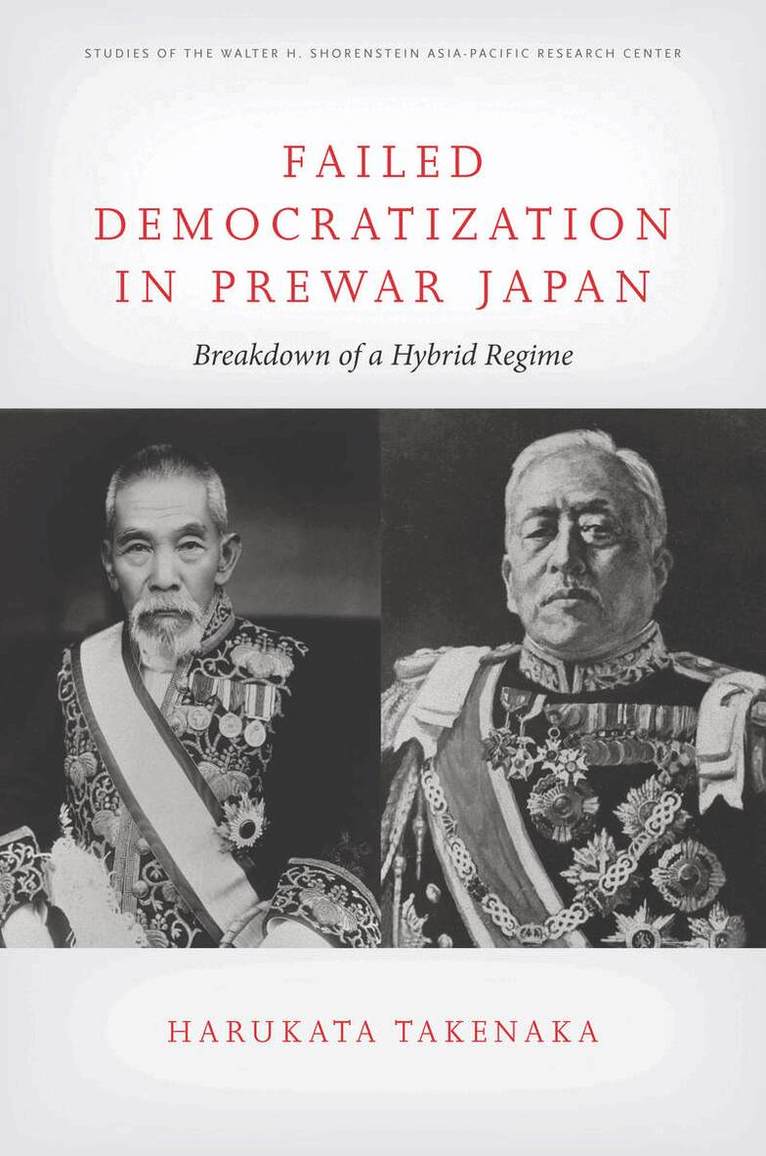
    Failed Democratization in Prewar Japan

    Breakdown of a Hybrid Regime

    AvHarukata Takenaka

    Inbunden, Engelska, 2014

    Del i serien Studies of the Walter H. Shorenstein Asia-Pacific Research Center

    726 kr

    Beställningsvara. Skickas inom 10-15 vardagar. Fri frakt över 249 kr.

    Fler format och utgåvor

    E-bok

    822 kr

    Beskrivning

    Failed Democratization in Prewar Japan presents a compelling case study on change in political regimes through its exploration of Japan's transition to democracy. Within a broad-ranging examination of Japan's "semi-democratic" political system from 1918 to 1932, when political parties tended to dominate the government, the book analyzes in detail why this system collapsed in 1932 and discusses the implications of the failure. By reference to comparable cases—prewar Argentina, prewar Germany, postwar Brazil, and 1980s Thailand—Harukata Takenaka reveals that the factors responsible for the breakdown of the Taisho democracy in Japan replicated those that precipitated the collapse of democracy in Europe, Latin America, and elsewhere in Asia. While most literature on these transitions focuses on successful cases, Takenaka explores democratic failure to answer questions about how and why political parties and their leaders can behave in ways that undermine the democratic institutions that serve as the basis for their formal authority.

    Produktinformation

    • Utgivningsdatum:2014-08-20
    • Mått:152 x 229 x 20 mm
    • Vikt:476 g
    • Format:Inbunden
    • Språk:Engelska
    • Serie:Studies of the Walter H. Shorenstein Asia-Pacific Research Center
    • Antal sidor:256
    • Förlag:Stanford University Press
    • ISBN:9780804763417

    Utforska kategorier

    • Statsskick och politiska processer inom Samhälle och politik
    • Politiskt förtryck inom Samhälle och politik

    Mer om författaren

    Harukata Takenaka is a Professor, at the National Graduate Institute for Policy Studies, Tokyo, Japan.

    Recensioner i media

    "Takenaka's strength lies in locating specific points where alternative actions might have facilitated a smooth Japanese transition to democracy . . . Takenaka thus offers an important corrective to the determinist vision of a prewar Japanese political culture adverse to democracy."—Frederick R. Dickinson, Pacific Affairs "Harukata Takenaka has written a sobering and impressive work on how democracy can break down before it is given solid birth—sobering because, of 31 Asian sovereign countries, only Japan and South Korea practice a fully fledged democracy while the rest are flawed democracies and hybrid and authoritarian regimes."—Takashi Inoguchi, Professor Emeritus, University of Tokyo and President, University of Niigata Prefecture "This book is a major contribution to the comparative literature on hybrid regimes and to the historical literature on pre-war Japanese politics. Takenaka shows how political leaders' bumbling policy performance and narrow pursuit of short term advantage exacerbated the dilemma of institutionally weak party government and a strong and increasingly politicized and ambitious military. This is a fascinating and important work of political history."—Larry Diamond, Senior Fellow, the Hoover Institution and the Freeman Spogli Institute for International Studies, Stanford University

    Innehållsförteckning

    • Failed Democratization in Prewar Japan: Breakdown of a Hybrid RegimeAuthor(s): Harukata TakenakaHow and why does a semi-democratic regime—one that developed as a result of significant degree of democratization—collapse without experiencing further democratization? This book answers these questions through a case study of the collapse of the semi-democratic regime in prewar Japan. Japan's gradual democratization after the Meiji Restoration in 1867 led to the rise of the semi-democratic regime in 1918. It was characterized by the rule of party government and electoral participation by a significant portion of the population. Confronted with a series of threats from the military, it collapsed in 1932 after the May Fifteenth Incident. This book explains the collapse of this regime as a result of shift in the balance of power between the party government and the military. It focuses on Meiji Constitution's institutional constraints as well as legitimacy and the semi-loyalty of political parties and their memebers as factors that affected the relationship/ Although the Meiji Constitution placed the party government in a weak position institutionally with respect to the military, the high legitimacy that it claimed initially enabled it to sustain the regime from the outset. Gradually, however, its legitimacy eroded and political parties became semi-loyal to the regime, tolerating or encouraging the military's challenge against to it. This led to the collapse of the semi-democratic regime. IntroductionChapter abstract: The introduction presents the central question of the book: how and why does a semi-democratic regime collapse without experiencing further democratization? It defines the semi-democratic regime, a subtype of hybrid regimes. It then describes the book's two objectives in answering this question, which it attempts to achieve through a study of the literature on hybrid regimes as well as on prewar Japanese political development. The first is to widen our knowledge of the political dynamics of hybrid regimes. The second is to provide a comprehensive analysis of Japan's political development from the late 1910s to the early 1930s. Lastly, it refers to three comparable cases of semi-democratic regimes: Great Britain in the latter half of 19th century, Brazil between 1945 and 1964, and Thailand between 1978 and 1997. 1Analytical FoundationsChapter abstract: This chapter examines various approaches to analyzing the collapse of semi-democratic regimes. It first examines whether it is possible to apply existing theories of democratization and regime change to explain such a collapse. Then it discusses the problems of these approaches and proposes an alternate analytical framework, arguing that the collapse of the prewar Japanese regime can be seen as gradual change in the relationship between the party government and the military. In other words, it can be analyzed as a process, in which democratic forces, political parties and party politicians supporting the regime, and non-democratic forces, the military opposing the regime, compete. The balance of power gradually shifted from the party government to the military. This chapter shows that it is possible to explain this shift by focusing on three factors: political institutions, regime legitimacy, and semi-loyalty. 2Defining the Regimes of Prewar JapanChapter abstract: This chapter has two objectives. First, it demonstrates that the regime that existed in Japan from 1918 to 1932 can be defined as semi-democratic. It argues that three distinct regimes—a competitive oligarchical one, a semi-democratic one, and a military authoritarian one—existed between 1889 and 1945. The first spanned 1889 to 1918, the second from 1918 to 1932, and the third from 1935 to 1945. Second, to illustrate the special nature of prewar Japanese democratization and the semi-democratic regime in prewar Japan, it compares democratization in Britain and Japan. In doing so, it examines the implications of their differences might have on the study of democratization as a whole. 3Political Institutions under the Meiji ConstitutionChapter abstract: This chapter describes characteristics of the Meiji Constitution that affected the relationship between the party government and the military. The constitution put many constraints on the party government while giving many prerogatives to the military. The party government was institutionally weak under the constitution. It was difficult for it to maintain internal cohesiveness. Second, political power was shared by various political institutions such as the Lower House, the House of Peers, Ministers, and Privy Council and thus the party government could not consolidate its political power. On the other hand, the military could employ prerogatives granted by the constitution, such as autonomy of supreme command, to challenge the government. 4The Semi-Democratic Regime, 1918-1926: Containment of the MilitaryChapter abstract: This chapter considers the relationship between the party government and the military from 1918 to 1926. It demonstrates that the party government did not face serious threats from the military; quite the contrary, it succeeded in containing it. The Hara cabinet achieved de facto subordination of supreme command of the military, party politicians continuously requested civilian ministers, and reduction of the army was implemented. The party government could take the upper hand against the military because the semi-democratic regime could claim a high level of legitimacy not only at an elite level, but also at the mass one. 5The Semi-Democratic Regime, 1926-1929: The Rise of the Military and the Decline of Party GovernmentChapter abstract: This chapter demonstrates how the semi-democratic regime gradually weakened between 1926 and 1929 under the First Wakatsuki cabinet and the Tanaka cabinet. The shift in the balance of power was clearly demonstrated by the assassination of Chang Tso-lin and—in the face of opposition from the army—the party government's failure to penalize the officers associated with it. It examines how the assassination and the government's reaction to it turned the tide between the military and the party government. This chapter then explores why the balance of power shifted toward the military, with particular reference to the legitimacy and semi-loyalty of political actors. It also considers how developments in this period affected the final breakdown of the semi-democratic regime in 1932. 6The Semi-Democratic Regime, 1929-1932: Crisis and BreakdownChapter abstract: This chapter demonstrates that between 1929 and 1932, under the Hamaguchi, the Second Wakatsuki, and the Inukai cabinets, the balance of power between the military and the party government shifted so decisively that the military succeeded in removing the party government from power in 1932, bringing an end to the semi-democratic regime. This was demonstrated by a series of crises that took place during this period: the signing of the London Naval Treaty in 1930; the March and October Incidents in 1931; the Manchurian Incident in 1931; and the May Fifteenth Incident in 1932. This chapter demonstrates that the party government could not constrain the military from taking over political power for two reasons. First, the semi-democratic regime lost its legitimacy because the party government could not effectively deal with economic problems while it revealed various political ones. Second, some party politicians acted semi-loyally to the regime. 7ConclusionChapter abstract: This chapter first summarizes the book's arguments. It then considers their implications. First, it discusses the role of semi-loyalty. It emphasizes the importance of the semi-loyalty of party politicians in changing balance of power between the military and the party government. It also demonstrates that the institutional arrangement of the Meiji Constitution was a major factor that caused party politicians to behave semi-loyally. Second, it examines findings related to legitimacy. This book shows that legitimacy also plays a decisive role in determining the fate of semi-democratic regime. It further reaffirms previous arguments on the factor that contributes to erosion of legitimacy: that is, political factors must be combined with economic crisis to severely undermine it. Lastly, it underlines importance of time as a factor in strengthening regime legitimacy.
    Hoppa över listan

    Mer från samma serie

    Gi-Wook Shin - Four Talent Giants, Häftad

    Four Talent Giants

    Gi-Wook Shin

    Häftad, 2025

    366 kr

    Rafiq Dossani, Henry Rowen - Prospects for Peace in South Asia, Inbunden

    Prospects for Peace in South Asia

    Rafiq Dossani, Henry Rowen

    Inbunden, 2005

    1 752 kr

    Rafiq Dossani, Henry Rowen - Prospects for Peace in South Asia, Häftad

    Prospects for Peace in South Asia

    Rafiq Dossani, Henry Rowen

    Häftad, 2005

    430 kr

    Joseph W. Esherick, Paul G. Pickowicz, Andrew G. Walder - Chinese Cultural Revolution As History, Inbunden

    Chinese Cultural Revolution As History

    Joseph W. Esherick, Paul G. Pickowicz, Andrew G. Walder

    Inbunden, 2006

    1 355 kr

    Joseph W. Esherick, Paul G. Pickowicz, Andrew G. Walder - Chinese Cultural Revolution As History, Häftad

    Chinese Cultural Revolution As History

    Joseph W. Esherick, Paul G. Pickowicz, Andrew G. Walder

    Häftad, 2006

    325 kr

    Gi-Wook Shin - Ethnic Nationalism in Korea, Inbunden

    Ethnic Nationalism in Korea

    Gi-Wook Shin

    Inbunden, 2006

    1 316 kr

    Gi-Wook Shin - Ethnic Nationalism in Korea, Häftad

    Ethnic Nationalism in Korea

    Gi-Wook Shin

    Häftad, 2006

    321 kr

    Yongshun Cai - Collective Resistance in China, Inbunden

    Collective Resistance in China

    Yongshun Cai

    Inbunden, 2010

    1 224 kr

    Yongshun Cai - Collective Resistance in China, Häftad

    Collective Resistance in China

    Yongshun Cai

    Häftad, 2010

    293 kr

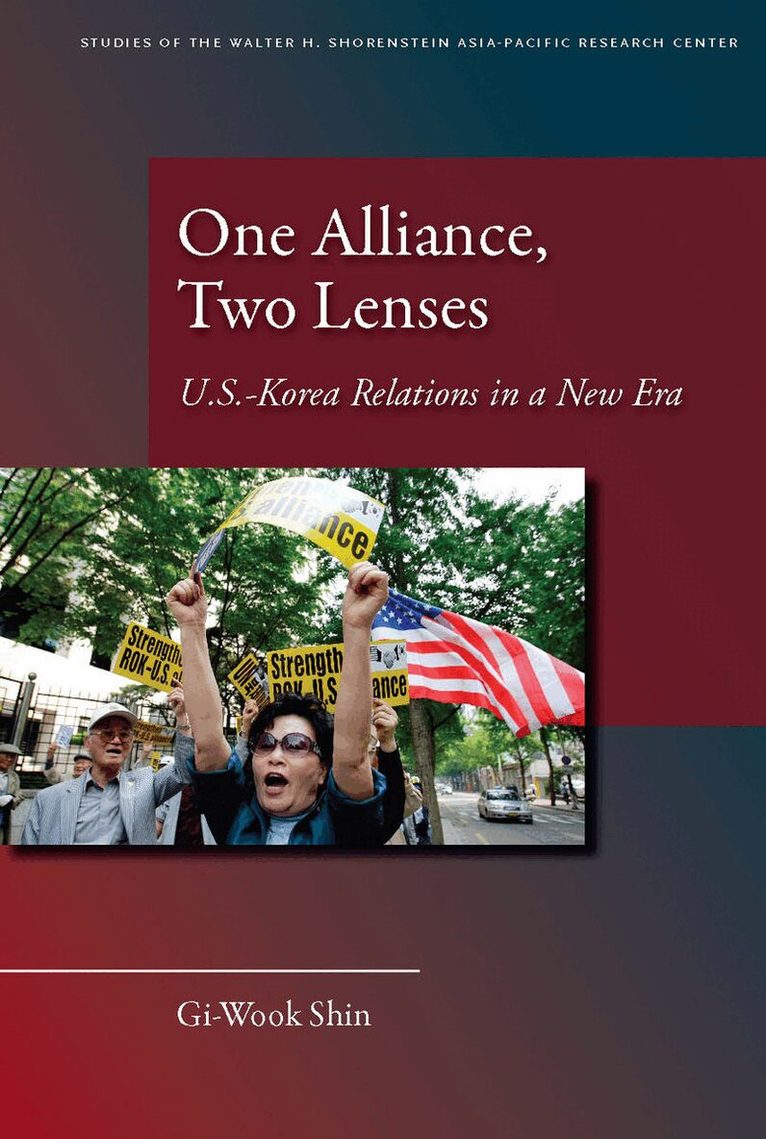
    Gi-Wook Shin - One Alliance, Two Lenses, Inbunden

    One Alliance, Two Lenses

    Gi-Wook Shin

    Inbunden, 2010

    867 kr

    Hoppa över listan

    Du kanske också är intresserad av

    Harukata Takenaka - Failed Democratization in Prewar Japan, E-bok

    Failed Democratization in Prewar Japan

    Harukata Takenaka

    E-bok
    2014

    822 kr

    Frida Gråsjö - Vatten över huvudet, Pocket
    • -45%
    Del 1

    Vatten över huvudet

    Frida Gråsjö

    Pocket, 2024

    3,4 utav 5 stjärnor. Totalt antal röster:(26)

    49 kr89 kr

    Frida Gråsjö - Beska droppar, Pocket
    • -45%
    Del 2

    Beska droppar

    Frida Gråsjö

    Pocket, 2025

    3,9 utav 5 stjärnor. Totalt antal röster:(7)

    49 kr89 kr

    Veronica Henry - Puben vid floden, Pocket
    • -51%

    Puben vid floden

    Veronica Henry

    Pocket, 2023

    4,2 utav 5 stjärnor. Totalt antal röster:(18)

    49 kr99 kr

    Kristan Higgins - Bokhandeln vid havet, Pocket
    • -51%

    Bokhandeln vid havet

    Kristan Higgins

    Pocket, 2025

    3,5 utav 5 stjärnor. Totalt antal röster:(11)

    49 kr99 kr

    Jo Nesbø - Natthuset, Pocket
    • -51%

    Natthuset

    Jo Nesbø

    Pocket, 2025

    2,5 utav 5 stjärnor. Totalt antal röster:(11)

    49 kr99 kr

    Anna Bååth - I tysta vatten, Pocket
    • -51%
    Del 1

    I tysta vatten

    Anna Bååth

    Pocket, 2025

    49 kr99 kr

    Mats Ahlstedt, Veronica Ahlstedt McCleave - Visselblåsaren, Pocket
    • -51%
    Del 1

    Visselblåsaren

    Mats Ahlstedt, Veronica Ahlstedt McCleave

    Pocket, 2025

    3,5 utav 5 stjärnor. Totalt antal röster:(2)

    49 kr99 kr

    Frida Gråsjö - En fråga om mord, Pocket
    • -51%
    Del 1

    En fråga om mord

    Frida Gråsjö

    Pocket, 2025

    3,8 utav 5 stjärnor. Totalt antal röster:(6)

    49 kr99 kr

    Mats Ahlstedt, Veronica Ahlstedt McCleave - Svindlarna, Pocket
    • -51%
    Del 2

    Svindlarna

    Mats Ahlstedt, Veronica Ahlstedt McCleave

    Pocket, 2025

    3,0 utav 5 stjärnor. Totalt antal röster:(1)

    49 kr99 kr