• Fri frakt över 249 kr
  • •
  • Snabba leveranser
  • •
  • Billiga böcker
Kundservice

Du är på sajten för privatpersoner.

Företag, bibliotek eller offentlig verksamhet?

Du handlar på classic.bokus.com, där alla dina funktioner finns intakta.
Till classic.bokus.com
Bokus logotyp. Gå till startsidan.
  • Erbjudanden
  • Nyheter
  • Student
  • Topplistor
  • Barn & ungdom
  • Bokus Play
  • E-böcker
  • Pocketböcker
  • Spel & pussel

10% studentrabatt med kod TERM26

Sidfot

Mina sidor

    Hjälp

    • Kundservice
    • Vanliga frågor och svar
    • Frakt och leverans
    • Retur vid ångerrätt
    • Reklamera vara
    • Betalning
    • Köpvillkor
    • Allmänna villkor
    • Information om webbplatsens tillgänglighet

    Om Bokus

    • Om oss
    • Pressrum
    • För studenter
    • För företag
    • För bibliotek och offentlig verksamhet
    • För leverantörer
    • Hållbarhet

    Populärt

    • Aktuella erbjudanden
    • Presentkort
    • Studentlitteratur
    • Nya böcker
    • Topplistor
    • Signerade böcker
    • Engelska böcker

    Inspiration

    • Boktips
    • BookTok
    • Populära bokserier
    • Barnbokskaraktärer
    • Populära författare

    Mina sidor

      Hjälp

      • Kundservice
      • Vanliga frågor och svar
      • Frakt och leverans
      • Retur vid ångerrätt
      • Reklamera vara
      • Betalning
      • Köpvillkor
      • Allmänna villkor
      • Information om webbplatsens tillgänglighet

      Om Bokus

      • Om oss
      • Pressrum
      • För studenter
      • För företag
      • För bibliotek och offentlig verksamhet
      • För leverantörer
      • Hållbarhet

      Populärt

      • Aktuella erbjudanden
      • Presentkort
      • Studentlitteratur
      • Nya böcker
      • Topplistor
      • Signerade böcker
      • Engelska böcker

      Inspiration

      • Boktips
      • BookTok
      • Populära bokserier
      • Barnbokskaraktärer
      • Populära författare
      Logotyp för Bokus
      Följ oss på Facebook (extern länk)Följ oss på Instagram (extern länk)Följ oss på YouTube (extern länk)Följ oss på TikTok (extern länk)
      bokus @ CookiesAnpassa cookiesIntegritetspolicyKöpvillkor
      Till Citymail hemsida (extern länk)Till Budbee hemsida (extern länk)Till Postnord hemsida (extern länk)Till Schenker hemsida (extern länk)Till Early Bird hemsida (extern länk)Till Walleys hemsida (extern länk)
      1. Ekonomi och Ledarskap
      2. Nationalekonomi
      3. Internationell ekonomi

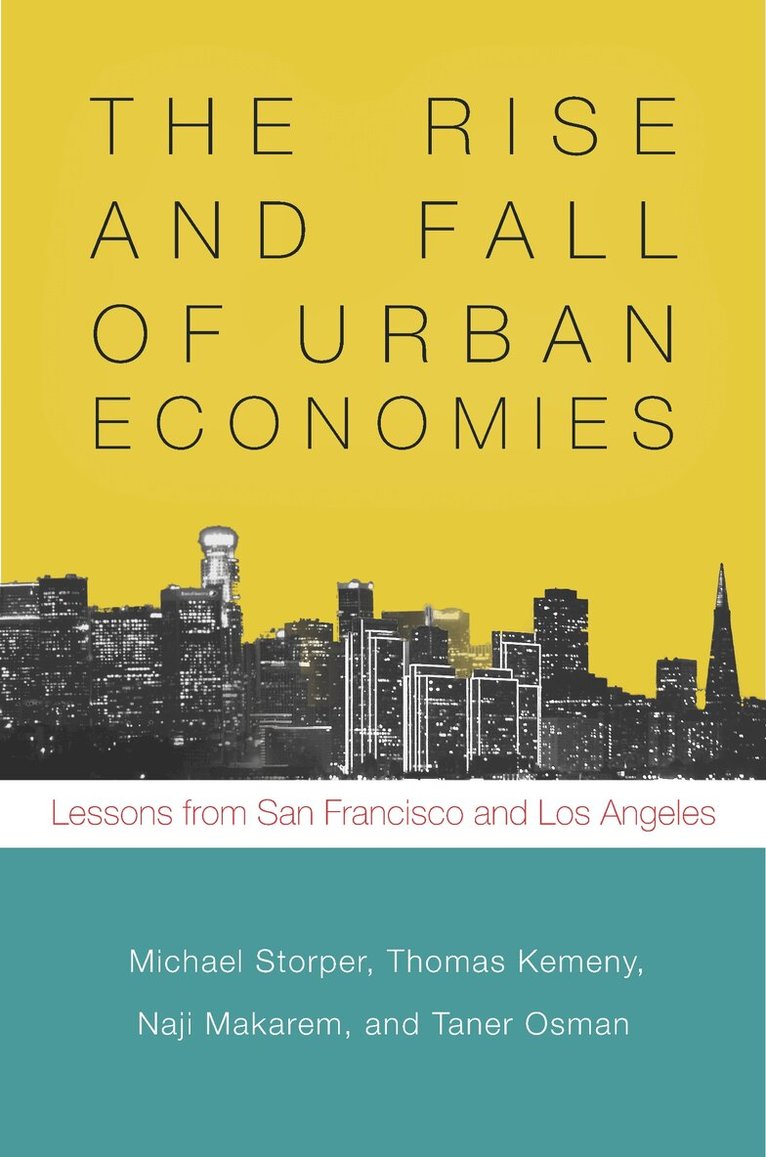
      Rise and Fall of Urban Economies

      Lessons from San Francisco and Los Angeles

      AvMichael Storper,Thomas Kemeny

      Inbunden, Engelska, 2015

      Del i serien Innovation and Technology in the World Economy

      1 654 kr

      Beställningsvara. Skickas inom 5-8 vardagar. Fri frakt över 249 kr.

      Fler format och utgåvor

      E-bok

      486 kr

      Häftad

      410 kr

      Beskrivning

      Today, the Bay Area is home to the most successful knowledge economy in America, while Los Angeles has fallen progressively further behind its neighbor to the north and a number of other American metropolises. Yet, in 1970, experts would have predicted that L.A. would outpace San Francisco in population, income, economic power, and influence. The usual factors used to explain urban growth—luck, immigration, local economic policies, and the pool of skilled labor—do not account for the contrast between the two cities and their fates. So what does?The Rise and Fall of Urban Economies challenges many of the conventional notions about economic development and sheds new light on its workings. The authors argue that it is essential to understand the interactions of three major components—economic specialization, human capital formation, and institutional factors—to determine how well a regional economy will cope with new opportunities and challenges. Drawing on economics, sociology, political science, and geography, they argue that the economic development of metropolitan regions hinges on previously underexplored capacities for organizational change in firms, networks of people, and networks of leaders. By studying San Francisco and Los Angeles in unprecedented levels of depth, this book extracts lessons for the field of economic development studies and urban regions around the world.

      Produktinformation

      • Utgivningsdatum:2015-09-02
      • Mått:152 x 229 x 25 mm
      • Vikt:499 g
      • Format:Inbunden
      • Språk:Engelska
      • Serie:Innovation and Technology in the World Economy
      • Antal sidor:328
      • Förlag:Stanford University Press
      • ISBN:9780804789400

      Utforska kategorier

      • Internationell ekonomi inom Ekonomi och Ledarskap
      • Ekonomisk politik inom Ekonomi och Ledarskap
      • Regional planering inom Naturvetenskap och teknik

      Mer om författaren

      Michael Storper is Professor of Urban Planning at the University of California, Los Angeles.Thomas Kemeny is Lecturer in Human Geography at the University of Southampton.Naji Makarem is Lecturer in the Bartlett Development Planning Unit (DPU) at University College London (UCL).Taner Osman is an instructor in the Department of Urban Planning at the University of California, Los Angeles.

      Recensioner i media

      "This is a very serious new book about economics and policy written by a team of academics under the leadership of Michael Storper . . . But it is written in a very accessible style, using the structure of a scientific detective story. And it is a must-read for anyone who cares about the future of California and cities more broadly."—Jon Christensen, SFGate "The Rise and Fall of Urban Economies is a path-breaking book, both empirically and theoretically. It brings together an impressive array of data that helps explain the divergent economic trajectories of the San Francisco Bay Area and the Los Angeles region, and provides new theoretical insights on the importance of social networks and knowledge communities in shaping economic growth."—Chris Benner, University of California, Santa Cruz "Throughout history, commerce and cities have invented and paced each other. Once developed, cities entered into competition. Blending the perspectives of history, business, urban planning, and public/private partnership, this lively and exhaustively documented study tells the story of how two representative urban regions—the Bay Area centered on San Francisco and Los Angeles, a metropolitan region unto itself— have carried on this ancient and ever new competition for commerce and hegemony."—Kevin Starr, University of Southern California "A highly original inquiry into the diverging development trajectories of Los Angeles and San Francisco since the 1970s. This book offers exemplary forensic evidence, while at the same time providing a robust theoretical appraisal of regional growth in general."—Allen J. Scott, Distinguished Research Professor, University of California, Los Angeles "Storper and his colleagues have crafted a sweeping yet nuanced account of how the economies of metropolitan Los Angeles and San Francisco have steadily diverged over the past several decades. Their interpretation, based on a wealth of data and interviews, has important lessons for many urban regions struggling to maintain or improve their place in the global economy."—Edward J. Malecki, The Ohio State University

      Innehållsförteckning

      • Contents and Abstracts1The Divergent Development of City Regions chapter abstractEconomic development is geographically uneven; incomes differ widely across places. After a long period during which incomes tended to become more even across cities and regions within developed countries, they are now diverging again. In 1970, the San Francisco Bay Area and Greater Los Angeles regions had very similar per capita incomes; in 2012, Los Angeles was almost 30 percent lower than the Bay Area. Understanding this process of divergence, which is widespread among metropolitan regions around the world, is a window on understanding economic development more generally.2Divergent Development: The Conceptual Challenge chapter abstractInnumerable forces influence economic development, and research on it uses many different methods and comes from several disciplines. Four theoretical fields that contribute to understanding divergent economic development of city regions are development theory, regional science and urban economics, the new economic geography, and the social science of institutions. Together, they provide a robust framework for understanding convergence and divergence in economic development.3The Motor of Divergence: High-Wage or Low-Wage specialization chapter abstractThe specialization of urban regions in different tradable industries is the source of significant differences in wages and income levels. Los Angeles was more specialized than San Francisco in 1970 but considerably less specialized in 2010. During this period, San Francisco consolidated its specialization in activities related to information technology, and Los Angeles consolidated its hold on the entertainment industries, but Los Angeles lost many other high-wage specializations it formerly contained, replacing them with low-wage specializations. Los Angeles also lost its lead over San Francisco in innovative sectors, as the latter soared in its per capita patenting rate. All in all, Los Angeles's economy came to have less overall focus and sophistication, while San Francisco's came to have more.4The Role of Labor in Divergence: Quality of Workers or Quality of Jobs? chapter abstractDifferences in average regional wages between San Francisco and Los Angeles increased from 5 percent in 1970 to 35 percent in 2010. Wage gaps are due partially to increasing differences in the skills of the labor force but are proportionally greater than the increase in skills gaps. Skills gaps themselves must also be explained. Do they emerge as different kinds of people migrate or stay according to different kinds of jobs created in the two regions? Or is it the reverse: people go to the two regions in search of lifestyle amenities and housing, and the two economies diverge by absorbing different kinds of people? This is the key debate in urban labor economics. This chapter shows that the key force in drawing different kinds of labor was an increasing gap in the types of employment available, itself driven by differences in regional economic specialization.5Economic Specialization: Pathways to Change chapter abstractIndustries, firms, and entrepreneurs in the Bay Area and Los Angeles did not plan the economic divergence of their regions. They faced challenges from the restructuring of the Old Economy and benefited from the opportunities of the New Economy. Their successes and failures widened the income gap between the two regions. This chapter presents comparative case studies of entertainment, aerospace, information technology, logistics, and biotechnology in San Francisco and Los Angeles, showing how they developed differently and shaped specialization, wages, and income divergence in the two regions.6Economic Development Policies: Their Role in Economic Divergence chapter abstractRegional economic development is shaped by many policies, which are implemented by national governments, regional and state governments, and local governments. But local economic development policies in Greater Los Angeles and the San Francisco Bay Area since 1970 had little to do with the economic divergence of these two regions. In reality, many so-called economic development policies have little to do with economic development as such, instead emphasizing land use changes and competition for sales tax revenue rather than industry and job development. Many of the problems with local planning and development policies in the United States in general are exemplified by the comparison of the San Francisco Bay Area and Greater Los Angeles.7Beliefs and Worldviews in Economic Development: To Which Club Do We Belong? chapter abstractDominant beliefs—those of political and economic entrepreneurs in a position to make policies—over time result in the accretion of an elaborate structure of institutions that determine economic and political performance. This chapter documents the worldviews and beliefs of regional leaders in the San Francisco Bay Area and Greater Los Angeles since 1970. In Los Angeles, leaders never developed a consistent vision of the new economy or the region's role in it; in San Francisco, this vision emerged early in the 1980s and was reinforced over time and diffused throughout the region's leadership institutions. Moreover, San Francisco's leadership institutions are stronger and more interconnected than those of Greater Los Angeles, and its political majorities are more consistent over time, leading to more consistent regional policy agendas.8Seeing the Landscape: The Relational Infrastructure of Regions chapter abstractNetworks of people and organizations create "invisible colleges" in labor markets, industries, communities, and political leadership. They influence who gets access to other people and hence to implementing ideas and finding resources. This chapter measures the corporate, philanthropic, and leadership networks of the San Francisco Bay Area and Greater Los Angeles since 1980. It shows that they had similar starting points in terms of their structure of connections, but that they diverged. Principal firms and industries in Los Angeles became less connected, while in San Francisco they become more closely intertied, with broader and deeper connections among their boards of directors. Networks among scientists, researchers, entrepreneurs, and firms are much denser in San Francisco than in Greater Los Angeles. There are more industry-building dealmakers in the Bay Area than in Los Angeles. The relational infrastructures of the two regions have become more and more different over time.9Connecting the Dots: What Caused Divergence? chapter abstractThe sources of economic divergence lie in their divergent levels and types of economic specialization. Specialization is caused by many forces, including lucky breakthroughs in technology, particular powerful individuals, decisions of key firms at critical turning points, and lock-in effects from initial advantages. Most of these forces cannot be predicted or created. But they must find fertile ground, and this ground is prepared by the ability of the regional economy's firms, leaders, and workers to create and absorb the organizational change that is key to new, high-wage industries. Los Angeles and San Francisco are a striking contrast in these abilities, with Los Angeles's firms and leaders persistently returning to Old Economy organizational forms and San Francisco's firms and leaders consistently inventing the organizational forms of the New Economy that become models for the American and world economies as a whole.10Shaping Economic Development: Policies and Strategies chapter abstractHigh-wage specialization comes from a complex sequence involving entrepreneurship, encouragement by local robust actors or leaders, breakthrough innovations, new organizational practices, the emergence of supportive overall relational infrastructure and networks, the proliferation of new specialized brokers and dealmakers, the diffusion of conventions or rules of thumb for doing business in new ways, and ultimately the consolidation of major firms. What is common to all processes of successful respecialization of a region's economy is the emergence of the right kinds of networks, organizational practices, worldviews, and beliefs for the region's evolving economic specializations. It is crucial to align understandings and change expectations so as to change policy agendas and to open up new forms of private action. When regional conversations are outdated, the process of organizational adjustment is stymied, as it has been in Los Angeles for 40 years. Old conversations must not crowd out new ones.11Improving Analysis of Urban Regions: Methods and Models chapter abstractThe chapter assesses the contributions of regional science and urban economics, the new economic geography, and the institutional approaches found in economics, sociology, and political science to the analysis of urban economic development. The concept of development clubs should guide empirical identification of city-regions that are in different structural categories and their different constraints and opportunities. Each theory has additional empirical and methodological gaps that can be improved on. If this is done, then the field of comparative regional economic analysis will be able to offer more robust insights into economic development.
      Hoppa över listan

      Mer från samma författare

      Allen J. Scott, Michael Storper - Pathways to Industrialization and Regional Development, Inbunden

      Pathways to Industrialization and Regional Development

      Allen J. Scott, Michael Storper

      Inbunden, 1992

      3 686 kr

      Michael Storper, Stavros Thomadakis - Latecomers in the Global Economy, Inbunden

      Latecomers in the Global Economy

      Michael Storper, Stavros Thomadakis

      Inbunden, 1998

      2 978 kr

      Richard Walker, Michael Storper - Capitalist Imperative, Häftad

      Capitalist Imperative

      Richard Walker, Michael Storper

      Häftad, 1989

      542 kr

      Michael Storper, Robert Salais - Worlds of Production, Inbunden

      Worlds of Production

      Michael Storper, Robert Salais

      Inbunden, 1997

      829 kr

      Michael Storper - Keys to the City, Inbunden

      Keys to the City

      Michael Storper

      Inbunden, 2013

      484 kr

      Michael Storper - Keys to the City, Häftad

      Keys to the City

      Michael Storper

      Häftad, 2020

      778 kr

      Stavros Thomadakis, Michael Storper - Latecomers in the Global Economy, E-bok

      Latecomers in the Global Economy

      Stavros Thomadakis, Michael Storper

      E-bok
      2005

      942 kr

      Stavros Thomadakis, Michael Storper - Latecomers in the Global Economy, E-bok

      Latecomers in the Global Economy

      Stavros Thomadakis, Michael Storper

      E-bok
      2005

      939 kr

      Michael Storper, Stavros Thomadakis - Latecomers in the Global Economy, Häftad

      Latecomers in the Global Economy

      Michael Storper, Stavros Thomadakis

      Häftad, 2014

      799 kr

      Michael Storper - Keys to the City, E-bok

      Keys to the City

      Michael Storper

      E-bok
      2013

      663 kr

      Hoppa över listan

      Mer från samma serie

      Urs von Burg - Triumph of Ethernet, Inbunden

      Triumph of Ethernet

      Urs von Burg

      Inbunden, 2002

      1 728 kr

      Urs von Burg - Triumph of Ethernet, Häftad

      Triumph of Ethernet

      Urs von Burg

      Häftad, 2002

      417 kr

      Gary Fields - Territories of Profit, Inbunden

      Territories of Profit

      Gary Fields

      Inbunden, 2003

      1 728 kr

      Gary Fields - Territories of Profit, Häftad

      Territories of Profit

      Gary Fields

      Häftad, 2003

      417 kr

      Martin Kenney, Richard Florida - Locating Global Advantage, Inbunden

      Locating Global Advantage

      Martin Kenney, Richard Florida

      Inbunden, 2003

      1 817 kr

      Martin Kenney, Richard Florida - Locating Global Advantage, Häftad

      Locating Global Advantage

      Martin Kenney, Richard Florida

      Häftad, 2003

      258 kr

      David C. Mowery, Richard R. Nelson, Bhaven N. Sampat, Arvids A. Ziedonis - Ivory Tower and Industrial Innovation, Inbunden

      Ivory Tower and Industrial Innovation

      David C. Mowery, Richard R. Nelson, Bhaven N. Sampat, Arvids A. Ziedonis

      Inbunden, 2004

      1 127 kr

      Martin Fransman - Global Broadband Battles, Häftad

      Global Broadband Battles

      Martin Fransman

      Häftad, 2006

      478 kr

      John Zysman, Abraham Newman - How Revolutionary Was the Digital Revolution?, Inbunden

      How Revolutionary Was the Digital Revolution?

      John Zysman, Abraham Newman

      Inbunden, 2006

      2 457 kr

      John Zysman, Abraham Newman - How Revolutionary Was the Digital Revolution?, Häftad

      How Revolutionary Was the Digital Revolution?

      John Zysman, Abraham Newman

      Häftad, 2006

      584 kr

      Hoppa över listan

      Du kanske också är intresserad av

      Michael Storper, Thomas Kemeny, Naji Makarem, Taner Osman - Rise and Fall of Urban Economies, E-bok

      Rise and Fall of Urban Economies

      Michael Storper, Thomas Kemeny, Naji Makarem, Taner Osman

      E-bok
      2015

      486 kr

      Michael Storper, Thomas Kemeny, Naji Makarem, Taner Osman - Rise and Fall of Urban Economies, Häftad

      Rise and Fall of Urban Economies

      Michael Storper, Thomas Kemeny, Naji Makarem, Taner Osman

      Häftad, 2016

      410 kr

      Jerry Hage - Restoring the Innovative Edge, Inbunden

      Restoring the Innovative Edge

      Jerry Hage

      Inbunden, 2011

      1 498 kr

      Michael Storper, Stavros Thomadakis - Latecomers in the Global Economy, Häftad

      Latecomers in the Global Economy

      Michael Storper, Stavros Thomadakis

      Häftad, 2014

      799 kr

      Richard Walker, Michael Storper - Capitalist Imperative, Häftad

      Capitalist Imperative

      Richard Walker, Michael Storper

      Häftad, 1989

      542 kr

      Stavros Thomadakis, Michael Storper - Latecomers in the Global Economy, E-bok

      Latecomers in the Global Economy

      Stavros Thomadakis, Michael Storper

      E-bok
      2005

      942 kr

      Michael Storper, Robert Salais - Worlds of Production, Inbunden

      Worlds of Production

      Michael Storper, Robert Salais

      Inbunden, 1997

      829 kr

      Michael Storper - Regional World, Häftad

      Regional World

      Michael Storper

      Häftad, 1997

      724 kr

      Michael Storper - Keys to the City, Inbunden

      Keys to the City

      Michael Storper

      Inbunden, 2013

      484 kr

      Michael Storper, Stavros Thomadakis - Latecomers in the Global Economy, Inbunden

      Latecomers in the Global Economy

      Michael Storper, Stavros Thomadakis

      Inbunden, 1998

      2 978 kr