• Fri frakt över 249 kr
  • •
  • Snabba leveranser
  • •
  • Billiga böcker
Kundservice

Du är på sajten för privatpersoner.

Företag, bibliotek eller offentlig verksamhet?

Du handlar på classic.bokus.com, där alla dina funktioner finns intakta.
Till classic.bokus.com
Bokus logotyp. Gå till startsidan.
  • Erbjudanden
  • Student
  • Topplistor
  • Barn & ungdom
  • Bokus Play
  • E-böcker
  • Ljudböcker
  • Pocketböcker
  • Spel & pussel

Upp till 25% på utvalda nyheter →

Sidfot

Mina sidor

    Hjälp

    • Kundservice
    • Vanliga frågor och svar
    • Frakt och leverans
    • Retur vid ångerrätt
    • Reklamera vara
    • Betalning
    • Köpvillkor
    • Allmänna villkor
    • Information om webbplatsens tillgänglighet

    Om Bokus

    • Om oss
    • Pressrum
    • För studenter
    • För företag
    • För bibliotek och offentlig verksamhet
    • För leverantörer
    • Hållbarhet

    Populärt

    • Aktuella erbjudanden
    • Presentkort
    • Studentlitteratur
    • Nya böcker
    • Topplistor
    • Signerade böcker
    • Engelska böcker

    Inspiration

    • Boktips
    • BookTok
    • Populära bokserier
    • Barnbokskaraktärer
    • Populära författare
    Logotyp för Bokus
    Följ oss på Facebook (extern länk)Följ oss på Instagram (extern länk)Följ oss på YouTube (extern länk)Följ oss på TikTok (extern länk)
    bokus @ CookiesAnpassa cookiesIntegritetspolicyKöpvillkor
    Till Citymail hemsida (extern länk)Till Budbee hemsida (extern länk)Till Postnord hemsida (extern länk)Till Schenker hemsida (extern länk)Till Early Bird hemsida (extern länk)Till Walleys hemsida (extern länk)
    1. Psykologi och pedagogik
    2. Pedagogik
    3. Pedagogisk psykologi

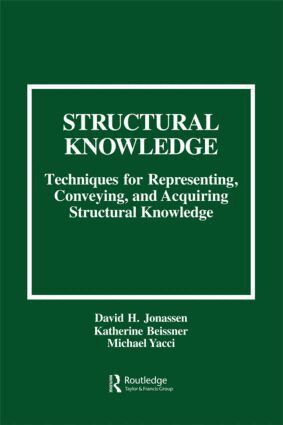
    Structural Knowledge

    Techniques for Representing, Conveying, and Acquiring Structural Knowledge

    AvDavid H. Jonassen,Katherine Beissner

    Häftad, Engelska, 1993

    894 kr

    Beställningsvara. Skickas inom 10-15 vardagar. Fri frakt över 249 kr.

    Fler format och utgåvor

    Inbunden

    2 354 kr

    Beskrivning

    This book introduces the concept of a hypothetical type of knowledge construction -- referred to as structural knowledge -- that goes beyond traditional forms of information recall to provide the bases for knowledge application. Assuming that the validity of the concept is accepted, the volume functions as a handbook for supporting the assessment and use of structural knowledge in learning and instructional settings. It's descriptions are direct and short, and its structure is consistent. Almost all of the chapters describe a technique for representing and assessing structural knowledge acquisition, conveying knowledge structures through direct instruction, or providing learners with strategies that they may use to acquire structural knowledge. These chapters include the following sections in the same sequence: * description of the technique and its theoretical or conceptual rationale * examples and applications * procedures for development and use * effectiveness -- learner interactions and differences, and advantages and disadvantages * references to the literature. The chapters are structured to facilitate access to information as well as to illuminate comparisons and contrasts among the techniques.

    Produktinformation

    • Utgivningsdatum:1993-02-01
    • Mått:152 x 229 x 16 mm
    • Vikt:385 g
    • Format:Häftad
    • Språk:Engelska
    • Antal sidor:280
    • Förlag:Taylor & Francis Inc
    • ISBN:9780805813609

    Utforska kategorier

    • Pedagogisk psykologi inom Psykologi och pedagogik
    • Kognitiv psykologi inom Psykologi och pedagogik

    Mer om författaren

    Jonassen, David H.; Beissner, Katherine; Yacci, Michael; Beissner, Katherine

    Recensioner i media

    "...represents a useful addition to the literature in this area, and goes some way to meeting one of its primary objectives, that is an introduction to the area of structural knowledge."—Ergonomics Abstracts

    Innehållsförteckning

    • Contents: Part I:Introduction to Structural Knowledge. Structural Knowledge: Description, Rationale, and Assumptions. Part II:Representing/Assessing Structural Knowledge. Eliciting Knowledge Through: Word Association Proximities. Similarity Ratings. Card Sorts. Representing Structural Knowledge Through: Tree Construction Task. Dimensional Representations(Cognitive Maps). Link Weighted Network Representations: Pathfinder Nets. Tree Representations: Ordered Tree Technique. Verbal Tests. Part III:Conveying Structural Knowledge. Implicit Methods for Conveying Structural Knowledge Through: Content Structures. Elaboration Theory. Frames & Slots. Explicit Methods for Conveying Structural Knowledge Through: Semantic Maps. Causal Interaction Maps. Concept Maps. Graphic Organizers/Structured Overviews. Cross Classification Tables. Semantic Features Analysis. Advance Organizers. Part IV:Structural Knowledge Learning Strategies: Pattern Notes. Spider Maps. Frame Games. Networks. Node Acquisition and Integration Technique.