• Fri frakt över 249 kr
  • •
  • Snabba leveranser
  • •
  • Billiga böcker
Kundservice

Du är på sajten för privatpersoner.

Företag, bibliotek eller offentlig verksamhet?

Du handlar på classic.bokus.com, där alla dina funktioner finns intakta.
Till classic.bokus.com
Bokus logotyp. Gå till startsidan.
  • Erbjudanden
  • Nyheter
  • Student
  • Topplistor
  • Barn & ungdom
  • Bokus Play
  • E-böcker
  • Pocketböcker
  • Spel & pussel

10% rabatt på allt med kod NYSTART10 →

Sidfot

Mina sidor

    Hjälp

    • Kundservice
    • Vanliga frågor och svar
    • Frakt och leverans
    • Retur vid ångerrätt
    • Reklamera vara
    • Betalning
    • Köpvillkor
    • Allmänna villkor
    • Information om webbplatsens tillgänglighet

    Om Bokus

    • Om oss
    • Pressrum
    • För studenter
    • För företag
    • För bibliotek och offentlig verksamhet
    • För leverantörer
    • Hållbarhet

    Populärt

    • Aktuella erbjudanden
    • Presentkort
    • Studentlitteratur
    • Nya böcker
    • Topplistor
    • Signerade böcker
    • Engelska böcker

    Inspiration

    • Boktips
    • BookTok
    • Populära bokserier
    • Barnbokskaraktärer
    • Populära författare
    Logotyp för Bokus
    Följ oss på Facebook (extern länk)Följ oss på Instagram (extern länk)Följ oss på YouTube (extern länk)Följ oss på TikTok (extern länk)
    bokus @ CookiesAnpassa cookiesIntegritetspolicyKöpvillkor
    Till Citymail hemsida (extern länk)Till Budbee hemsida (extern länk)Till Postnord hemsida (extern länk)Till Schenker hemsida (extern länk)Till Early Bird hemsida (extern länk)Till Walleys hemsida (extern länk)
    1. Ekonomi och Ledarskap
    2. Företagsekonomi
    3. Organisationsteori

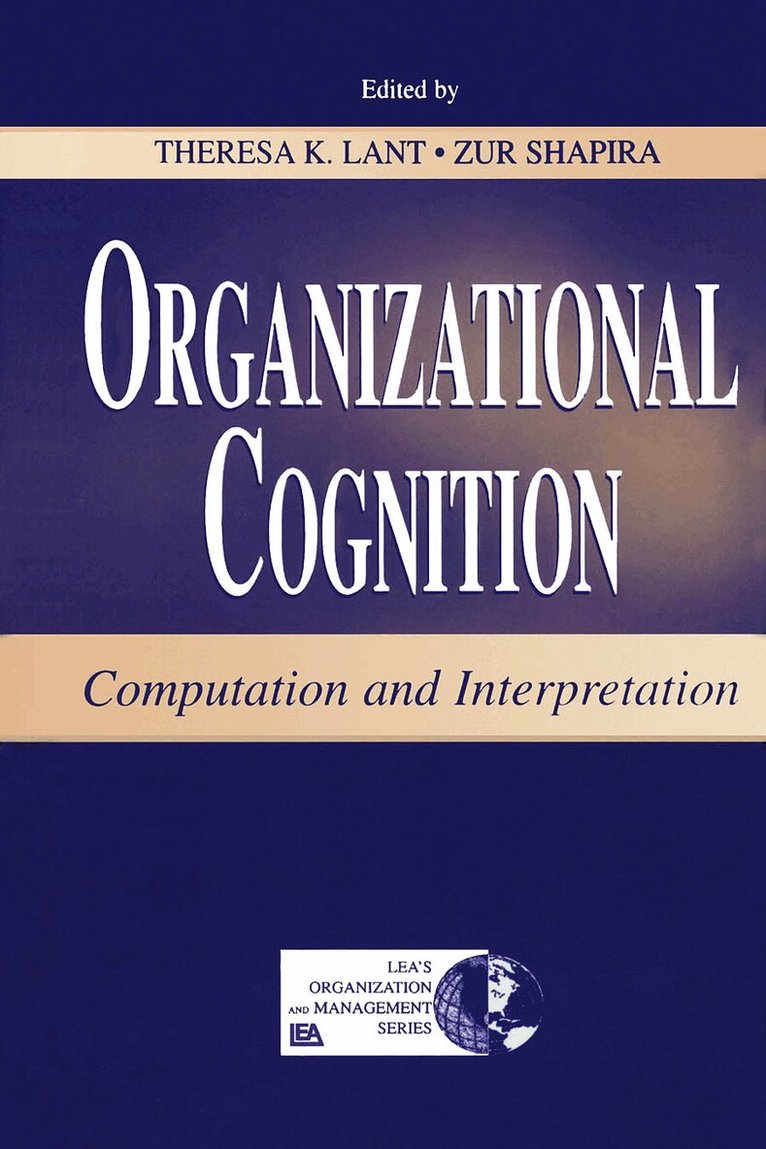
    Organizational Cognition

    Computation and Interpretation

    AvTheresa K. Lant,Zur Shapira

    Inbunden, Engelska, 2000

    Del i serien Organization and Management Series

    2 354 kr

    Beställningsvara. Skickas inom 10-15 vardagar. Fri frakt över 249 kr.

    Beskrivning

    Organizational Cognition is a collection of chapters written by scholars from around the world. The editors outline the history of two approaches to the study of cognition in organizations, the computational approach and the interpretive approach. The chapters represent some of the most cutting-edge research on organizational cognition, covering research that spans many levels of analysis. Much of the work in the book demonstrates how computational and interpretive approaches can be combined in a way that provides greater insight into cognitive processes in and among organizations. The editors conclude by elaborating the likely boundary conditions of each approach and how they can be combined for a more complete understanding of cognition in organizations.

    Produktinformation

    • Utgivningsdatum:2000-07-01
    • Mått:152 x 229 x 26 mm
    • Vikt:816 g
    • Format:Inbunden
    • Språk:Engelska
    • Serie:Organization and Management Series
    • Antal sidor:408
    • Förlag:Taylor & Francis Inc
    • ISBN:9780805833331

    Utforska kategorier

    • Organisationsteori inom Ekonomi och Ledarskap
    • Socialpsykologi och gruppsykologi inom Psykologi och pedagogik
    • Psykologiska teorier och skolor inom Psykologi och pedagogik

    Recensioner i media

    "...this book provides a fascinating story of the emergence of theoretical constructs, metaphors, and paradigms in a topical area of organizational research....If the purpose of this book is to be provocative and motivational to scholars in this area, I think it succeeds. Research directions and issues are identified; numerous conceptualizations meriting tests are proposed. The importance of the study of cognition in organizations is firmly established, and...the challenge is laid out and will hopefully inspire interested parties."—Personnel Psychology

    Innehållsförteckning

    • Contents: A.P. Brief, J.P. Walsh, Series Editors' Foreword. Preface. T.K. Lant, Z. Shapira, Introduction: Foundations of Research on Cognition in Organizations. Part I:Theoretical Foundations.V. Dhar, The Role of Machine Learning in Organizational Learning. W. Ocasio, How Do Organizations Think? J.G. March, The Pursuit of Intelligence in Organizations. S.B. Sitkin, Commentary: The Theoretical Foundations of Organizational Cognition. Part II:Knowledge and Learning in Organizational Settings.D. Rulke, S. Zaheer, Shared and Unshared Transactive Knowledge in Complex Organizations: An Exploratory Study. C. Paul-Chowdhury, Internal Dissemination of Learning From Loan Loss Crises. P.R. Murphy, S.J. Mezias, Y.R. Chen, Adapting Aspirations to Feedback: The Role of Success and Failure. K.M. Sutcliffe, Commentary: Motivational Preconditions and Intraorganizational Barriers to Learning in Organizational Settings. Part III:Cognition at Work: Managerial Thinking and Decision Making.M. Tamuz, Defining Away Dangers: A Study in the Influences of Managerial Cognition on Information Systems. R.H. Bennett, III, W.P. Anthony, Understanding the Role of Intuition--Tacit Knowledge and Analysis--Explicit Knowledge in Bank Board Deliberations. K.U. Nair, Cognitive Maps of Managers and Complex Problem Solving. B. Vidaillet, Cognitive Processes and Decision Making in a Crisis Situation: A Case Study. J.M. Dukerich, Commentary: More Is Not Always Better: Limits to Managerial Thinking and Decision Making. Part IV:Social and Strategic Aspects of Cognition.V. Odorici, A. Lomi, Classifying Competition: An Empirical Study of the Cognitive Social Structure of Strategic Groups. A. Oldfield, Stakeholder Analysis as Decision Support for Project Risk Management. L. Brooks, C. Kimble, P. Hildreth, Understanding Managerial Cognition: A Structurational Approach. D.A. Gioia, Commentary: Strategy Is Social Cognition. Part V:The Past and Future of Organizational Cognition Research.W.H. Starbuck, Is Janus the God of Understanding? T.K. Lant, Z. Shapira, New Research Directions on Organizational Cognition.