• Fri frakt över 249 kr
  • •
  • Snabba leveranser
  • •
  • Billiga böcker
Kundservice

Du är på sajten för privatpersoner.

Företag, bibliotek eller offentlig verksamhet?

Du handlar på classic.bokus.com, där alla dina funktioner finns intakta.
Till classic.bokus.com
Bokus logotyp. Gå till startsidan.
  • Erbjudanden
  • Nyheter
  • Student
  • Topplistor
  • Barn & ungdom
  • Bokus Play
  • E-böcker
  • Pocketböcker
  • Spel & pussel

10% rabatt på allt med kod: NYSTART10 →

Sidfot

Mina sidor

    Hjälp

    • Kundservice
    • Vanliga frågor och svar
    • Frakt och leverans
    • Retur vid ångerrätt
    • Reklamera vara
    • Betalning
    • Köpvillkor
    • Allmänna villkor
    • Information om webbplatsens tillgänglighet

    Om Bokus

    • Om oss
    • Pressrum
    • För studenter
    • För företag
    • För bibliotek och offentlig verksamhet
    • För leverantörer
    • Hållbarhet

    Populärt

    • Aktuella erbjudanden
    • Presentkort
    • Studentlitteratur
    • Nya böcker
    • Topplistor
    • Signerade böcker
    • Engelska böcker

    Inspiration

    • Boktips
    • BookTok
    • Populära bokserier
    • Barnbokskaraktärer
    • Populära författare
    Logotyp för Bokus
    Följ oss på Facebook (extern länk)Följ oss på Instagram (extern länk)Följ oss på YouTube (extern länk)Följ oss på TikTok (extern länk)
    bokus @ CookiesAnpassa cookiesIntegritetspolicyKöpvillkor
    Till Citymail hemsida (extern länk)Till Budbee hemsida (extern länk)Till Postnord hemsida (extern länk)Till Schenker hemsida (extern länk)Till Early Bird hemsida (extern länk)Till Walleys hemsida (extern länk)
    1. Ekonomi och Ledarskap
    2. Företagsekonomi
    3. Organisationsteori

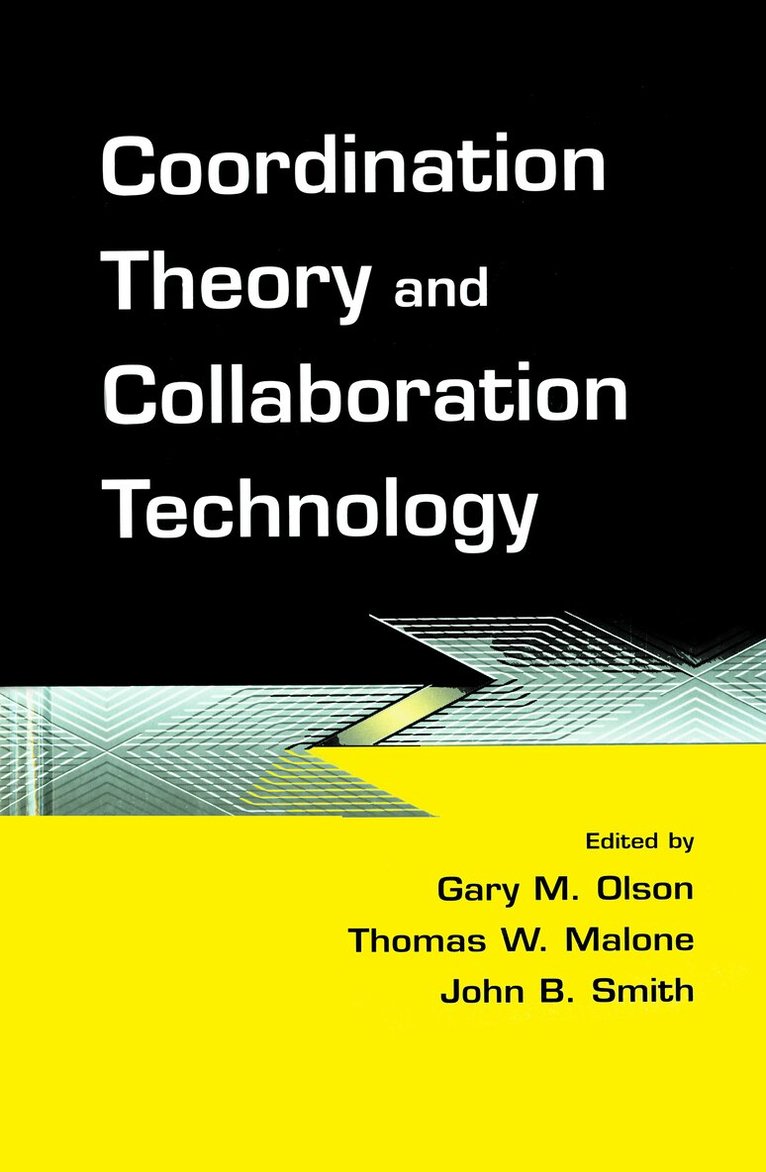
    Coordination Theory and Collaboration Technology

    AvGary M. Olson,Thomas W. Malone

    Inbunden, Engelska, 2001

    3 556 kr

    Beställningsvara. Skickas inom 10-15 vardagar. Fri frakt över 249 kr.

    Beskrivning

    The National Science Foundation funded the first Coordination Theory and Collaboration Technology initiative to look at systems that support collaborations in business and elsewhere. This book explores the global revolution in human interconnectedness. It will discuss the various collaborative workgroups and their use in technology. The initiative focuses on processes of coordination and cooperation among autonomous units in human systems, in computer and communication systems, and in hybrid organizations of both systems. This initiative is motivated by three scientific issues which have been the focus of separate research efforts, but which may benefit from collaborative research. The first is the effort to discover the principles underlying how people collaborate and coordinate work efficiently and productively in environments characterized by a high degree of decentralized computation and decision making. The second is to gain a better fundamental understanding of the structure and outputs of organizations, industries, and markets which incorporate sophisticated, decentralized information and communications technology as an important component of their operations. The third is to understand problems of coordination in decentralized or open computer systems.

    Produktinformation

    • Utgivningsdatum:2001-05-01
    • Mått:152 x 229 x undefined mm
    • Vikt:1 224 g
    • Format:Inbunden
    • Språk:Engelska
    • Antal sidor:816
    • Förlag:Taylor & Francis Inc
    • ISBN:9780805834031

    Utforska kategorier

    • Organisationsteori inom Ekonomi och Ledarskap
    • Socialpsykologi och gruppsykologi inom Psykologi och pedagogik

    Mer om författaren

    Gary M. Olson, Thomas W. Malone, John B. Smith

    Recensioner i media

    "This is a rich collection of research reports. Few readers even within the HCI/CSCW domain will be familiar with all the disciplinary approaches included here, and hence almost any reader will learn a good deal from this book."—Contemporary Psychology

    Innehållsförteckning

    • Contents: Introduction. Part I: Theoretical Approaches to Coordination and Collaboration.T.W. Malone, K. Crowston, The Interdisciplinary Study of Coordination. R.J. Boland, Jr., R.V. Tenkasi, Communication and Collaboration in Distributed Cognition. E.H. Durfee, D. Damouth, P.J. Gmytrasiewicz, M.J. Huber, T.A. Montgomery, S. Sen, Coordination as Distributed Search. S. Kraus, J. Wilkenfeld, Strategic Negotiation in Multiagent Environments. T.W. Malone, K-Y. Lai, K.R. Grant, Two Design Principles for Collaboration Technology: Examples of Semiformal Systems and Radical Tailorability. T. Marschak, On Economies of Scope in Communication. S. Reiter, Knowledge, Discovery, and Growth. Part II: Collaboration Technology for Specific Domains.P. Dewan, V. Mashayekhi, J. Riedl, Infrastructure and Applications for Collaborative Software Engineering. C.A. Jasek, P.M. Jones, Cooperative Support for Distributed Supervisory Control. R. Furuta, P.D. Stotts, Trellis: A Formally Defined Hypertextual Basis for Integrating Task and Information. J. Pasquale, Problems of Decentralized Control: Using Randomized Coordination to Deal With Uncertainty and Avoid Conflicts. D.E. Shackelford, J.B. Smith, F.D. Smith, The Architecture and Implementation of a Distributed Hypermedia Storage System. Part III: Studies of Collaboration.R.C. Arkin, T. Balch, Communication and Coordination in Reactive Robotic Teams. G. Fischer, J. Grudin, R. McCall, J. Ostwald, D. Redmiles, B. Reeves, F. Shipman, Seeding, Evolutionary Growth, and Reseeding: The Incremental Development of Collaborative Design Environments. S.R. Hiltz, D. Dufner, J. Fjermestad, Y. Kim, R. Ocker, A. Rana, M. Turoff, Distributed Group Support Systems: Theory Development and Experimentation. R. Kling, K.L. Kraemer, J.P. Allen, Y. Bakos, V. Gurbaxani, M. Elliott, Transforming Coordination: The Promise and Problems of Information Technology in Coordination. C.M. Neuwirth, D.S. Kaufer, R. Chandhok, J.H. Morris, Computer Support for Distributed Collaborative Writing: A Coordination Science Perspective. G.M. Olson, J.S. Olson, Technology Support for Collaborative Workgroups. Part IV: Organizational Modeling.T. Berger, N.M. Kiefer, Central Coordination of Decentralized Information in Large Chains and Franchises. K.M. Carley, Organizational Performance, Coordination, and Cognition. R.E. Levitt, Y. Jin, G.A. Oralkan, J.C. Kunz, T.R. Christiansen, Computational Enterprise Models: Toward Analysis Tools for Designing Organizations. C. Lewis, R. Reitsma, E.V. Wilson, I. Zigurs, Extending Coordination Theory to Deal With Goal Conflicts. W-P. Wang, D.L. Kleinman, P.B. Luh, Modeling Team Coordination and Decisions in a Distributed Dynamic Environment. Part V: Collaboratories.G.C. Bowker, S.L. Star, Social Theoretical Issues in the Design of Collaboratories: Customized Software for Community Support Versus Large Scale Infrastructure. H. Chen, B.R. Schatz, A Path to Concept-Based Information Access: From National Collaboratories to Digital Libraries. G.M. Olson, D.E. Atkins, R. Clauer, T. Weymouth, T.A. Finholt, A. Prakash, C. Rasmussen, F. Jahanian, Technology to Support Distributed Team Science: The First Phase of the Upper Atmospheric Research Collaboratory (UARC).