• Fri frakt över 249 kr
  • •
  • Snabba leveranser
  • •
  • Billiga böcker
Kundservice

Du är på sajten för privatpersoner.

Företag, bibliotek eller offentlig verksamhet?

Du handlar på classic.bokus.com, där alla dina funktioner finns intakta.
Till classic.bokus.com
Bokus logotyp. Gå till startsidan.
  • Erbjudanden
  • Nyheter
  • Student
  • Topplistor
  • Barn & ungdom
  • Bokus Play
  • E-böcker
  • Pocketböcker
  • Spel & pussel

10% rabatt på allt med kod: NYSTART10 →

Sidfot

Mina sidor

    Hjälp

    • Kundservice
    • Vanliga frågor och svar
    • Frakt och leverans
    • Retur vid ångerrätt
    • Reklamera vara
    • Betalning
    • Köpvillkor
    • Allmänna villkor
    • Information om webbplatsens tillgänglighet

    Om Bokus

    • Om oss
    • Pressrum
    • För studenter
    • För företag
    • För bibliotek och offentlig verksamhet
    • För leverantörer
    • Hållbarhet

    Populärt

    • Aktuella erbjudanden
    • Presentkort
    • Studentlitteratur
    • Nya böcker
    • Topplistor
    • Signerade böcker
    • Engelska böcker

    Inspiration

    • Boktips
    • BookTok
    • Populära bokserier
    • Barnbokskaraktärer
    • Populära författare
    Logotyp för Bokus
    Följ oss på Facebook (extern länk)Följ oss på Instagram (extern länk)Följ oss på YouTube (extern länk)Följ oss på TikTok (extern länk)
    bokus @ CookiesAnpassa cookiesIntegritetspolicyKöpvillkor
    Till Citymail hemsida (extern länk)Till Budbee hemsida (extern länk)Till Postnord hemsida (extern länk)Till Schenker hemsida (extern länk)Till Early Bird hemsida (extern länk)Till Walleys hemsida (extern länk)
    1. Psykologi och pedagogik
    2. Pedagogik
    3. Undervisning i specifika ämnen

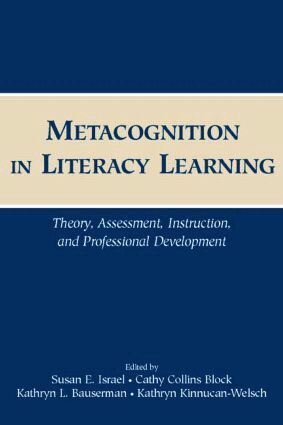
    Metacognition in Literacy Learning

    Theory, Assessment, Instruction, and Professional Development

    AvSusan E. Israel,Cathy Collins Block

    Häftad, Engelska, 2005

    758 kr

    Beställningsvara. Skickas inom 10-15 vardagar. Fri frakt över 249 kr.

    Beskrivning

    This volume provides the first comprehensive, research-based examination of metacognition in literacy learning. Bringing together research findings from reading, linguistics, psychology, and education, it is logically organized as follows: Part I provides the theoretical foundation that supports the teaching of metacognition; Parts II and III provide new methods for metacognitive assessment and instruction in literacy contexts at all grade levels; and Part IV provides new information on integrating metacognition into professional development programs.Key features include:*Chapter Structure.Teacher reflections at the beginning of each chapter illustrate teacher thinking about the chapter topic and metacognitive connections at the end of each chapter link its content with that of the preceding and following chapters.*Contributor Expertise. Few volumes can boast of a more luminous cast of contributing authors (see table of contents).*Comprehensiveness. Twenty chapters organized into four sections plus a summarizing chapter make this the primary reference work in the field of literacy-based metacognition.This volume is appropriate for reading researchers, professional development audiences, and for upper-level undergraduate and graduate level courses in reading and educational psychology.

    Produktinformation

    • Utgivningsdatum:2005-06-17
    • Mått:152 x 229 x 21 mm
    • Vikt:612 g
    • Format:Häftad
    • Språk:Engelska
    • Antal sidor:440
    • Förlag:Taylor & Francis Inc
    • ISBN:9780805852301

    Utforska kategorier

    • Undervisning i specifika ämnen inom Psykologi och pedagogik

    Mer om författaren

    Susan E. Israel, Cathy Collins Block, Kathryn L. Bauserman, Kathryn Kinnucan-Welsch

    Recensioner i media

    "...'Metacognition in Literacy Learning: Theory, Assessment, Instruction, and Professional Development' one of the first in its field to offer an integrated approach in showing how metacognitive theory can be used by reading teachers (taken in its purest sense as the literal comprehension of text) during reading and writing tasks."—PsycCRITIQUES"This book presents an up-to-date, broad, and very useful summary of theory, research, and practice concerning the important role of metacognition in literacy learning. It should prove an invaluable resource for teachers, parents and others concerned with fostering children's literacy. The book contains several helpful reviews of the field's history and research accomplishments (e.g., the chapters by Baker, Paris and Flukes, and Pressley) as well as informative chapters on metacognitive assessment and professional development. Readers whose knowledge of the area is mostly confined to its beginnings in the seventies and eighties will surely be amazed at how much has been done and learned in recent years. The book is full of insightful ideas and suggestions about the topic."—John FlavellStanford University

    Innehållsförteckning

    • Contents: Preface. Part I: Metacognition and Theory.P.L. Griffith, J. Ruan, What Is Metacognition and What Should Be Its Role in Literacy Instruction? J. Randi, E.L. Grigorenko, R.J. Sternberg, Revisiting Definitions of Reading Comprehension: Just What Is Reading Comprehension Anyway? S.J. Samuels, K-A.M. Ediger, J.R. Willcutt, T.J. Palumbo, Role of Automaticity in Metacognition and Literacy Instruction. L. Baker, Developmental Differences in Metacognition: Implications for Metacognitively Oriented Reading Instruction. Part II: Metacognition and Assessment.C.C. Block, What Are Metacognitive Assessments? M.C. Schmitt, Measuring Students' Awareness and Control of Strategic Processes. S.G. Paris, J. Flukes, Assessing Children's Metacognition About Strategic Reading. P. Afflerbach, K. Meuwissen, Teaching and Learning Self-Assessment Strategies in Middle School. K.L. Bauserman, Metacognitive Processes Inventory: An Informal Instrument to Assess a Student's Developmental Level of Metacognition. Part III: Metacognition and Literacy Instruction.S.E. Israel, D. Massey, Metacognitive Think-Alouds: Using a Gradual Release Model With Middle School Students. L.M. Joseph, The Role of Self-Monitoring in Literacy Learning. F.J. Schrieber, Metacognition and Self-Regulation in Literacy. S.J. Donndelinger, Integrating Comprehension and Metacognitive Reading Strategies. P.A. Smith, A Window Into a Thinking Classroom. C. Cummins, M.T. Stewart, C.C. Block, Teaching Several Metacognitive Strategies Together Increases Students' Independent Metacognition. Part IV: Metacognition and Professional Development.G.R. Duffy, Developing Metacognitive Teachers: Visioning and the Expert's Changing Role in Teacher Education and Professional Development. V.J. Risko, K. Roskos, C. Vukelich, Reflection and the Self-Analytic Turn of Mind: Toward More Robust Instruction in Teacher Education. C.L. Bowman, M. Galvez-Martin, M. Morrison, Developing Reflection in Preservice Teachers. C.A. Rosemary, Teacher Learning Instrument: A Metacognitive Tool for Improving Literacy Teaching. K. Kinnucan-Welsch, Coaching for Metacognitive Instructional Practice. M. Pressley, Final Reflections: Metacognition in Literacy Learning: Then, Now, and in the Future.