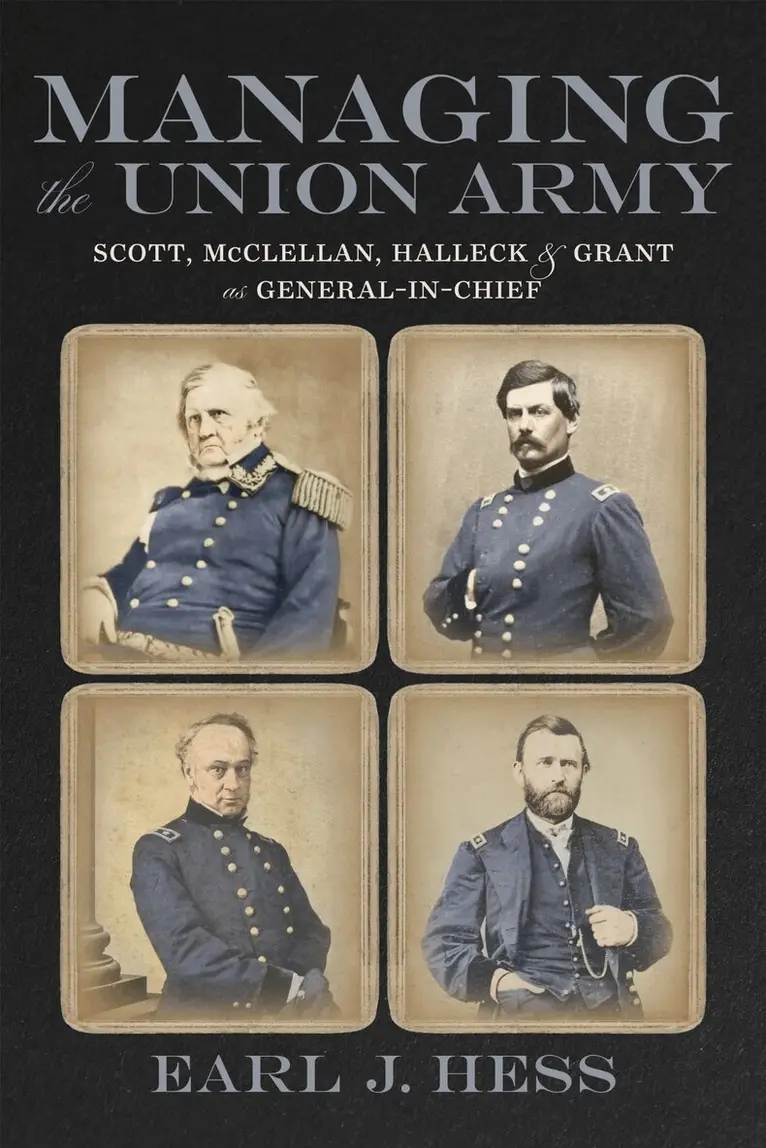
Inbunden, Engelska, 2026
Managing the Union Army
Scott, McClellan, Halleck, and Grant As General-in-Chief
Av Earl J. Hess
707 kr
Skickas tisdag 17/11. Fri frakt över 249 kr.
Beskrivning
Produktinformation
- Utgivningsdatum: 2026-10-14
- Mått: 152 x 229 x 32 mm
- Vikt: 820 g
- Format: Inbunden
- Språk: Engelska
- Antal sidor: 480
- Förlag: Louisiana State University Press
- ISBN: 9780807185230
Utforska kategorier
Mer om författaren
Earl J. Hess is professor emeritus of history at Lincoln Memorial University and the author or editor of more than thirty books on the American Civil War, including Civil War Cavalry: Waging Mounted Warfare in Nineteenth-Century America.
Recensioner i media
"In this volume, Earl J. Hess examines the often-misinterpreted role of the United States Army's general-in-chief during the Civil War. Noting saliently that neither constitutional nor legislative authority had authorized the office of general-in-chief, the author crafts an incisive analytical framework in the assessment of the four generals who served their civilian leaders in the management of the largest conflict ever undertaken on American soil. This is a rewarding book, one that will remain essential in understanding the unique, bounded nature of Civil War high-level command." - Christopher S. Stowe, Command and Staff College, Marine Corps University"Hess convincingly demonstrates the evolution of a poorly defined position into a crucial Union advantage. This post depended on individuals and did not survive the war, but Henry Halleck provided the hands-on management that Winfield Scott lacked, and Grant delivered the willingness to work with Lincoln, the field experience, and the national strategic plan that his predecessors lacked. This detailed analysis of Union strategy and top-level civil-military relations shows that McClellan (like the Confederate generals) lacked the national perspective needed, while Grant's confidence and humility made him the indispensable man." - Samuel J. Watson, editor of The Oxford Handbook of American Military History"In numerous prior works, Earl Hess has shown us the internal mechanisms of Civil War military life, making possible an understanding of those mechanisms as the soldiers of the Civil War saw them. In this new work, Hess adopts a different perspective—what we might call the thirty-thousand-foot view of the Civil War—as he examines the four Union generals who held the top military post as general-in-chief: Winfield Scott, George B. McClellan, Henry Wager Halleck, and Ulysses S. Grant. Hess accomplishes two important tasks: first, he explains how each of the generals-in-chief undertook this responsibility, and then he evaluates their performance. In his customary fashion, Hess asks precisely the questions that were pressing and evident to the war's participants, but which time and the modernization of warfare have rendered invisible. Managing the Union Army is an important contribution to Civil War military history in particular, and American military history in general." - Allen C. Guelzo, author of Abraham Lincoln: Redeemer President
Betyg & recensioner
0 recensioner
Inga recensioner tillgängliga.