• Fri frakt över 249 kr
  • •
  • Snabba leveranser
  • •
  • Billiga böcker
Kundservice

Du är på sajten för privatpersoner.

Företag, bibliotek eller offentlig verksamhet?

Du handlar på classic.bokus.com, där alla dina funktioner finns intakta.
Till classic.bokus.com
Bokus logotyp. Gå till startsidan.
  • Erbjudanden
  • Student
  • Topplistor
  • Barn & ungdom
  • Bokus Play
  • E-böcker
  • Ljudböcker
  • Pocketböcker
  • Spel & pussel

10% rabatt på allt med kod NYSTART10 →

Sidfot

Mina sidor

    Hjälp

    • Kundservice
    • Vanliga frågor och svar
    • Frakt och leverans
    • Retur vid ångerrätt
    • Reklamera vara
    • Betalning
    • Köpvillkor
    • Allmänna villkor
    • Information om webbplatsens tillgänglighet

    Om Bokus

    • Om oss
    • Pressrum
    • För studenter
    • För företag
    • För bibliotek och offentlig verksamhet
    • För leverantörer
    • Hållbarhet

    Populärt

    • Aktuella erbjudanden
    • Presentkort
    • Studentlitteratur
    • Nya böcker
    • Topplistor
    • Signerade böcker
    • Engelska böcker

    Inspiration

    • Boktips
    • BookTok
    • Populära bokserier
    • Barnbokskaraktärer
    • Populära författare
    Logotyp för Bokus
    Följ oss på Facebook (extern länk)Följ oss på Instagram (extern länk)Följ oss på YouTube (extern länk)Följ oss på TikTok (extern länk)
    bokus @ CookiesAnpassa cookiesIntegritetspolicyKöpvillkor
    Till Citymail hemsida (extern länk)Till Budbee hemsida (extern länk)Till Postnord hemsida (extern länk)Till Schenker hemsida (extern länk)Till Early Bird hemsida (extern länk)Till Walleys hemsida (extern länk)
    1. Skönlitteratur
    2. Litteraturvetenskap
    3. Litteraturvetenskap

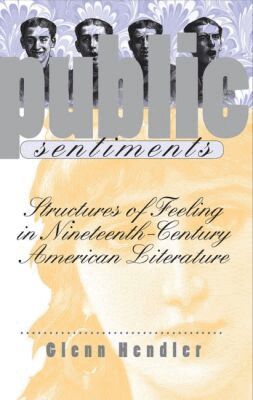
    Public Sentiments

    Structures of Feeling in Nineteenth-Century American Literature

    AvGlenn Hendler

    Häftad, Engelska, 2001

    534 kr

    Beställningsvara. Skickas inom 10-15 vardagar. Fri frakt över 249 kr.

    Fler format och utgåvor

    E-bok

    579 kr

    E-bok

    553 kr

    Beskrivning

    In this book, Glenn Hendler explores what he calls the ""logic of sympathy"" in novels by Walt Whitman, Louisa May Alcott, T.S. Arthur, Martin Delany, Horatio Alger, Fanny Fern, Nathaniel Parker Willis, Henry James, Mark Twain, and William Dean Howells. For these 19th-century writers, he argues, sympathetic identification was not strictly an individual, feminizing, and private feeling but the quintessentially public sentiment - a transformative emotion with the power to shape social institutions and political movements. Uniting scholarship on gender in 19th-century American culture with theoretical and historical debates on the definition of the public sphere in the period, Hendler shows how novels taught diverse readers to ""feel right"", to experience their identities as male or female, black or white, middle or working class, through a sentimental, emotionally based structure of feeling. He links novels with such wide-ranging cultural and political discourses as the temperance movement, feminism, and black nationalism. ""Public Sentiments"" demonstrates that, whether published for commercial reasons or for higher moral and aesthetic purposes, the 19th century American novel was conceived of as a public instrument designed to play in a sentimental key.

    Produktinformation

    • Utgivningsdatum:2001-04-30
    • Mått:141 x 215 x 17 mm
    • Vikt:456 g
    • Format:Häftad
    • Språk:Engelska
    • Antal sidor:288
    • Förlag:The University of North Carolina Press
    • ISBN:9780807849217

    Utforska kategorier

    • Litteraturvetenskap inom Skönlitteratur
    • Kulturvetenskap inom Samhälle och politik

    Mer om författaren

    Glenn Hendler, assistant professor of English at the University of Notre Dame, is coeditor of Sentimental Men: Masculimity and the Politics of Affect in American Culture.

    Recensioner i media

    In this full-scale account of male sentiment and the limits of female sympathy, Hendler analyzes with imagination and wit how we can gauge the nineteenthcentury significance of sentimentality. It is a remarkably lucid, forceful book. - Dale M. Bauer, University of Kentucky