• Fri frakt över 249 kr
  • •
  • Snabba leveranser
  • •
  • Billiga böcker
Kundservice

Du är på sajten för privatpersoner.

Företag, bibliotek eller offentlig verksamhet?

Du handlar på classic.bokus.com, där alla dina funktioner finns intakta.
Till classic.bokus.com
Bokus logotyp. Gå till startsidan.
  • Erbjudanden
  • Nyheter
  • Student
  • Topplistor
  • Barn & ungdom
  • Bokus Play
  • E-böcker
  • Pocketböcker
  • Spel & pussel

10% rabatt på allt med kod: NYSTART10 →

Sidfot

Mina sidor

    Hjälp

    • Kundservice
    • Vanliga frågor och svar
    • Frakt och leverans
    • Retur vid ångerrätt
    • Reklamera vara
    • Betalning
    • Köpvillkor
    • Allmänna villkor
    • Information om webbplatsens tillgänglighet

    Om Bokus

    • Om oss
    • Pressrum
    • För studenter
    • För företag
    • För bibliotek och offentlig verksamhet
    • För leverantörer
    • Hållbarhet

    Populärt

    • Aktuella erbjudanden
    • Presentkort
    • Studentlitteratur
    • Nya böcker
    • Topplistor
    • Signerade böcker
    • Engelska böcker

    Inspiration

    • Boktips
    • BookTok
    • Populära bokserier
    • Barnbokskaraktärer
    • Populära författare
    Logotyp för Bokus
    Följ oss på Facebook (extern länk)Följ oss på Instagram (extern länk)Följ oss på YouTube (extern länk)Följ oss på TikTok (extern länk)
    bokus @ CookiesAnpassa cookiesIntegritetspolicyKöpvillkor
    Till Citymail hemsida (extern länk)Till Budbee hemsida (extern länk)Till Postnord hemsida (extern länk)Till Schenker hemsida (extern länk)Till Early Bird hemsida (extern länk)Till Walleys hemsida (extern länk)
    1. Samhälle och politik
    2. Samhälle och kultur
    3. Sociala grupper och identitet
    4. Etnicitet

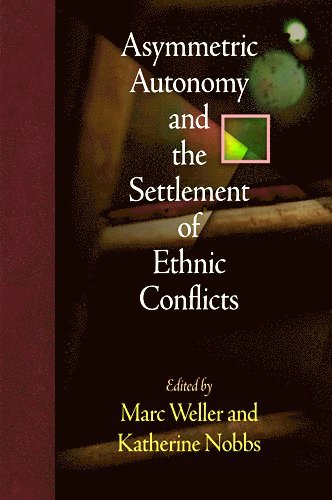
    Asymmetric Autonomy and the Settlement of Ethnic Conflicts

    AvMarc Weller,Katherine Nobbs

    Häftad, Engelska, 2012

    Del i serien National and Ethnic Conflict in the 21st Century

    431 kr

    Beställningsvara. Skickas inom 5-8 vardagar. Fri frakt över 249 kr.

    Beskrivning

    Throughout the world many sovereign states grant one or more of their territories greater autonomy than other areas. This arrangement, known as asymmetric autonomy, has been adopted with greater regularity as a solution to ethnic strife and secessionist struggles in recent decades. As asymmetric autonomy becomes one of the most frequently used conflict resolution methods, examination of the positive and negative consequences of its implementation, as well as its efficacy, is vital.Asymmetric Autonomy and the Settlement of Ethnic Conflicts assesses the ability of such power distribution arrangements to resolve violent struggles between central governments and separatist groups. This collection of new case studies from around the world covers a host of important developments, from recentralization in Russia, to "one country, two systems" in China, to constitutional innovation in Iraq. As a whole, these essays examine how well asymmetric autonomy agreements can bring protracted and bloody conflicts to an end, satisfy the demands of both sides, guarantee the physical integrity of a state, and ensure peace and stability. Contributors to this book also analyze the many problems and dilemmas that can arise when autonomous regions are formed. For example, powers may be loosely defined or unrealistically assigned to the state within a state. Redrawn boundaries can create new minorities and make other groups vulnerable to human rights violations. Given the number of limited self-determination systems in place, the essays in this volume present varied evaluations of these political structures.Asymmetric state agreements have the potential to remedy some of humanity's most intractable disputes. In Asymmetric Autonomy and the Settlement of Ethnic Conflicts, leading political scientists and diplomatic experts shed new light on the practical consequences of these settlements and offer sophisticated frameworks for understanding this path toward lasting peace.

    Produktinformation

    • Utgivningsdatum:2012-11-29
    • Mått:152 x 229 x 28 mm
    • Vikt:476 g
    • Format:Häftad
    • Språk:Engelska
    • Serie:National and Ethnic Conflict in the 21st Century
    • Antal sidor:360
    • Förlag:University of Pennsylvania Press
    • ISBN:9780812222388

    Utforska kategorier

    • Etnicitet inom Samhälle och politik

    Mer om författaren

    Marc Weller is Professor in International Law and International Constitution Studies at the University of Cambridge, Director of the Lauterpacht Centre for International Law, and former Director of the European Centre for Minority Issues. Katherine Nobbs is Human Dimension Officer at Organisation for Security and Cooperation in Europe (OSCE) Mission in Kosovo.

    Recensioner i media

    "A strong collection of empirically-rich case studies." (Journal of Peace Research) "A useful collection of articles that analyses issues of autonomy and asymmetry from a multi-dimensional perspective." (International Journal on Minority and Group Rights)

    Innehållsförteckning

    • PrefaceIntroductionPART I. ASYMMETRICAL APPROACHES TO STATE DESIGN1 Cases of Asymmetrical Territorial Autonomy-Stefan Wolff2 The Russian Constitutional System: Complexity and Asymmetry-Bill Bowring3 Partial Asymmetry and Federal Construction: Accommodating Diversity in the Canadian Constitution-Raffaele Iacovino4 Elusive Autonomy in Sub-Saharan Africa-Coel Kirkby and Christina Murray5 Asymmetry in the Face of Heavily Disproportionate Power Relations: Hong Kong-Johannes Chan6 Asymmetric Autonomy in the United Kingdom-John McGarryPART II. CONFLICT SETTLEMENTS7 Thinking About Asymmetry and Symmetry in the Remaking of Iraq-Brendan O'LearyPART III. EMERGING SETTLEMENTS8 The Case for Asymmetric Federalism in Georgia: A Missed Opportunity-Jonathan Wheatley9 Gagauz Autonomy in Moldova: The Real and the Virtual in Post-Soviet State Design-Oleh Protsyk10 Asymmetric Autonomy and Power Sharing for Sri Lanka: A Political Solution to Ethnic Conflict?-Kristina Eichhorst11 Puntland's Declaration of Autonomy and Somaliland's Secession: Two Quests for Self-Governance in a Failed State-Janina DillConclusionList of ContributorsIndex