• Fri frakt över 249 kr
  • •
  • Snabba leveranser
  • •
  • Billiga böcker
Kundservice

Du är på sajten för privatpersoner.

Företag, bibliotek eller offentlig verksamhet?

Du handlar på classic.bokus.com, där alla dina funktioner finns intakta.
Till classic.bokus.com
Bokus logotyp. Gå till startsidan.
  • Erbjudanden
  • Student
  • Topplistor
  • Barn & ungdom
  • Bokus Play
  • E-böcker
  • Ljudböcker
  • Pocketböcker
  • Spel och pussel

5% studentrabatt – använd koden KURSBOK27 →

Sidfot

Mina sidor

    Hjälp

    • Kundservice
    • Vanliga frågor och svar
    • Frakt och leverans
    • Retur vid ångerrätt
    • Reklamera vara
    • Betalning
    • Köpvillkor
    • Allmänna villkor
    • Information om webbplatsens tillgänglighet

    Om Bokus

    • Om oss
    • Pressrum
    • För studenter
    • För företag
    • För bibliotek och offentlig verksamhet
    • För leverantörer
    • Hållbarhet

    Populärt

    • Aktuella erbjudanden
    • Presentkort
    • Studentlitteratur
    • Nya böcker
    • Topplistor
    • Signerade böcker
    • Engelska böcker

    Inspiration

    • Boktips
    • BookTok
    • Barnbokskaraktärer
    • Populära författare
    Logotyp för Bokus
    Följ oss på Facebook (extern länk)Följ oss på Instagram (extern länk)Följ oss på YouTube (extern länk)Följ oss på TikTok (extern länk)
    bokus @ CookiesAnpassa cookiesIntegritetspolicyKöpvillkor
    Till Citymail hemsida (extern länk)Till Budbee hemsida (extern länk)Till Postnord hemsida (extern länk)Till Schenker hemsida (extern länk)Till Early Bird hemsida (extern länk)Till Walleys hemsida (extern länk)
    1. Skönlitteratur
    2. Litteraturvetenskap

    Queer Philologies

    Sex, Language, and Affect in Shakespeare's Time

    AvJeffrey Masten

    E-bok
    Engelska, 2016

    Del i serien Material Texts

    635 kr

    Läs direkt i Bokus Reader – eller ladda ned till din enhet

    Fler format och utgåvor

    Häftad

    431 kr

    Inbunden

    1 370 kr

    Beskrivning

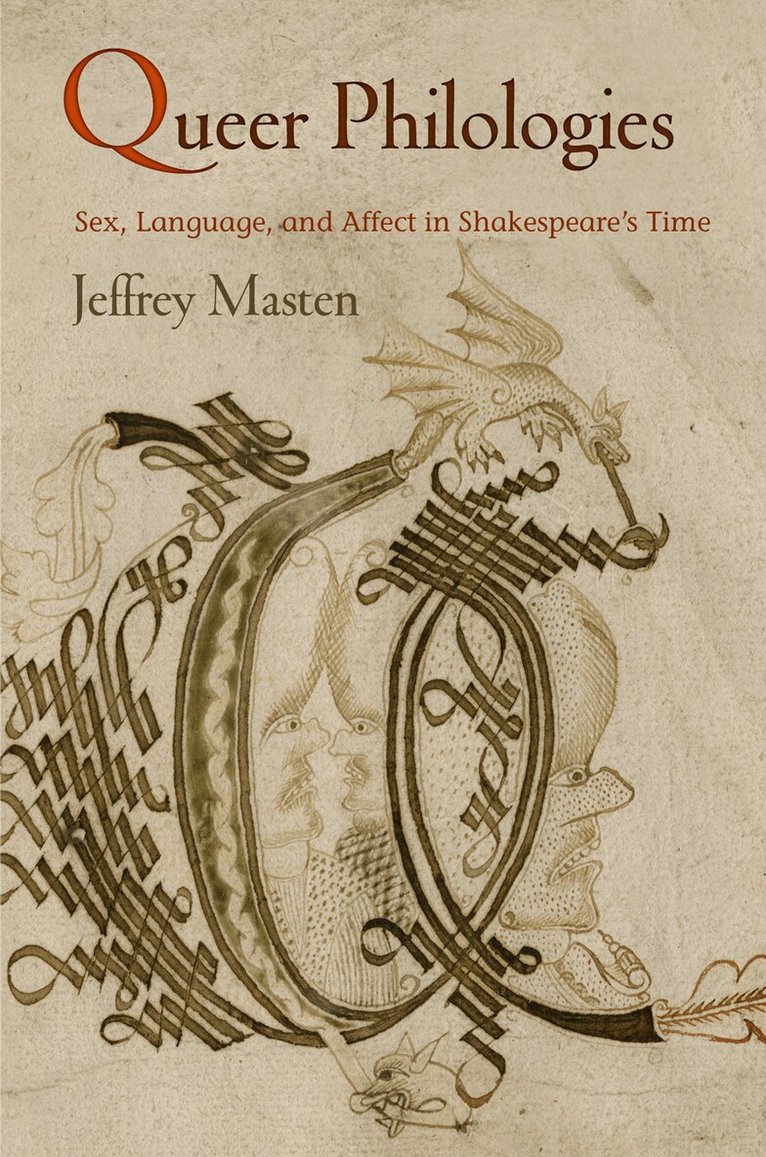
    For Jeffrey Masten, the history of sexuality and the history of language are intimately related. In Queer Philologies, he studies particular terms that illuminate the history of sexuality in Shakespeare's time and analyzes the methods we have used to study sex and gender in literary and cultural history. Building on the work of theorists and historians who have, following Foucault, investigated the importance of words like "homosexual," "sodomy," and "tribade" in a variety of cultures and historical periods, Masten argues that just as the history of sexuality requires the history of language, so too does philology, "the love of the word," require the analytical lens provided by the study of sexuality.Masten unpacks the etymology, circulation, transformation, and constitutive power of key words within the early modern discourse of sex and gender-terms such as "conversation" and "intercourse," "fundament" and "foundation," "friend" and "boy"-that described bodies, pleasures, emotions, sexual acts, even (to the extent possible in this period) sexual identities. Analyzing the continuities as well as differences between Shakespeare's language and our own, he offers up a queer lexicon in which the letter "Q" is perhaps the queerest character of all.

    Produktinformation

    • Utgivningsdatum:2016-06-10
    • Språk:Engelska
    • Antal sidor:368
    • Filformat:EPUB
    • Kopieringsskydd:LCP
    • ISBN:9780812293173
    • Förlag:University of Pennsylvania Press
    • Serie:Material Texts

    Utforska kategorier

    • Litteraturvetenskap inom Skönlitteratur
    • Litteraturvetenskap inom Skönlitteratur
    • HBTQ+ inom Samhälle och politik

    Mer om författaren

    Jeffrey Masten is Professor of English and of Gender and Sexuality Studies at Northwestern University and author of Textual Intercourse: Collaboration, Authorship, and Sexualities in Renaissance Drama.

    Recensioner i media

    "Masten has much to teach us about the consequence of learning to hear how words resonated for Shakespeare's first audiences, and how they can be made to sound and resound today. . . . As Masten indicates, queer philology need not be confined to the study of terms used to describe and 'inscribe' sex and gender, but should be extended to include all the terms of the social exclusions that currently concern us." (Times Literary Supplement) "A groundbreaking new study. . . . Queer Philologies should prove a seminal work for literary critics, sexual historians, queer theorists, and textual editors. Animated by Masten's witty prose, deeply enmeshed in the relevant scholarship, and often breathtaking in its acuity, originality, and capaciousness of thought, it is the most pleasurable polemic in recent literary history." (Review of English Studies) "[A] tour de force of erudition and intellectual wit that maps out a new region of scholarship: 'queer philology.' . . . Masten undertakes a vast philological program to show how vagaries and occluded regularities of early modern sex/gender vocabularies are intimately woven into specific traits of early modern orthography, rhetorical structures, etymologies, and familial bonds between words and word clusters." (SEL Studies in English Literature 1500-1900) "A careful and thought-provoking study . . . with stunning insight and extremely thoughtful attention to detail. Queer Philologies suggests exciting new possibilities in one of the foundational fields of literary study." (Comparative Drama) "Masten's page-turning case studies show us the necessity to get fully philological in order to get fully queer. It is not that we should queer time or locate some version of the 'homosexual' in early modern texts but that we should be more historical and more philological in order to read queerly." (GLQ: A Journal of Lesbian and Gay Studies) "Queer Philologies, Jeffrey Masten's brilliant new book, makes the queerness of linguistic relations into the stuff of a genuine page-turner. Doing nothing less than reinventing the field of philology for the twenty-first century, Masten charts striking moments in the two-way traffic between words and world, exploring how accident and error figure in the shaping of sexuality and multiply its significations beyond all scholarly control. To dip into this book is to recognize that it's destined to become a classic, one of the works without which queer theory and early modernism no longer can be thought." (Lee Edelman, Tufts University) "A masterpiece as well as a great intellectual joy. Masten finds in philology and in the history of the book a new approach to the analysis of norms and normativities-that is, to practices of standardization, including the standardization of sex and gender. This queer manifesto for the mutual implication of the history of sexuality and the materiality of language is as powerful as it is scrupulous, as original as it is radical. No one who reads this book will ever think of the letter Q in the same way again." (David Halperin, University of Michigan) "A brilliant, exacting, original book. Coherently organized, deftly argued, elegant in style, and utterly unique, Queer Philologies is not only full of insights relevant to scholars of early modern literature; it advances paradigm-shattering proposals relevant to queer studies scholars and historians of sexuality more generally." (Valerie Traub, University of Michigan) "Jeffrey Masten's witty and searching book will help a new generation of students to recover the philological grounds for the early modern period's sexual relations and gender constructions. Deploying and extending his signature combination of queer theory and textual scholarship, Masten gives us startling new readings of key works, words, and even letters that leave them looking very queer indeed." (William Sherman, Victoria and Albert Museum)

    Innehållsförteckning

    • Note on Citations and QuotationsIntroduction. On Q: An Introduction to Queer PhilologyChapter 1. Spelling Shakespeare: Early Modern "Orthography" and the Secret Lives of Shakespeare's CompositorsLEXICON 1. FRIENDSHIPChapter 2. "Sweet Persuasion," the Taste of Letters, and Male FriendshipChapter 3. Extended "Conversation": Living with Christopher Marlowe; a Brief History of "Intercourse"LEXICON 2. BOY-DESIREChapter 4. Reading "Boys": Performance and PrintChapter 5. "Amorous Leander," Boy-desire, Gay Shame; Or, Straightening Out Christopher MarloweLEXICON 3. SODOMYChapter 6. Is the "Fundament" a Grave? Translating the Early Modern BodyChapter 7. When Genres Breed: "Mongrell Tragicomedie" and Queer Kinship Editing PhilologiesChapter 8. All Is Not Glossed: Editing Sex, Race, Gender, and Affect in ShakespeareChapter 9. More or Less Queer: Female "Bumbast" in Sir Thomas MoreNotesBibliography