• Fri frakt över 249 kr
  • •
  • Snabba leveranser
  • •
  • Billiga böcker
Kundservice

Du är på sajten för privatpersoner.

Företag, bibliotek eller offentlig verksamhet?

Du handlar på classic.bokus.com, där alla dina funktioner finns intakta.
Till classic.bokus.com
Bokus logotyp. Gå till startsidan.
  • Erbjudanden
  • Nyheter
  • Student
  • Topplistor
  • Barn & ungdom
  • Bokus Play
  • E-böcker
  • Pocketböcker
  • Spel & pussel

10% rabatt på allt med kod: NYSTART10 →

Sidfot

Mina sidor

    Hjälp

    • Kundservice
    • Vanliga frågor och svar
    • Frakt och leverans
    • Retur vid ångerrätt
    • Reklamera vara
    • Betalning
    • Köpvillkor
    • Allmänna villkor
    • Information om webbplatsens tillgänglighet

    Om Bokus

    • Om oss
    • Pressrum
    • För studenter
    • För företag
    • För bibliotek och offentlig verksamhet
    • För leverantörer
    • Hållbarhet

    Populärt

    • Aktuella erbjudanden
    • Presentkort
    • Studentlitteratur
    • Nya böcker
    • Topplistor
    • Signerade böcker
    • Engelska böcker

    Inspiration

    • Boktips
    • BookTok
    • Populära bokserier
    • Barnbokskaraktärer
    • Populära författare
    Logotyp för Bokus
    Följ oss på Facebook (extern länk)Följ oss på Instagram (extern länk)Följ oss på YouTube (extern länk)Följ oss på TikTok (extern länk)
    bokus @ CookiesAnpassa cookiesIntegritetspolicyKöpvillkor
    Till Citymail hemsida (extern länk)Till Budbee hemsida (extern länk)Till Postnord hemsida (extern länk)Till Schenker hemsida (extern länk)Till Early Bird hemsida (extern länk)Till Walleys hemsida (extern länk)
    1. Kultur
    2. Musikböcker
    3. Tonsättare och låtskrivare

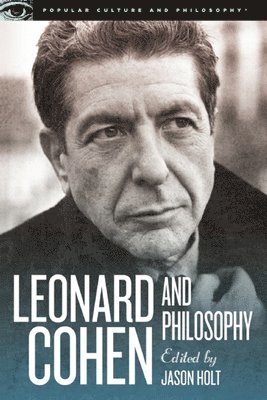
    Leonard Cohen and Philosophy

    Various Positions

    AvJason Holt

    Häftad, Engelska, 2014

    Del 84 i serien Popular Culture and Philosophy

    301 kr

    Beställningsvara. Skickas inom 5-8 vardagar. Fri frakt över 249 kr.

    Beskrivning

    From the early years, when he morphed from celebrated poet to provocative singer/songwriter, to his induction into the Rock and Roll Hall of Fame, Leonard Cohen has endured as one of the most enigmatic and profound figures in all of popular music. With his uniquely compelling voice and unparalleled depth of artistic vision, the aesthetic quality and intellectual merit of Cohen's work are above dispute; here, for the first time, a team of philosophers takes an in-depth look at its real significance. Want to know what Cohen and Kierkegaard have in common? Or whether Cohen rivals the great philosophical pessimist Schopenhauer? Then this book is for you. It provides the first thorough analysis of Cohen from various (philosophical) positions. It is intended not only for Cohen fans but also undergraduates in philosophy and other areas. It explores important neglected aspects of Cohen's work without attempting to reduce them to academic tropes, yet nonetheless it is also useful to academics -- or anyone -- beguiled by the enigma that is Leonard Cohen.

    Produktinformation

    • Utgivningsdatum:2014-11-20
    • Mått:152 x 228 x 20 mm
    • Vikt:396 g
    • Format:Häftad
    • Språk:Engelska
    • Serie:Popular Culture and Philosophy
    • Antal sidor:288
    • Förlag:Open Court Publishing Co ,U.S.
    • ISBN:9780812698565

    Utforska kategorier

    • Tonsättare och låtskrivare inom Kultur
    • Filosofiska discipliner inom Filosofi och religion
    • Litteraturvetenskap inom Skönlitteratur

    Mer om författaren

    Jason Holt is a published poet and a philosopher who specializes in aesthetics and the philosophy of mind. He's an associate professor at Acadia University in Wolfville, Nova Scotia. He is the editor of numerous books, including The Daily Show and Philosophy, and he is the author of Blindsight and the Nature of Consciousness.

    Innehållsförteckning

    • "Popstar-Poet: The Leonard Cohen Paradox," Jason Holt Introduces the book by presenting Cohen as an enigmatic, paradoxical figure in part because he challenges the popular art/high art dichotomy. Part I--Songs of Existence (1) "Leonard Cohen as a Guide to Life: Stoicism, Epicureanism, and Skepticism," Brendan Shea Cohen as reflecting the wisdom of these ancient Greek and Roman philosophies. (2) "That's How the Light Gets In: The Existential Cohen and the Joy of Infinite Resignation," Agust Magnusson Cohen's worldview from the point of view of existentialism. (3) "Naked at the End of the World: Leonard Cohen and Apocalyptic Time," Gary Shapiro "The Future" as exploring philosophical views of the apocalypse. Part II--Songs of Identity (4) "Give or Take a Night or Two: Kierkegaard, Cohen, and the Dialectic of Irony," Christopher Lauer Kierkegaard's account of irony illuminating how Cohen creates a sense of intimacy with his listeners. (5) "Why Cohen Is Our Man," Wieland Schwanebeck Complexities of masculine identity as variously expressed in Cohen's songs. (6) "Emending the Soul of the Lost Past: Cohen's Path to Self-Knowledge," Daniele Santoro Cohen as mapping a path to wisdom through painful and nostalgic self-knowledge. Part III--Songs of Love (7) "Her Beauty in the Moonlight Overthrew You: Leonard Cohen on Self-Deception in Love," Simon Riches Cohen's views of love as resolving the "paradox of self-deception." (8) "The Self, the Other, and the Mystery of the Mirror," Lisa Warenski Bodily awareness and mirroring of the beloved in love as ways of understanding but not dispelling the mystery of "touching a perfect body with your mind." (9) "Love and Longing in Leonard Cohen, Heidegger, and Merleau-Ponty," Ellen M. Miller Themes of Cohen's work as reflecting the philosophies of Heidegger and Merleau-Ponty and how it "all comes together" in experience. (10) "You and Who in Leonard Cohen: Telling Time, Playing Love, and Ancient Ethics," Babette Babich The erotic and ancient philosophical significance of Cohen's use of pronouns. Part IV--Songs of Aesthetics (11) "Hey, That's No Way to Use Metaphor!" Wieland Schwanebeck Cohen's lyrics as exhibiting different theories of metaphor. (12) "Covering Cohen," Adam Auch Aesthetic complexities of covering Cohen including the tension between authenticity and generic artistry, especially in terms of how context shapes meaning. (13) "Is Leonard Cohen a Good Singer?" Jason Holt Aspects of this question as reflecting the problem addressed by Hume of whether there really can be objective standards of taste. (14) "Duende," Ed Winters Cohen's appeal explained in part through Goethe's/Lorca's aesthetic notion of the duende, "a mysterious power which everyone senses and no philosopher explains." Part V--Songs of Literature (15) "Leonard Cohen and the Philosophy of Memory," Pawel Dobrosielski and Marcin Napiorkowski Cohen's Flowers for Hitler through the lens of and as challenging Adorno's view that "there can be no poetry after Auschwitz." (16) Topic: Schopenhauer's pessimism and Cohen's poetry (title TBA), Liane Heller Schopenhauer's philosophy (pessimism, aesthetics, will and representation) as seen in elements of Cohen's poetry. (17) "The Politics of Leonard Cohen," Steven Burns Beautiful Losers as expressing a particular political philosophy which gives a unity to the novel that it is often seen as lacking. Part VI--Songs from a Mind (18) "Is a Tear an Intellectual Thing? Leonard Cohen's Philosophy of Emotion," Liam Dempsey Cohen's perspective as fitting "process theories" which take emotions as quick but clumsy responses in contrast to the slower but wiser intellect. (19) "Can You Touch Someone's Body with Your Mind?" Rachel Haliburton Cohen's view of mind and body as similar to Thomas Nagel's in affirming the reality of subjectivity as irreducible to mere physical or functional characteristics. (20) "From a Dark Space," Christopher Ketchum Listening to Dear Heather as echoing Eugene Minkowski's phenomenology of "dark space." Part VII--Songs of Spirituality (21) "Clouds of Unknowing: Cohen's Via Negativa," Bernard Wills Cohen's "Judeo-Christianity" contrasted with his Buddhism as reflected in "Ballad of the Absent Mare" and elsewhere. (22) "The Prophetic Mr. Cohen in a Post-9/11 World," Timothy P. Jackson Cohen's "musical synthesis" of the religious and the secular as providing resources to cope with religious and political conflicts post-9/11. (23) "Breaking the Spell of 'Hallelujah'," Peter Stone Dennett's view of religion as "all things to all people" applied to the interpretive openness of "Hallelujah" to explain its popularity. Our Hands Bloody with Commas Contributor bios Index