• Fri frakt över 249 kr
  • •
  • Snabba leveranser
  • •
  • Billiga böcker
Kundservice

Du är på sajten för privatpersoner.

Företag, bibliotek eller offentlig verksamhet?

Du handlar på classic.bokus.com, där alla dina funktioner finns intakta.
Till classic.bokus.com
Bokus logotyp. Gå till startsidan.
  • Erbjudanden
  • Student
  • Topplistor
  • Barn & ungdom
  • Bokus Play
  • E-böcker
  • Ljudböcker
  • Pocketböcker
  • Spel & pussel

Upp till 25% på utvalda nyheter →

Sidfot

Mina sidor

    Hjälp

    • Kundservice
    • Vanliga frågor och svar
    • Frakt och leverans
    • Retur vid ångerrätt
    • Reklamera vara
    • Betalning
    • Köpvillkor
    • Allmänna villkor
    • Information om webbplatsens tillgänglighet

    Om Bokus

    • Om oss
    • Pressrum
    • För studenter
    • För företag
    • För bibliotek och offentlig verksamhet
    • För leverantörer
    • Hållbarhet

    Populärt

    • Aktuella erbjudanden
    • Presentkort
    • Studentlitteratur
    • Nya böcker
    • Topplistor
    • Signerade böcker
    • Engelska böcker

    Inspiration

    • Boktips
    • BookTok
    • Populära bokserier
    • Barnbokskaraktärer
    • Populära författare
    Logotyp för Bokus
    Följ oss på Facebook (extern länk)Följ oss på Instagram (extern länk)Följ oss på YouTube (extern länk)Följ oss på TikTok (extern länk)
    bokus @ CookiesAnpassa cookiesIntegritetspolicyKöpvillkor
    Till Citymail hemsida (extern länk)Till Budbee hemsida (extern länk)Till Postnord hemsida (extern länk)Till Schenker hemsida (extern länk)Till Early Bird hemsida (extern länk)Till Walleys hemsida (extern länk)
    1. Psykologi och pedagogik
    2. Psykologi
    3. Arbetspsykologi

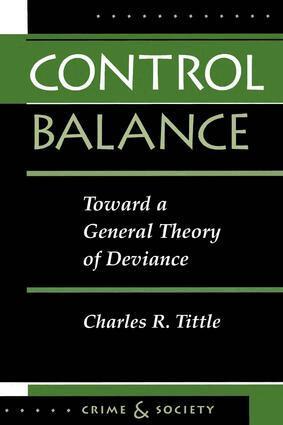
    Control Balance

    Toward A General Theory Of Deviance

    AvCharles R Tittle

    Häftad, Engelska, 1995

    798 kr

    Beställningsvara. Skickas inom 10-15 vardagar. Fri frakt över 249 kr.

    Fler format och utgåvor

    Inbunden

    2 422 kr

    E-bok

    973 kr

    E-bok

    973 kr

    Beskrivning

    A major contribution to the field of crime eviance, this volume by noted criminologist Charles R. Tittle puts forth an integrated theory of deviance,control balance. Its central premise is that the total amount of control people are subjected to, relative to the control they can exercise, will affect the probability and type of their deviant behaviour.In developing control balance, Tittle critically reviews other general theories such as anomie, Marxian conflict, social control, differential association/social learning, labelling, and routine activities and offers reasons why those theories are insufficient. Using real-world examples to illustrate his argument, he contends that deviance results from the convergence of four variables, each of which represents an interactive nexus of several inputs, including most prominently a control imbalance. The variables are predisposition, motivation, opportunity, and constraint. Control balance theory also explains six basic types of deviance, ranging from predation, defiance, and submissiveness on one end of a control ratio continuum to exploitation, plunder, and decadence on the other.Tittle conceives of control balance as a continuation, or temporary culmination, of the collective efforts of crime eviance scholars who have gone before, presenting it as a vehicle for trying to achieve a fully adequate general theory of deviance.

    Produktinformation

    • Utgivningsdatum:1995-10-27
    • Mått:154 x 229 x 20 mm
    • Vikt:456 g
    • Format:Häftad
    • Språk:Engelska
    • Antal sidor:336
    • Förlag:Taylor & Francis Inc
    • ISBN:9780813326320

    Utforska kategorier

    • Arbetspsykologi inom Psykologi och pedagogik
    • Brottslighet och kriminologi inom Samhälle och politik

    Mer om författaren

    Charles R. Tittle is professor of sociology at Washington State University at Pullman. He is the editor of Criminology, the journal of the American Society of Criminology, and the author of Society of Subordinates and Sanctions and Social Deviance.

    Innehållsförteckning

    • The Problem with Simple Theories -- Features of Adequate Theory -- Conventional Methods of Theory Building -- Theoretical Integration -- What Is to Be Explained -- The Concepts of Control Balance Theory -- The Causal Process of Control Balance Theory -- Contingencies for the Central Causal Process -- Compatibility of the Theory with Evidence -- Integration and Critique