• Fri frakt över 249 kr
  • •
  • Snabba leveranser
  • •
  • Billiga böcker
Kundservice

Du är på sajten för privatpersoner.

Företag, bibliotek eller offentlig verksamhet?

Du handlar på classic.bokus.com, där alla dina funktioner finns intakta.
Till classic.bokus.com
Bokus logotyp. Gå till startsidan.
  • Erbjudanden
  • Nyheter
  • Student
  • Topplistor
  • Barn & ungdom
  • Bokus Play
  • E-böcker
  • Pocketböcker
  • Spel & pussel

10% rabatt på allt med kod: NYSTART10 →

Sidfot

Mina sidor

    Hjälp

    • Kundservice
    • Vanliga frågor och svar
    • Frakt och leverans
    • Retur vid ångerrätt
    • Reklamera vara
    • Betalning
    • Köpvillkor
    • Allmänna villkor
    • Information om webbplatsens tillgänglighet

    Om Bokus

    • Om oss
    • Pressrum
    • För studenter
    • För företag
    • För bibliotek och offentlig verksamhet
    • För leverantörer
    • Hållbarhet

    Populärt

    • Aktuella erbjudanden
    • Presentkort
    • Studentlitteratur
    • Nya böcker
    • Topplistor
    • Signerade böcker
    • Engelska böcker

    Inspiration

    • Boktips
    • BookTok
    • Populära bokserier
    • Barnbokskaraktärer
    • Populära författare
    Logotyp för Bokus
    Följ oss på Facebook (extern länk)Följ oss på Instagram (extern länk)Följ oss på YouTube (extern länk)Följ oss på TikTok (extern länk)
    bokus @ CookiesAnpassa cookiesIntegritetspolicyKöpvillkor
    Till Citymail hemsida (extern länk)Till Budbee hemsida (extern länk)Till Postnord hemsida (extern länk)Till Schenker hemsida (extern länk)Till Early Bird hemsida (extern länk)Till Walleys hemsida (extern länk)
    1. Ande, kropp och själ
    2. Övernaturliga fenomen / det paranormala
    3. Mystik, magi och det ockulta

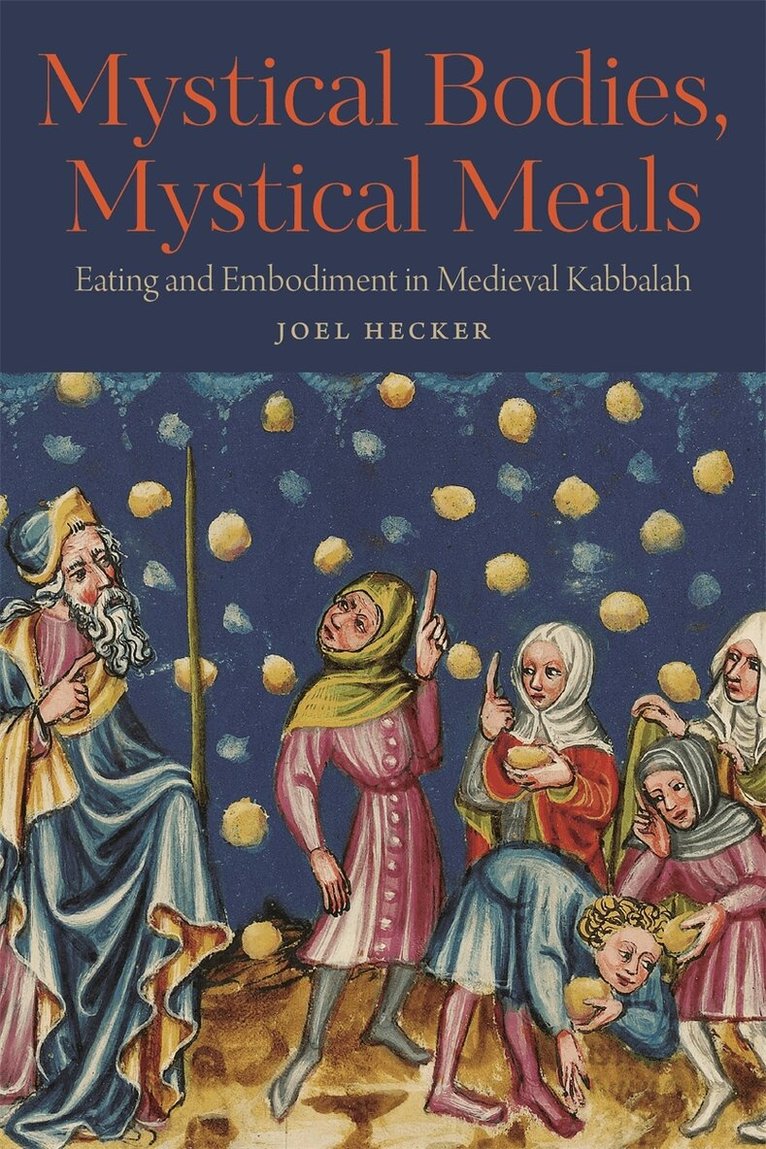
    Mystical Bodies, Mystical Meals

    Eating and Embodiment in Medieval Kabbalah

    AvJoel Hecker

    Häftad, Engelska, 2023

    Del i serien Raphael Patai Series in Jewish Folklore and Anthropology

    326 kr

    Beställningsvara. Skickas inom 10-15 vardagar. Fri frakt över 249 kr.

    Fler format och utgåvor

    Inbunden

    1 062 kr

    Beskrivning

    Focusing on the Jewish mystical literature of late thirteenth-century Spain, author Joel Hecker analyzes how the Zohar and other esoteric literature represent mystical attainment in their homilies about food. What emerges is not only consideration of eating practices but, more broadly, the effects such practices and experiences have on the bodies of practitioners.Drawing on anthropology, sociology, ritual studies, and gender theory, Hecker shows that Kabbalists conceived the internal topography of the body as itself mystical. Nourishment imagery is used throughout Kabbalistic texts as a metaphor signifying the flow of divine blessing from the upper worlds to the lower, from masculine to feminine, and from Israel to the Godhead. The body's spiritual continuity allows for unions between mystics and their food, table, chair, and wine and is exemplified in the practices and experiences surrounding the consumption of food. This continuity is also applicable to other aspects of embodiment, such as union with other people. Bringing this entire spectrum into focus, Hecker ultimately considers how Kabbalists use the oral cavity and stomach, and even the emotions associated with festive meals, to produce the soul of the mystical saint.

    Produktinformation

    • Utgivningsdatum:2023-09-26
    • Mått:152 x 229 x 18 mm
    • Vikt:272 g
    • Format:Häftad
    • Språk:Engelska
    • Serie:Raphael Patai Series in Jewish Folklore and Anthropology
    • Antal sidor:296
    • Förlag:Wayne State University Press
    • ISBN:9780814350935

    Utforska kategorier

    • Mystik, magi och det ockulta inom Ande, kropp och själ
    • Sociala grupper och identitet inom Samhälle och politik
    • Judendom inom Filosofi och religion

    Mer om författaren

    Joel Hecker is professor of Jewish mysticism at the Reconstructionist Rabbinical College. A leading expert on the Zohar and medieval kabbalah, Hecker is the translator and commentator of volume 11 and volume 12 (with Nathan Wolski) of The Zohar: Pritzker Edition, coeditor of the forthcoming Emotions and Jewish Mysticism, and author of numerous articles dealing with kabbalah, ritual, and emotion in Jewish mysticism. He holds a PhD from New York University and rabbinical ordination from Yeshiva University.

    Recensioner i media

    Hecker is to be highly commended for presenting a systematic study of the variegated aspects of eating within the non-systematic material found in the Zohar and related literature, such as Sefer Rimmonim ('The Book of the Pomegranates'). This work is accessible to non-specialists who subscribe to the popularity of present-day Kabbalah, as taught and practiced in popular culture; it was a pleasure to read." - Journal of Religion and Popular Culture"This book is a superb and distinctive contribution to the study of ritual in Judaism in general, and Kabbalah in particular. By focusing on the meaning of food and the act of eating in medieval Kabbalah, Hecker broadens and deepens our understanding of the role of ritual performance in Jewish mysticism. A work of considerable methodological sophistication, it is also an important contribution to the history of religion." - Lawrence Fine, Irene Kaplan Leiwant Chair of Jewish Studies, Mount Holyoke College"Hecker's book is notable for the fact that it does not strive to solve the interpretive difficulties presented by the Zohar but that it is able to capitalize on them to sketch a kabbalistic God that is simultaneously incarnate and carnal and a kabbalistic form of mystical experience that is simultaneously disembodies and embodied." - History of Religions"Hecker's book offers an insightful and disciplined exploration of important themes in medieval religiosity." - Speculum Journal of Medieval Studies"This extraordinary text has proven to be an unending wellspring of insights into kabbalistic theology, devotional experience, and exegetical technique. Hecker has advanced the field in important new ways, offering an example to other scholars of the ways in which Kabbalah may be studied productively through the lens of lived religion and historical anthropology." - Eitan P. Fishbane, AJS Review