• Fri frakt över 249 kr
  • •
  • Snabba leveranser
  • •
  • Billiga böcker
Kundservice

Du är på sajten för privatpersoner.

Företag, bibliotek eller offentlig verksamhet?

Du handlar på classic.bokus.com, där alla dina funktioner finns intakta.
Till classic.bokus.com
Bokus logotyp. Gå till startsidan.
  • Erbjudanden
  • Nyheter
  • Student
  • Topplistor
  • Barn & ungdom
  • Bokus Play
  • E-böcker
  • Pocketböcker
  • Spel & pussel

Må bättre, för mindre! Upp till 50% rabatt på hälsoböcker

Sidfot

Mina sidor

    Hjälp

    • Kundservice
    • Vanliga frågor och svar
    • Frakt och leverans
    • Retur vid ångerrätt
    • Reklamera vara
    • Betalning
    • Köpvillkor
    • Allmänna villkor
    • Information om webbplatsens tillgänglighet

    Om Bokus

    • Om oss
    • Pressrum
    • För studenter
    • För företag
    • För bibliotek och offentlig verksamhet
    • För leverantörer
    • Hållbarhet

    Populärt

    • Aktuella erbjudanden
    • Presentkort
    • Studentlitteratur
    • Nya böcker
    • Topplistor
    • Signerade böcker
    • Engelska böcker

    Inspiration

    • Boktips
    • BookTok
    • Populära bokserier
    • Barnbokskaraktärer
    • Populära författare
    Logotyp för Bokus
    Följ oss på Facebook (extern länk)Följ oss på Instagram (extern länk)Följ oss på YouTube (extern länk)Följ oss på TikTok (extern länk)
    bokus @ CookiesAnpassa cookiesIntegritetspolicyKöpvillkor
    Till Citymail hemsida (extern länk)Till Budbee hemsida (extern länk)Till Postnord hemsida (extern länk)Till Schenker hemsida (extern länk)Till Early Bird hemsida (extern länk)Till Walleys hemsida (extern länk)
    1. Samhälle och politik
    2. Politik och statsskick
    3. Politiska ideologier och rörelser
    4. Konservatism och högerideologier

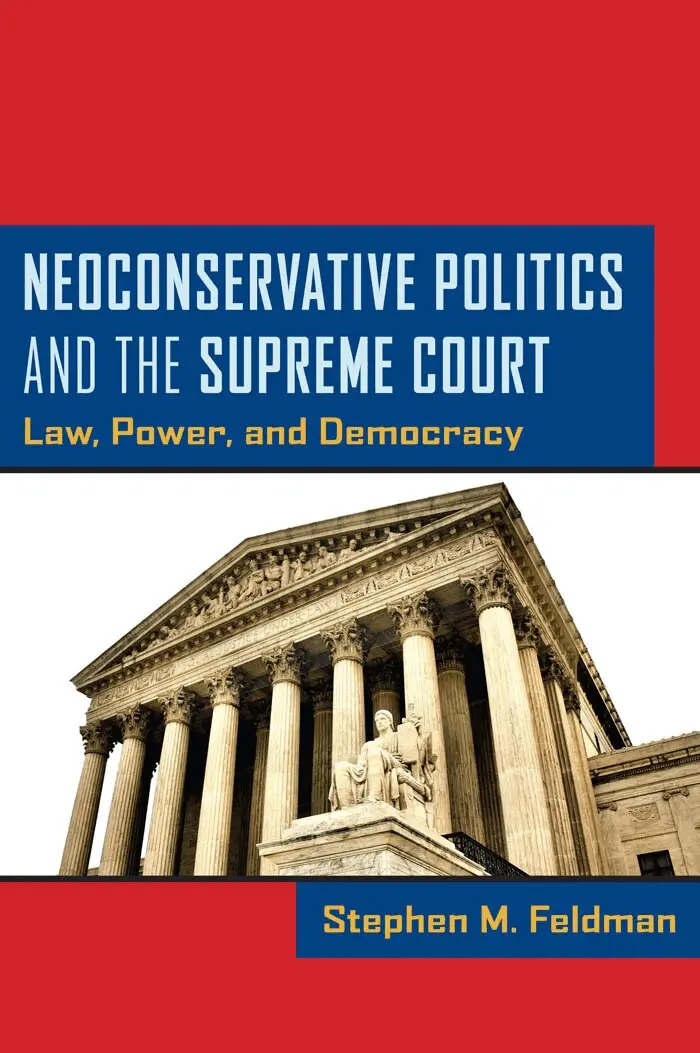
    Neoconservative Politics and the Supreme Court

    Law, Power, and Democracy

    AvStephen M. Feldman

    Inbunden, Engelska, 2012

    673 kr

    Beställningsvara. Skickas inom 10-15 vardagar. Fri frakt över 249 kr.

    Beskrivning

    In this concise, timely book, constitutional law expert Stephen M. Feldman draws on neoconservative writings to explore the rise of the neocons and their influence on the Supreme Court. Neocons burst onto the political scene in the early 1980s via their assault on pluralist democracy's ethical relativism, where no pre-existing or higher principles limit the agendas of interest groups. Instead, they advocated for a resurrection of republican democracy, which declares that virtuous citizens and officials pursue the common good. Yet despite their original goals, neocons quickly became an interest group themselves, competing successfully within the pluralist democratic arena. When the political winds shifted in 2008, however, neocons found themselves shorn of power in Congress and the executive branch. But portentously, theystill controlled the Supreme Court. Neoconservative Politics and the Supreme Court explains how and why the neoconservatives criticized but operated within pluralist democracy, and, most important, what the entrenchment of neocons on the Supreme Court means for present and future politics and law.

    Produktinformation

    • Utgivningsdatum:2012-12-03
    • Mått:152 x 229 x 25 mm
    • Vikt:499 g
    • Format:Inbunden
    • Språk:Engelska
    • Antal sidor:235
    • Förlag:New York University Press
    • ISBN:9780814764664

    Utforska kategorier

    • Konservatism och högerideologier inom Samhälle och politik
    • Statsskick: demokrati inom Samhälle och politik

    Mer om författaren

    Stephen M. Feldman is the Jerry W. Housel/Carl F. Arnold Distinguished Professor of Law and Adjunct Professor of Political Science at the University of Wyoming. He is the author of Please Don't Wish Me a Merry Christmas: A Critical History of the Separation of Church and State, Free Expression and Democracy in America: A History, and Pack the Court! A Defense of Supreme Court Expansion among other titles.

    Recensioner i media

    "A remarkably concise and accessible overview first of the rise of neoconservatism, and then of its impact on the Supreme Court. Consistently illuminating and challenging." - Sanford Levinson,author of Framed: America's 51 Constitutions and the Crisis of Governance "A helpful explanation of the Supreme Court's latest lurch to the right. By showing how many of the Court's latest decisions can be seen as expressions of the neoconservative impulse, Feldman exposes how deeply politics, personalities, and convictions shape judicial behavior." - Richard Delgado,University Professor of Law, Seattle University "In forthright prose laying out a provocative and subtle argument, Feldman places todays Supreme Court in a broad intellectual and historical context, showing how the Courts conservatives cut and paste themes of neo-conservative nostalgia for an irretrievable past of republican democracy into more traditionalist conservative responses to the pluralist democracy we have and are likely to continue to have." - Mark Tushnet,author of A Court Divided: The Rehnquist Court and the Future of Constitutional Law "In this concise and clearly written book, Stephen M. Feldman argues that the conservative ascendance in the United States since the presidency of Ronald Reagan can be understood as an effort to reestablish the legal and political order that existed prior to the New Deal. He labels this pre-New Deal order 'republican democracy,' distinct from the 'pluralist democracy' that characterizes our politics since 1937. The heart of the book is the analysis of the Supreme Court and how its conservative majority has pushed this agenda....[T]his is a provocative and compelling argument." - Robert B. Horwitz (Political Science Quarterly) "This is a well-written, interesting, and useful book. Summing Up: Highly recommended." (CHOICE)

    Innehållsförteckning

    • (FYI: Pared-down TOC below. Actual is more detailed/has tons of subsections, etc.!) 1. Reagan, Cross-Pollination, and Neoconservatism: An Introduction2. From Republican to Pluralist Democracy 3. Pluralist Democracy: Dissent and Evolution 4. On Neoconservatism 5. The Supreme Court and Neoconservatism 6. The Supreme Court in the Future