• Fri frakt över 249 kr
  • •
  • Snabba leveranser
  • •
  • Billiga böcker
Kundservice

Du är på sajten för privatpersoner.

Företag, bibliotek eller offentlig verksamhet?

Du handlar på classic.bokus.com, där alla dina funktioner finns intakta.
Till classic.bokus.com
Bokus logotyp. Gå till startsidan.
  • Erbjudanden
  • Nyheter
  • Student
  • Topplistor
  • Barn & ungdom
  • Bokus Play
  • E-böcker
  • Pocketböcker
  • Spel & pussel

10% rabatt på allt med kod: NYSTART10 →

Sidfot

Mina sidor

    Hjälp

    • Kundservice
    • Vanliga frågor och svar
    • Frakt och leverans
    • Retur vid ångerrätt
    • Reklamera vara
    • Betalning
    • Köpvillkor
    • Allmänna villkor
    • Information om webbplatsens tillgänglighet

    Om Bokus

    • Om oss
    • Pressrum
    • För studenter
    • För företag
    • För bibliotek och offentlig verksamhet
    • För leverantörer
    • Hållbarhet

    Populärt

    • Aktuella erbjudanden
    • Presentkort
    • Studentlitteratur
    • Nya böcker
    • Topplistor
    • Signerade böcker
    • Engelska böcker

    Inspiration

    • Boktips
    • BookTok
    • Populära bokserier
    • Barnbokskaraktärer
    • Populära författare
    Logotyp för Bokus
    Följ oss på Facebook (extern länk)Följ oss på Instagram (extern länk)Följ oss på YouTube (extern länk)Följ oss på TikTok (extern länk)
    bokus @ CookiesAnpassa cookiesIntegritetspolicyKöpvillkor
    Till Citymail hemsida (extern länk)Till Budbee hemsida (extern länk)Till Postnord hemsida (extern länk)Till Schenker hemsida (extern länk)Till Early Bird hemsida (extern länk)Till Walleys hemsida (extern länk)
    1. Juridik
    2. Internationell rätt

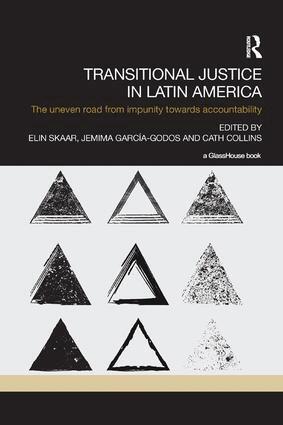
    Transitional Justice in Latin America

    The Uneven Road from Impunity towards Accountability

    AvElin Skaar,Jemima Garcia-Godos

    Häftad, Engelska, 2017

    Del i serien Transitional Justice

    704 kr

    Beställningsvara. Skickas inom 10-15 vardagar. Fri frakt över 249 kr.

    Beskrivning

    This book addresses current developments in transitional justice in Latin America – effectively the first region to undergo concentrated transitional justice experiences in modern times. Using a comparative approach, it examines trajectories in truth, justice, reparations, and amnesties in countries emerging from periods of massive violations of human rights and humanitarian law. The book examines the cases of Argentina, Brazil, Chile, Colombia, Guatemala, El Salvador, Paraguay, Peru and Uruguay, developing and applying a common analytical framework to provide a systematic, qualitative and comparative analysis of their transitional justice experiences. More specifically, the book investigates to what extent there has been a shift from impunity towards accountability for past human rights violations in Latin America. Using ‘thick’, but structured, narratives – which allow patterns to emerge, rather than being imposed – the book assesses how the quality, timing and sequencing of transitional justice mechanisms, along with the context in which they appear, have mattered for the nature and impact of transitional justice processes in the region. Offering a new approach to assessing transitional justice, and challenging many assumptions in the established literature, this book will be of enormous benefit to scholars and others working in this area.

    Produktinformation

    • Utgivningsdatum:2017-12-04
    • Mått:156 x 234 x 28 mm
    • Vikt:486 g
    • Format:Häftad
    • Språk:Engelska
    • Serie:Transitional Justice
    • Antal sidor:348
    • Förlag:Taylor & Francis Inc
    • ISBN:9780815392927

    Utforska kategorier

    • Internationell rätt inom Juridik
    • Straffrätt: process och brott inom Juridik
    • Referensverk och tvärvetenskap inom Samhälle och politik

    Mer om författaren

    Elin Skaar is based at the Chr. Michelsen Institute, Bergen, Norway.Jemima Garcia-Godos is in the Department of Sociology and Human Geography at the University of Oslo, Norway.Cath Collins is at the Transitional Justice Institute, Ulster University, Northern Ireland, and Universidad Diego Portales, Chile.

    Recensioner i media

    "Finally, a book convincingly and empirically demonstrates that Latin America serves as a model on how to best deal with human rights abuses from the past. Using rich comparative narrative evidence about the transitional justice experience, the book offers an original, sophisticated and nuanced interpretation of these efforts. The authors focus on nine Latin American countries and expand the traditional analysis into the twenty first century with attention to factors influencing successes and failures while attempting to illustrate regional commonalities." - Ariel Dulitzky, University of Texas School of Law/ Member of the United Nations Working Group on Enforced or Involuntary Disappearances "The editors take on one of the key challenges in writing about transitional justice: establishing valid systematic comparisons without losing the context and particularity of each country’s process. The writers are experts and often participants in the events they analyze, and pulling their studies together in a single volume is itself a great service to researchers and policymakers. But the editors go farther, drawing lessons from the case studies that will be applicable far beyond the Latin American context, and will add greatly to theoretical and practical discussions on the direction and future of transitional (and post-transitional) justice."- Naomi Roht-Arriaza, University of California, Hastings College of Law"This book presents the most ambitious and systematic attempt yet to provide an in-depth comparative analysis of transitional justice processes. It combines a rigorous longitudinal analysis of case studies with a broad perspective that manages to identify and explain essential patterns and trends. The study presents an important step in shaping the development of empirical research in the transitional justice field." - Hugo van der Merwe, Centre for the Study of Violence and Reconciliation, Cape Town, South Africa"A great contribution for our understanding of transitional justice in Latin America. It combines systematic comparative analysis with qualitative case studies and historical sequencing with synchronic assessments of policy outcomes. The challenge was great but the authors clearly succeeded!" – Catalina Smulovitz, Universidad Torcuato Di Tella"In recent years, the transitional justice literature has been beset by a range of methodological controversies. This ambitious collection aims to achieve several things to move important debates forward. The editors usefully establish a common framework with which to more systematically analyze the rich qualitative data collected by an impressive roster of country specialists. The chapters also trace transitional justice processes over years, if not decades, which is another rarity, particularly for such a large number of cases. Some innovative data visualizations are used to illustrate outcomes in particular cases, and also to facilitate cross-national comparison across space and time. Overall, it is a welcome addition to the literature."- Eric Wiebelhaus-Brahm, University of Arkansas at Little Rock, USA

    Innehållsförteckning

    • 1. Introduction: the accountability challenge Elin Skaar, Jemima García-Godos and Cath Collins 2. Analytical framework Elin Skaar, Cath Collins, and Jemima García-Godos 3. Argentina: regional protagonist of transitional justice Lorena Balardini 4. Uruguay: halfway towards accountability Francesca Lessa and Elin Skaar 5. Brazil: the tortuous path to truth and justice Glenda Mezarobba 6. Chile: incremental truth, late justice Cath Collins with Boris Hau 7. Paraguay: accountability in the shadow of Stroessner Cath Collins 8. El Salvador: the difficult fight against impunity Elena Martínez Barahona and Martha Liliana Gutiérrez Salazar 9. Guatemala: truth and memory on trial Jemima García-Godos and Luis Raúl Salvadó 10. Peru: beyond paradigmatic cases Jemima García-Godos and Félix Reátegui 11. Colombia: transitional justice before transition Nelson Camilo Sánchez León, Jemima García-Godos, and Catalina Vallejo 12. Conclusions: the uneven road towards accountability in Latin America, Elin Skaar, Cath Collins and Jemima García-Godos